Institutional Crypto Surge: A Deep Dive into the $16.9 Billion Mid-Year Capital Influx
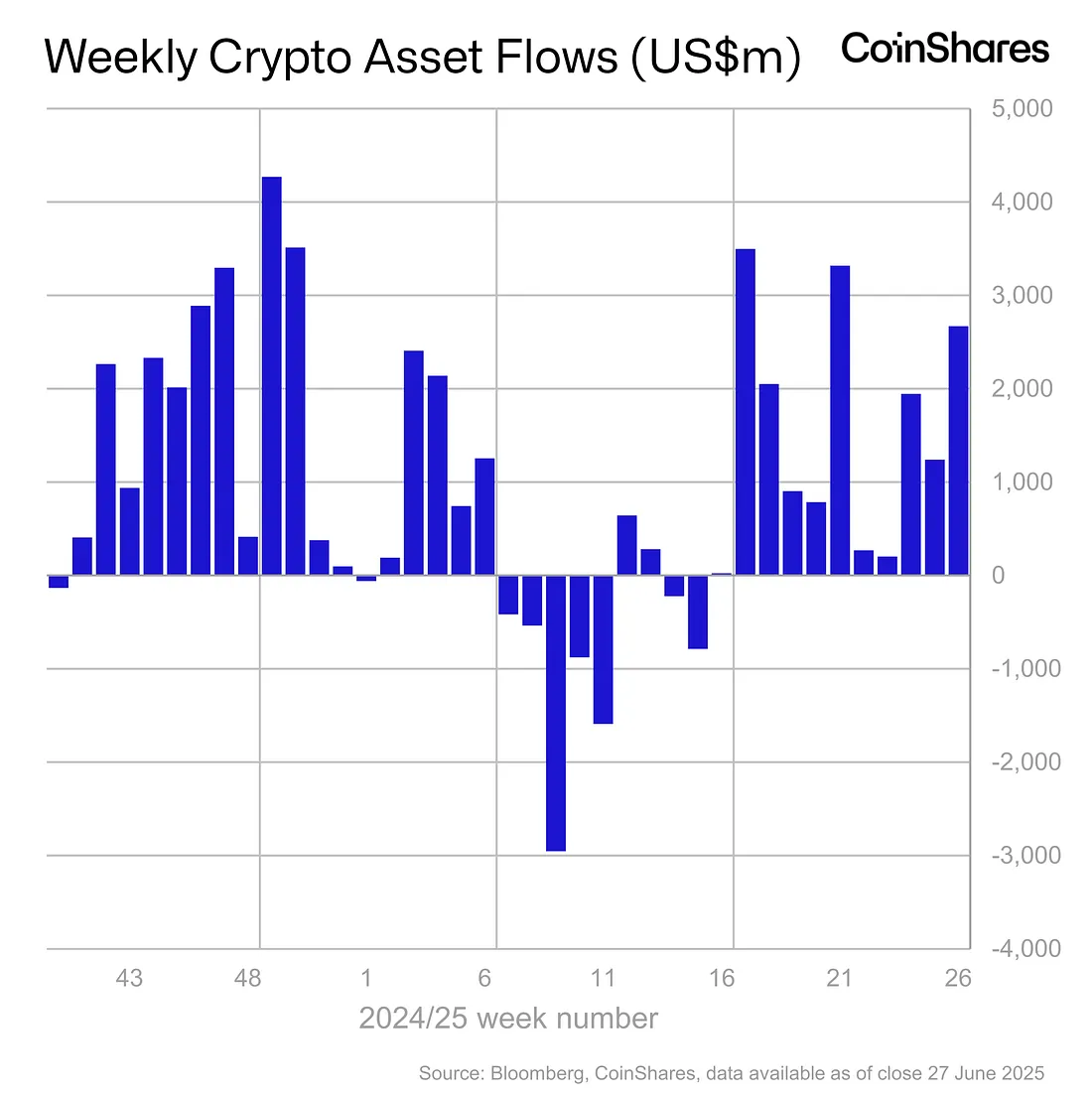
The global financial landscape is witnessing a seismic shift in how institutional capital views digital assets. According to the latest "Digital Asset Fund Flows Weekly" report by CoinShares, institutional investment vehicles have experienced a monumental surge, recording over $16.9 billion in net inflows over the last eleven consecutive weeks. This sustained accumulation of capital signals that, despite macroeconomic instability and regulatory headwinds, institutional interest in the cryptocurrency sector remains remarkably robust as we cross the midway point of 2025.
Main Facts: The Numbers Behind the Momentum
The data provided by CoinShares paints a picture of aggressive accumulation. In the most recent week alone, digital asset investment products raked in $2.7 billion. This brings the total inflows for the eleven-week streak to $16.9 billion.
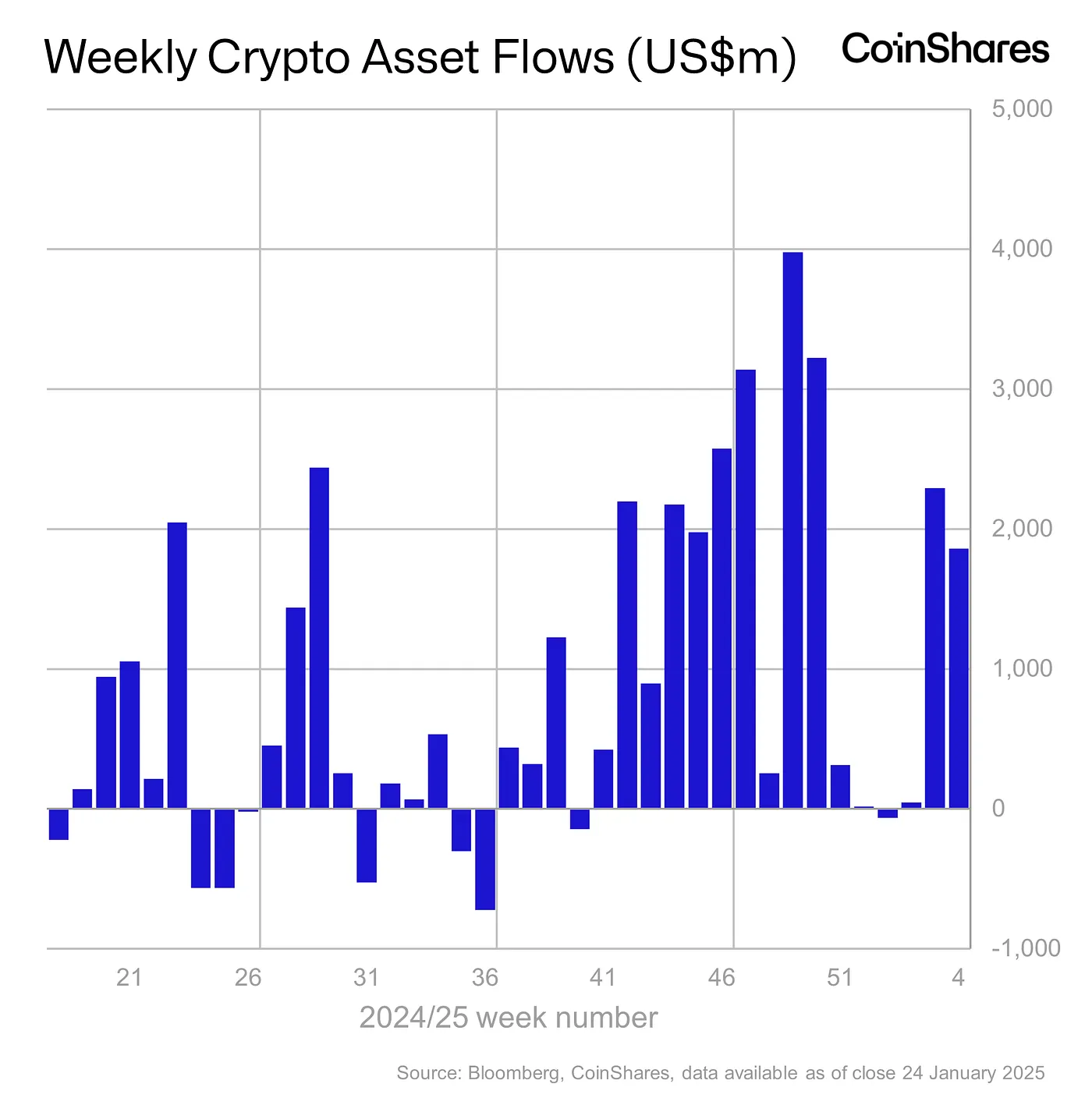
When comparing this to the previous year, the momentum is strikingly consistent. In the first half of 2024, institutional inflows reached $18.3 billion by the end of June. With the first half of 2025 closing out at just under that figure, the market is demonstrating a high degree of maturity and resilience. This is no longer merely a speculative retail phenomenon; it is a calculated institutional pivot toward digital assets as a legitimate asset class.
The primary drivers of this trend, according to analysts, are twofold: heightened geopolitical volatility and lingering uncertainty regarding the trajectory of global monetary policy. As traditional safe-haven assets face pressures from inflation and fiscal deficits, large-scale investors are increasingly viewing Bitcoin and Ethereum as digital hedges against the volatility of fiat-based systems.
Chronology of the 2025 Institutional Shift
To understand the current state of the market, one must examine the progression of capital flows throughout the first half of 2025:
- Q1 2025: The year began with a cautious optimism, as investors digested the lingering impacts of the previous year’s market cycles. However, February and March saw a marked increase in demand for spot-linked investment products, setting the stage for the spring rally.
- April – May 2025: As geopolitical tensions flared in multiple global theaters, institutional appetite for "digital gold" accelerated. This period marked the beginning of the current eleven-week streak, as capital began moving out of traditional equity funds and into crypto-focused exchange-traded products (ETPs).
- June 2025: The final month of the half-year saw the highest concentration of weekly inflows. Notably, while the US market surged, other regions began to diverge in their investment behaviors, with significant outflows recorded in specific jurisdictions like Hong Kong, highlighting the fragmented global regulatory environment.
Supporting Data: Regional Divergence and Asset Performance
The geographical distribution of these flows reveals a stark contrast in sentiment across major financial hubs.
The Dominance of the United States
The United States continues to be the undisputed engine of the current bull run. With $2.65 billion in net inflows in the most recent reporting period, US-based institutions are driving the bulk of the market activity. This is largely attributed to the deeper integration of crypto ETPs into standard portfolio management strategies for US-based hedge funds and family offices.
European Mixed Signals
European markets show a more nuanced picture. Switzerland and Germany recorded modest but positive inflows of $23 million and $19.8 million, respectively. These nations remain leaders in European crypto infrastructure, providing stable environments for institutional participation. Conversely, other regions have seen capital flight. Canada, Hong Kong, and Brazil saw outflows of $13.6 million, $2.3 million, and $2.4 million, respectively.
Hong Kong, in particular, has seen a challenging month, with $132 million in outflows during June alone. This suggests that local market conditions or regulatory shifts in the Asian financial hub may be prompting a reallocation of capital back toward US or European vehicles.

Asset-Specific Performance
Bitcoin (BTC) remains the primary beneficiary of institutional interest, accounting for 83% of total inflows last week ($2.2 billion). Perhaps the most telling indicator of bullish sentiment is the performance of "short-Bitcoin" products. These instruments, which profit when the price of Bitcoin falls, recorded $2.9 million in outflows. Year-to-date, short-Bitcoin products have seen $12 million in outflows, confirming that the "smart money" is overwhelmingly betting on long-term appreciation rather than hedging against a downturn.
Ethereum (ETH) is not far behind in terms of sentiment. The asset saw a healthy $429 million in inflows last week, signaling that institutional investors are diversifying beyond Bitcoin and positioning themselves for potential upgrades or market catalysts specific to the Ethereum ecosystem.
Official Analysis and Expert Outlook
CoinShares’ market analysts attribute this "resilient investor demand" to a calculated response to the macro environment. As central banks struggle to balance interest rate decisions with the need to curb persistent inflation, the "wait-and-see" approach of global policymakers has created a vacuum of certainty.
Institutional investors are not necessarily seeking high-risk exposure; rather, they are seeking assets that operate outside the direct control of traditional central banking mechanisms. When monetary policy becomes unpredictable, the deterministic nature of Bitcoin’s supply schedule becomes an attractive feature for institutional risk managers.
Furthermore, the data suggests that the "digital asset" category has officially graduated from a fringe investment to a staple of modern portfolio construction. The consistency of these inflows—eleven weeks of consecutive growth—indicates that these are not impulsive retail trades, but systematic rebalancing efforts by institutional desks.
Implications for the Future of Finance
The implications of $16.9 billion in institutional capital flowing into crypto over a short period are profound:
- Increased Market Liquidity: As more capital enters institutional vehicles, the depth of the market increases, potentially reducing the extreme volatility that has historically plagued the crypto sector.
- Regulatory Legitimacy: Large-scale institutional adoption often forces regulators to speed up the creation of clear legal frameworks. As pension funds and sovereign wealth entities begin to hold digital assets, the pressure on governments to provide legal clarity will reach a breaking point.
- The Decoupling of Crypto and Tech Stocks: For years, crypto has traded in high correlation with high-growth tech stocks. However, if institutional capital continues to flow into crypto as a specific "hedge" against geopolitical instability, we may see a historic decoupling where Bitcoin behaves less like a tech stock and more like a hybrid of gold and a global settlement layer.
Conclusion: A New Paradigm
The mid-year data for 2025 confirms that the institutional interest in digital assets is not merely a passing phase. It is a strategic pivot. With Bitcoin absorbing the vast majority of capital and Ethereum continuing to command institutional respect, the market is entering a phase of consolidation and growth.
While regions like Hong Kong face temporary outflows, the overarching trend remains undeniably positive. As we head into the second half of 2025, the key indicators to watch will be the stability of US inflows and whether European markets can regain their momentum. For now, the narrative is clear: global capital is migrating toward digital assets, driven by the search for security in an increasingly uncertain world.
Disclaimer: Opinions expressed in this report are for informational purposes only and do not constitute financial, investment, or legal advice. Digital asset investments involve high risks. Investors are strongly encouraged to conduct their own due diligence and consult with a professional financial advisor before making any investment decisions. The information provided here is based on market reports and does not guarantee future results.