Diverging Fortunes: Ethereum Spot ETFs Witness Resurgence Amidst Bitcoin Outflows
In the volatile landscape of digital asset investment, the performance of U.S.-listed spot exchange-traded funds (ETFs) has long served as a bellwether for institutional sentiment. Recent data from market intelligence platform SoSoValue reveals a compelling narrative of divergence: while Bitcoin spot ETFs have struggled to maintain momentum, facing significant capital exodus, Ethereum spot ETFs have bucked the trend, recording a notable resurgence in investor interest. This shift suggests a nuanced change in risk appetite among institutional players, even as broader market conditions remain uncertain.
The Mechanism of Institutional Crypto Exposure
To understand the significance of these flows, one must first recognize the role these investment vehicles play. Launched in the United States—Bitcoin ETFs in January 2024 and Ethereum ETFs in July 2024—these funds represent a bridge between traditional finance (TradFi) and the decentralized ledger.
For the institutional investor, these ETFs provide a regulated, secure, and operationally simple pathway to gain exposure to the price movements of underlying assets. By eliminating the need for complex custody solutions, private key management, or interaction with disparate cryptocurrency exchanges, these vehicles have effectively democratized access to digital assets for hedge funds, pension funds, and family offices. They are, in essence, the "safe harbor" for institutional capital entering the crypto ecosystem under the watchful eye of the Securities and Exchange Commission (SEC).
Chronology of Recent Market Flux
The current market cycle has been defined by what analysts refer to as "bearish winds," a sentiment reflected in the consistent outflows seen across the broader crypto-ETF sector.

The Ethereum Recovery
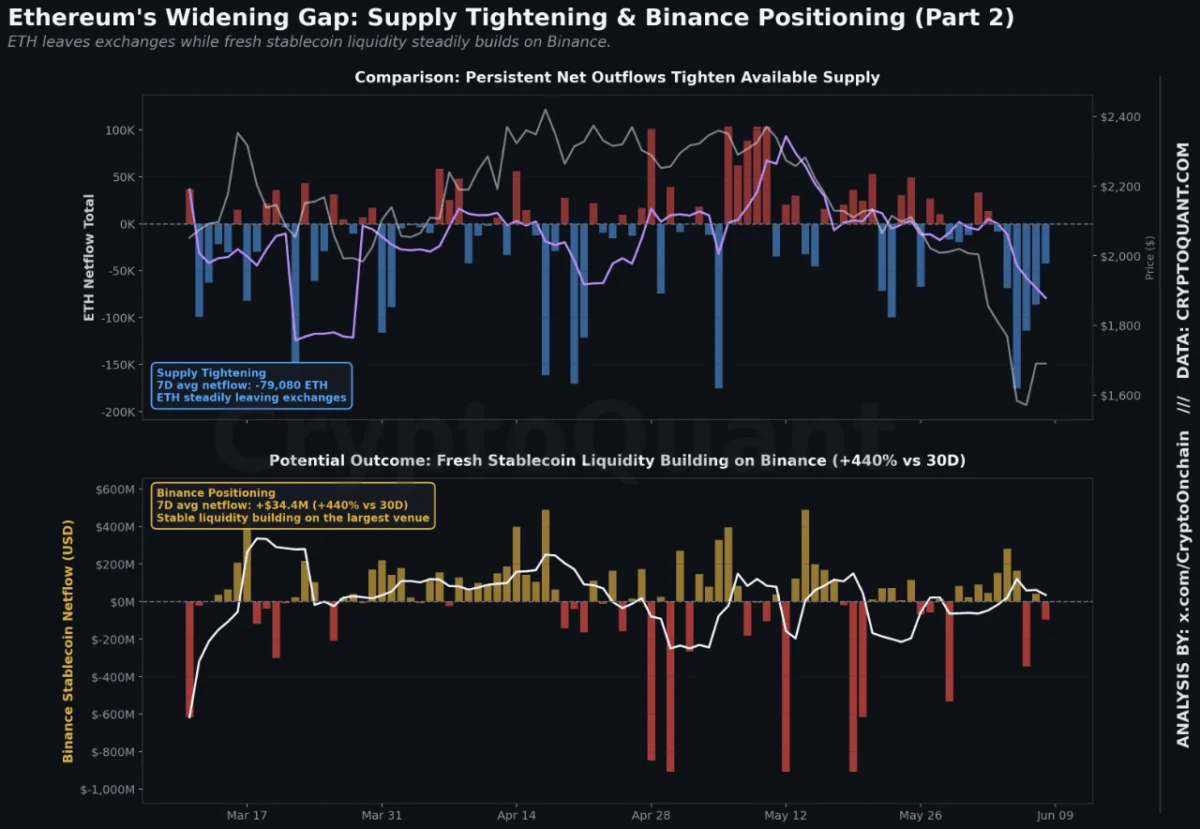
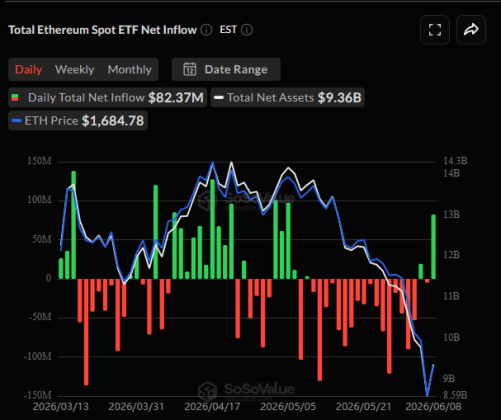
Since early May 2024, Ethereum ETFs had been caught in a sustained period of capital flight, mirroring the asset’s price decline from the $2,300 level toward the sub-$1,600 floor. However, the first week of June signaled a potential pivot point.
- June 4th: A breakthrough occurred when ETH spot ETFs recorded a net inflow of $19 million, effectively ending a prolonged streak of negative sentiment.
- June 5th: The market saw a minor contraction with a negligible outflow, indicating a state of equilibrium.
- June 7th (Monday): The most significant development emerged, with data showing a robust net inflow of $82 million into Ethereum-based products. This influx suggests that savvy investors may be viewing the recent price depreciation as an attractive entry point for long-term accumulation.
The Bitcoin Stagnation
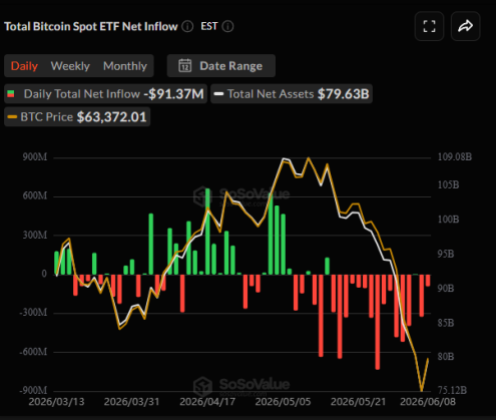
Conversely, Bitcoin’s recent ETF performance tells a story of cooling enthusiasm. While Bitcoin also attempted a recovery on June 4th, it managed a meager $3 million inflow—a figure so low that analysts characterized it as functionally neutral. Following that brief respite, the downward pressure resumed. By Monday, Bitcoin ETFs witnessed a net exit of $91 million, a stark contrast to the $82 million attracted by its primary rival, Ethereum.
Supporting Data and Market Analysis
The divergence in these flows is not merely a statistical anomaly; it highlights a potential tactical rotation within institutional portfolios. For months, Bitcoin was the undisputed beneficiary of the ETF wave, acting as a "digital gold" proxy. However, as Bitcoin’s price volatility persists and its recent growth stalls, market participants appear to be re-evaluating the risk-reward profile of Ethereum.
Ethereum, often viewed as a "high-beta" play compared to Bitcoin, offers a different value proposition due to its utility in smart contracts, decentralized finance (DeFi), and tokenization. The $82 million shift on Monday suggests that institutional liquidity is becoming increasingly sensitive to valuation gaps. As Ethereum recovered to trade around the $1,670 mark, the sudden interest suggests that the "smart money" may be betting on a recovery cycle for the second-largest cryptocurrency by market capitalization.

The Implications of Capital Rotation
The shift in capital from Bitcoin to Ethereum ETFs carries several profound implications for the digital asset space:
1. Shift in Institutional Risk Tolerance
Institutions are traditionally risk-averse. A move away from the perceived safety of Bitcoin toward the utility-driven ecosystem of Ethereum signals that investors are becoming more comfortable with the broader Web3 value proposition. This is a critical indicator of market maturity, suggesting that investors are looking beyond simple store-of-value narratives and toward the long-term potential of programmable money.
2. Validation of the ETF Gateway
The sheer volume of these flows underscores the efficiency of the ETF structure. Despite the price volatility of the underlying assets, the infrastructure successfully channeled nearly $100 million in combined capital movements within a 24-hour window. This validates the SEC’s decision to approve these products as a legitimate component of the modern investment portfolio.
3. Price Sensitivity and Market Support
The recent price bounce in Ethereum, which saw the asset reclaim ground after testing the $1,600 support level, is inextricably linked to this ETF demand. When institutional buying meets retail hesitation, ETFs often provide the necessary liquidity to form a "floor" for price action. If the current trend of Ethereum inflows continues, it may create a technical support level that prevents further capitulation.
Future Outlook and Expert Consensus
While the current data from SoSoValue provides a snapshot of short-term sentiment, market experts advise caution. The crypto sector is notoriously reactive to macroeconomic indicators, such as inflation data, interest rate decisions from the Federal Reserve, and global geopolitical stability.
"The divergence we are seeing is likely a temporary recalibration rather than a permanent trend shift," notes one industry analyst. "Bitcoin remains the foundational asset for the institutional class. However, the appetite for Ethereum’s ecosystem benefits is clearly growing as the price stabilizes. We are witnessing the maturation of the crypto-ETF market, where investors are finally starting to treat Bitcoin and Ethereum as distinct assets with different use cases, rather than a monolithic ‘crypto’ block."
Conclusion
The recent surge in Ethereum ETF inflows, contrasted with the persistent outflows from Bitcoin, marks a fascinating chapter in the evolution of digital asset finance. As Ethereum continues to show signs of recovery around the $1,670 price point, the capital influx provides a glimmer of optimism for stakeholders.
Investors should continue to monitor the daily netflow data, as these figures serve as a proxy for institutional confidence. Whether this trend represents a sustained rotation or a brief deviation remains to be seen. However, one thing is certain: the institutionalization of crypto is accelerating, and the role of spot ETFs in defining the market’s trajectory has never been more prominent.
As the industry moves forward, the ability of these funds to absorb selling pressure and facilitate institutional entry will continue to be a primary driver of market liquidity and price discovery. For now, all eyes remain on the next set of data from SoSoValue to see if Ethereum can maintain its newfound momentum in the face of broader market volatility.