
Institutional Capital Returns: Ethereum, XRP, and Bitcoin Kick Off 2026 with Massive Inflows
As the global financial markets settle into the rhythm of a new year, the digital asset landscape is witnessing a resounding vote of confidence from institutional investors. According to the latest data from CoinShares, a leading manager of digital asset investment products, the institutional appetite for crypto-exposure has surged, marking a robust start to 2026. This trend suggests that despite the volatility that characterized the final quarter of the previous year, the "smart money" remains firmly committed to the long-term potential of blockchain-based assets.
Main Facts: A Resilient Start to the Year
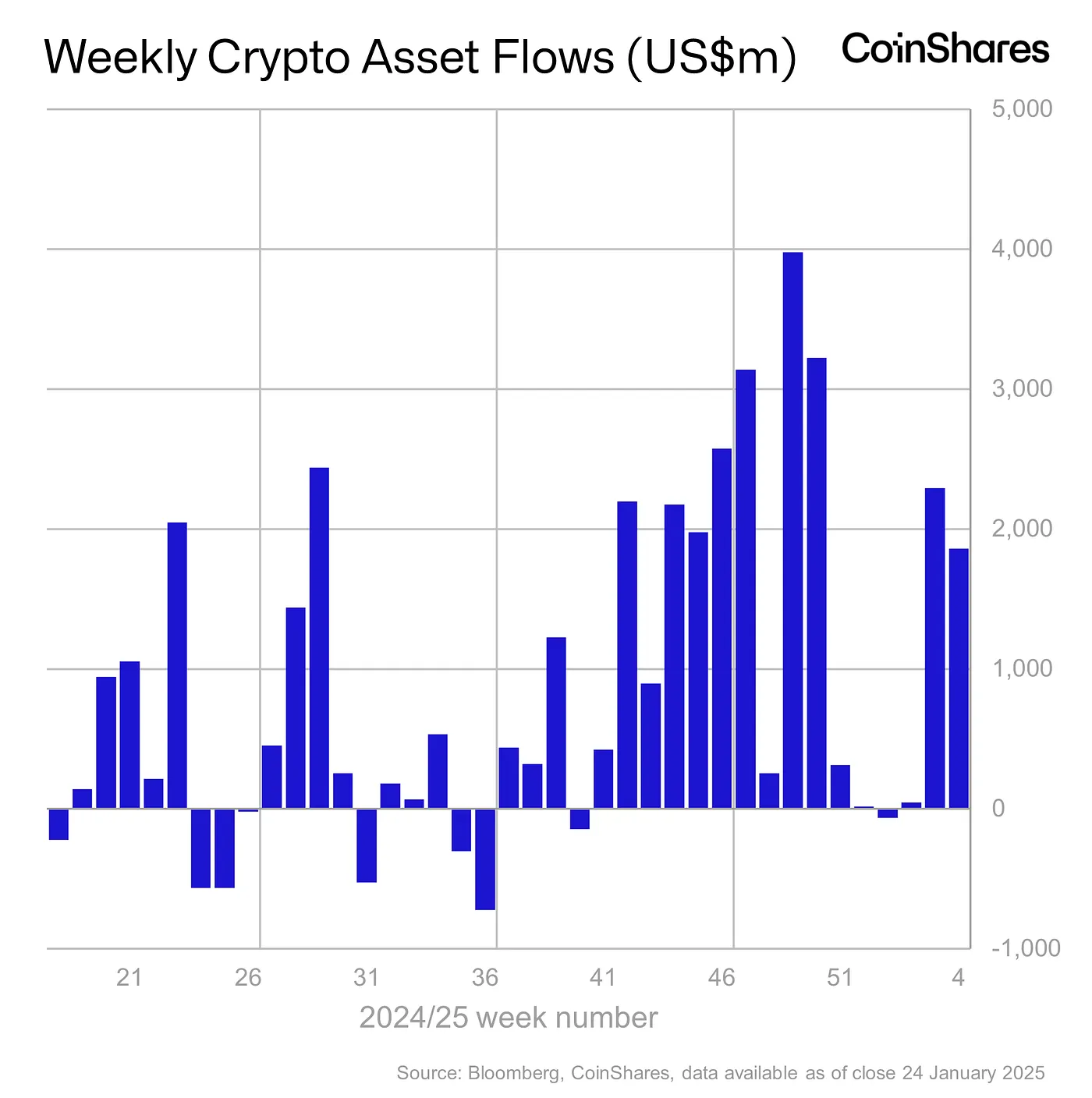
The latest weekly report from CoinShares reveals that digital asset investment products recorded a net inflow of $582 million. This figure is particularly impressive when one considers the initial market friction experienced during the early days of the week, which saw brief periods of selling pressure.
However, the momentum shifted decisively by the end of the week. CoinShares noted, "The year also began on a high note with inflows of $671 million last Friday, bringing the full week inflows to $582 million following outflows earlier in the week." This dramatic reversal highlights the reactionary nature of institutional desks, which are clearly waiting for entry points to bolster their holdings in major crypto-assets.
The breakdown of these inflows reveals a clear preference for the market leaders. Bitcoin (BTC) secured the lion’s share of interest, attracting $512 million in new capital. Ethereum (ETH) followed as a significant beneficiary, capturing $119 million in inflows, while XRP saw a respectable $10.7 million. Interestingly, Solana (SOL), which has been a darling of the institutional world over the past year, experienced a temporary cooling-off period, recording $30 million in outflows—a move likely attributed to profit-taking after a period of intense price appreciation.
Chronology: From a Record-Breaking 2025 to Present Day
To understand the current sentiment, one must look at the momentum carried over from 2025. The previous year was nothing short of historic for the crypto-investment industry, with total global inflows reaching $47.2 billion. While this fell slightly short of the all-time record of $48.7 billion set in 2024, the volume remains staggering, indicating that institutional adoption is no longer a fringe phenomenon but a core component of modern portfolio management.
The 2025 Recap
- The US Dominance: The United States remained the epicenter of digital asset activity, accounting for $44.5 billion in total inflows for 2025. While this represented a 12% decline from the 2024 peak, the sheer scale of the US market continues to dwarf other jurisdictions.
- European Turnarounds: Germany emerged as a standout performer in 2025, recording $2.5 billion in inflows. This represented a significant shift in sentiment compared to the previous year, where the region faced consistent outflows. Similarly, Canada and Switzerland remained reliable hubs for crypto capital, adding $1.1 billion and $775 million, respectively.
- The Asset Breakdown: Bitcoin product inflows dominated the narrative with $26.9 billion. Meanwhile, Ethereum displayed remarkable resilience and growth, posting $12.7 billion in inflows—a 138% increase year-over-year.
The most dramatic growth stories, however, were found in the altcoin sector. XRP saw inflows of $3.7 billion (a 500% increase), and Solana saw $3.6 billion (a staggering 1,000% increase). These figures underscore a broader diversification strategy among institutional investors, who are increasingly looking beyond Bitcoin to capture alpha in the smart-contract and cross-border payment ecosystems.
Supporting Data: Why Institutional Sentiment Matters
The data provided by CoinShares serves as a bellwether for the broader crypto market. When institutions pour hundreds of millions into these products, it signals more than just price speculation; it suggests that the underlying infrastructure—custody, regulatory compliance, and liquidity—is finally meeting the requirements of high-net-worth individuals and corporate treasuries.
Analyzing the "Short" Sentiment
An interesting metric in the report is the performance of "short-bitcoin" products. These instruments, which allow investors to profit from a decline in the price of Bitcoin, attracted $105 million in 2025. While this is a noteworthy sum, it remains a "small segment of the market," as CoinShares pointed out. The overwhelming majority of institutional capital is clearly positioned for long-term growth, rather than tactical hedging or betting against the asset class.
The Declining Interest in Niche Altcoins
While the "big three" (BTC, ETH, and XRP) continue to thrive, the report indicates that sentiment toward smaller, less liquid altcoins is weakening. Inflows into "other" altcoin products fell by 30% year-over-year. This indicates a "flight to quality" among institutional allocators. In uncertain macroeconomic climates, investors tend to concentrate their capital in assets with proven track records, high liquidity, and robust development ecosystems, leaving smaller projects to struggle for capital.
Official Responses and Industry Outlook
Industry analysts are interpreting these numbers as a sign of maturation. The fact that the market can absorb $582 million in new capital after a week of outflows demonstrates a depth of liquidity that simply did not exist in previous cycles.
"The consistency of these flows, even when the market faces headwinds, is a testament to the fact that institutional players are now ‘buy-the-dip’ participants rather than fair-weather speculators," says a senior market strategist at a major European exchange. "They have long-term models that rely on the four-year cycle, and they are viewing the current price discovery phase as a prime accumulation window."
Conversely, some market observers urge caution, noting that the decline in US-based inflows—down 12% from 2024—could suggest that the initial "ETF-fueled" frenzy is normalizing. The focus has now shifted from the novelty of crypto-investment products to the utility of the underlying assets themselves.
Implications: What Does This Mean for the Market?
The implications of this institutional trend are multifaceted:
- Price Stability: Higher institutional participation generally leads to reduced volatility over the long term. As these investors hold assets in cold storage or long-term custody solutions, the "circulating supply" available for retail day-trading effectively decreases, which can exert upward pressure on prices during periods of sustained demand.
- Regulatory Legitimacy: The consistent inflow of capital into regulated investment products provides a strong argument for policymakers. It demonstrates that the demand for digital assets is not merely a retail fad but a fundamental shift in how global capital is allocated.
- Market Concentration: With Bitcoin, Ethereum, and XRP capturing the majority of institutional attention, we are likely to see a further bifurcation in the crypto market. Assets that fail to secure a place in institutional portfolios may find it increasingly difficult to attract the liquidity necessary for survival.
- The "Flight to Quality": As the 30% decline in minor altcoin interest suggests, the era of "easy money" for any project with a whitepaper is over. Investors are demanding real-world utility, clear regulatory status, and institutional-grade security.
Conclusion: The Path Forward
As 2026 progresses, the market will be watching closely to see if the momentum of the first week sets the tone for the rest of the year. If the $582 million weekly inflow becomes the new "normal," we could be on track to match or exceed the staggering $47 billion influx seen in 2025.
For the average investor, these numbers serve as a reminder that the crypto market is being reshaped by forces far larger than retail sentiment. Institutional investors are not just buying the price; they are buying the technology and the future infrastructure of the financial system. Whether this trend continues will depend on the broader macroeconomic climate, the stability of inflation, and the continued integration of digital assets into traditional banking and brokerage systems.
Disclaimer: Opinions expressed at The Daily Hodl are not investment advice. Investors should do their due diligence before making any high-risk investments in Bitcoin, cryptocurrency, or digital assets. Please be advised that your transfers and trades are at your own risk, and any losses you may incur are your responsibility. The Daily Hodl does not recommend the buying or selling of any assets including cryptocurrencies, nor is The Daily Hodl an investment advisor. Please note that The Daily Hodl participates in affiliate marketing.