
Institutional Capital Flood: Digital Asset Inflows Surge to Nearly $2 Billion Amid Regulatory Optimism
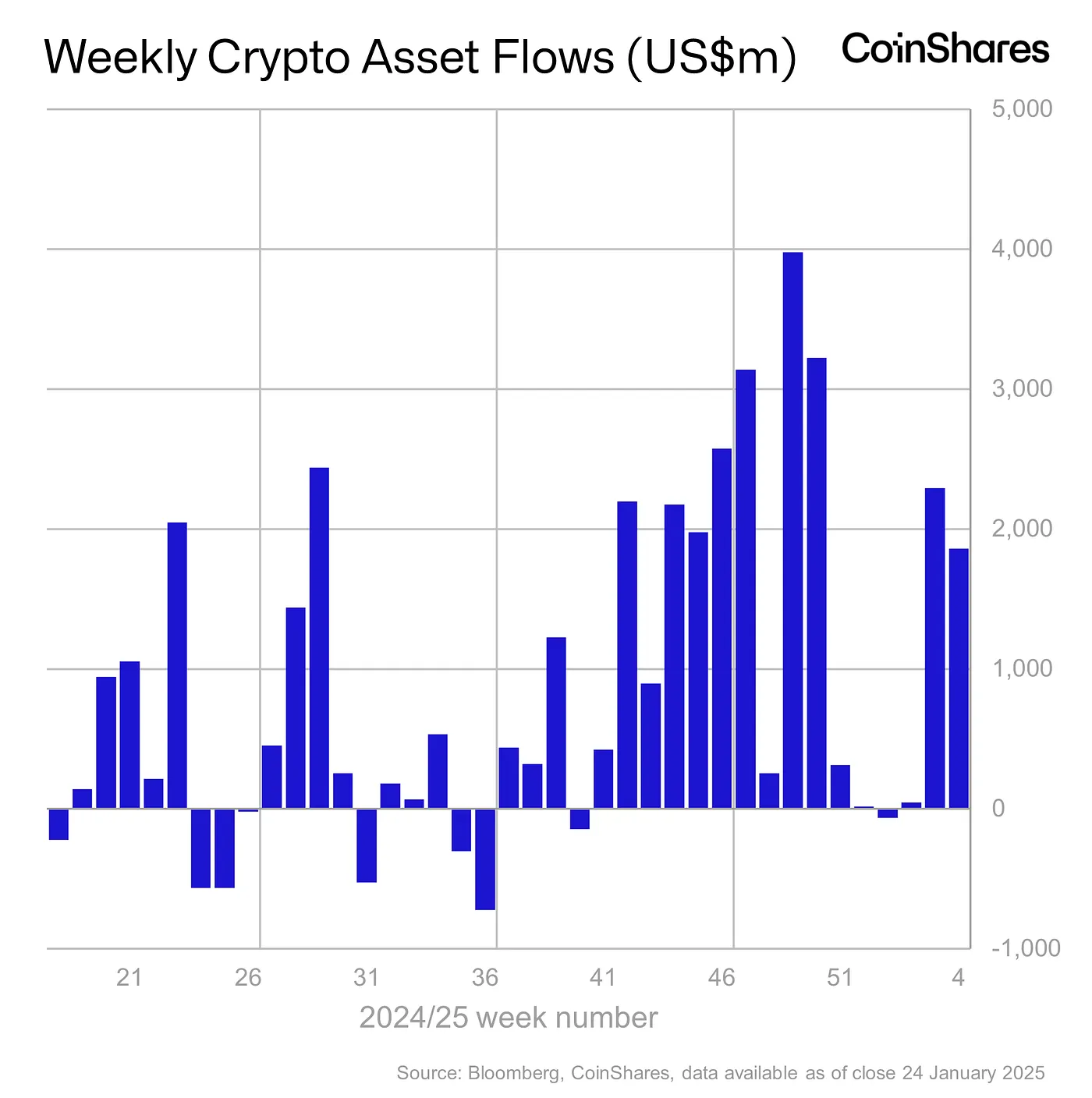
The global digital asset landscape has experienced a monumental shift in sentiment as institutional investors rush to capitalize on a rapidly evolving regulatory environment in the United States. According to the latest Digital Asset Fund Flows report from CoinShares, institutional investment vehicles dedicated to cryptocurrencies recorded an influx of approximately $1.9 billion last week. This massive capital injection brings the total year-to-date (YTD) inflows to an impressive $4.8 billion, signaling a robust appetite for digital assets among professional fund managers and institutional players.
Industry analysts are largely attributing this surge to the recent executive actions taken by President Donald Trump, which have signaled a pivotal change in the U.S. government’s stance toward digital assets. Specifically, proposals concerning the establishment of a strategic national Bitcoin reserve have catalyzed a "fear of missing out" (FOMO) among institutional entities that were previously sidelined by regulatory uncertainty.
The Main Facts: A $1.9 Billion Influx
The CoinShares data provides a granular look at how institutional capital is being deployed. Despite a period of relatively flat price action for major cryptocurrencies last week, the underlying market activity told a different story. Trading volumes on trusted crypto exchanges reached $25 billion—representing roughly 37% of total market activity—which indicates that the influx of funds was not merely speculative but driven by high-conviction institutional positioning.
The $1.9 billion figure is significant not only for its scale but for its geographic distribution. The United States remains the epicenter of this activity, accounting for $1.7 billion of the total global inflows. Other regions, while trailing significantly, also saw positive momentum: Canada, Switzerland, and Germany recorded inflows of $31 million, $35 million, and $23 million, respectively.
Chronology: From Executive Order to Market Surge
To understand the current market behavior, one must look at the recent timeline of events that triggered this investor confidence:
- Pre-Inauguration Momentum: In the weeks leading up to the inauguration, Bitcoin (BTC) reached several new all-time highs. This rally created a bullish narrative that paved the way for institutional entry.
- The Executive Action: Following the transition of power, the issuance of executive orders directed at the digital asset industry served as a massive catalyst. The focus on integrating Bitcoin into the national financial framework provided the regulatory clarity that large-scale institutional investors had been waiting for since the inception of the asset class.
- The Surge: Immediately following these policy announcements, institutional desks began aggressive accumulation. Within a single trading week, the $1.9 billion flow was recorded, cementing the trend of institutional adoption as a dominant force in the current market cycle.
Supporting Data: Bitcoin and Altcoin Performance
Bitcoin, as the primary vehicle for institutional investment, dominated the flow data. According to CoinShares, BTC attracted $1.6 billion in new capital last week, accounting for a staggering 92% of all inflows into the digital asset sector. This brings the YTD total for Bitcoin investment products to $4.4 billion.
Interestingly, the report noted that while the majority of capital is betting on price appreciation, there remains a contingent of hedgers. Short-Bitcoin ETFs, which allow investors to profit from price declines, saw inflows of $5.1 million. This suggests that while the dominant sentiment is overwhelmingly bullish, institutional players are maintaining sophisticated hedging strategies to manage risk amid the high volatility associated with new all-time highs.
Ethereum and the Altcoin Landscape
Ethereum (ETH) emerged as the clear leader among altcoins, capturing $205 million in new inflows. This surge is particularly notable as it brings ETH’s YTD inflows to $177 million, suggesting a turnaround in sentiment for the second-largest cryptocurrency. Other altcoins saw generally positive flows, with Cardano (ADA) being the notable exception; it was the only major digital asset product to suffer net outflows last week. This indicates that while institutional capital is broad-based, it remains highly selective, favoring assets with clear network utility and established regulatory standing.
Official Responses and Expert Commentary
The shift in the U.S. regulatory climate has drawn reactions from various corners of the financial world. CoinShares analysts noted in their report: "Digital asset investment products saw inflows totaling US$1.9bn last week… likely as a result of recent presidential executive orders that proposed the initiation of a strategic reserve asset in Bitcoin."

Industry advocates have praised the executive orders as a "watershed moment" for the industry. Proponents argue that by moving to legitimize Bitcoin as a strategic reserve, the U.S. government is effectively de-risking the asset for pension funds, insurance companies, and family offices. Conversely, traditional skeptics remain cautious, pointing to the inherent volatility of digital assets. However, the volume data—showing 37% of all exchange trading coming from institutional vehicles—suggests that the "institutionalization" of crypto is no longer a future prospect but a present reality.
Implications for the Future of Finance
The implications of this massive capital inflow are profound, affecting everything from market liquidity to global monetary policy.
1. The Legitimacy of Bitcoin as a Reserve Asset
If the U.S. successfully moves to hold Bitcoin in a strategic reserve, it will fundamentally change the perception of the asset from a speculative "tech stock" proxy to a foundational monetary asset. This move would likely force other sovereign nations to reconsider their own digital asset policies to remain competitive in the global financial arena.
2. Shift in Institutional Portfolio Construction
The fact that nearly $2 billion entered the market in a single week suggests that institutional portfolio managers are now including crypto as a core component of their asset allocation strategies. This is a departure from the "experimentation" phase of previous years. Asset managers are now viewing digital assets as a necessary hedge against fiat currency debasement and a tool for diversification.
3. Regulatory "Flight to Quality"
The concentration of inflows into Bitcoin and Ethereum demonstrates a "flight to quality." Investors are shunning high-risk, unproven protocols and concentrating their capital in assets that have demonstrated resilience and liquidity. This trend is likely to continue, potentially leaving smaller altcoins behind unless they can provide a compelling institutional-grade use case.
4. Impact on Market Volatility
While large-scale institutional inflows bring stability through increased liquidity, they also introduce a new type of systemic risk. Institutional investors are subject to fiduciary duties and quarterly reporting requirements; a sudden change in sentiment or a regulatory pivot could lead to rapid divestment, which would have a magnified impact on market prices compared to retail-driven cycles.
Conclusion
The recent surge in digital asset inflows serves as a testament to the power of regulatory clarity. By signaling a willingness to integrate digital assets into the national economic framework, the United States has effectively unlocked a new wave of institutional participation. As the year progresses, the focus will remain on whether these inflows are sustained and whether the proposed strategic reserve initiatives manifest into tangible policy.
For now, the data is clear: the wall between traditional finance and the digital asset economy is thinning. Institutional investors have signaled their intent, and the capital flowing into the market reflects a long-term commitment to the digital asset ecosystem. Investors are advised to remain vigilant, as while the macro-trend is bullish, the volatility inherent in this sector remains a significant factor that requires careful, disciplined risk management.
Disclaimer: The information provided in this article is for educational and informational purposes only and does not constitute financial, investment, or legal advice. The Daily Hodl is not an investment advisor. Cryptocurrency investments carry a high level of risk and may not be suitable for all investors. Always conduct your own due diligence and consult with a professional financial advisor before making any investment decisions.