
The Illusion of Liquidity: Why Wash Trading Remains Crypto’s Persistent Shadow
In the volatile world of cryptocurrency, trading volume is often treated as the primary heartbeat of market health. It signals liquidity, adoption, and, perhaps most importantly, legitimacy. However, beneath the surface of these high-frequency numbers lies a persistent and deceptive practice: wash trading.
Bobby Ong, co-founder of the prominent market data aggregator CoinGecko, recently issued a sobering assessment of the state of crypto markets. According to Ong, the prevalence of wash trading is not merely a historical footnote but a growing malignancy that threatens the integrity of digital asset valuation. As the industry matures, the dichotomy between regulated, transparent platforms and the opaque, offshore wild west has never been more pronounced.
Understanding the Deception: What is Wash Trading?
At its core, wash trading is a form of market manipulation where an entity simultaneously acts as both the buyer and the seller of a financial instrument. By trading with oneself, the perpetrator creates the illusion of high market activity, volume, and demand.
The goal is two-fold: first, to trick automated trading algorithms and retail investors into believing a token has high liquidity; and second, to artificially inflate the perceived ranking of an exchange on data aggregators. When unsuspecting investors see a coin with massive 24-hour volume, they often assume it is a "hot" asset, leading to a "fear of missing out" (FOMO) that the manipulator exploits to offload their own holdings at inflated prices.
The Chronology of a Market Crisis
The concern regarding fake volume is not new, but the scale has evolved alongside the crypto market itself.
- The Early Years (2014–2017): Wash trading was largely viewed as an annoyance, mostly confined to smaller, low-liquidity exchanges attempting to attract listings.
- The 2018 Reckoning: As the crypto bubble burst, research firms like Bitwise Asset Management published landmark reports revealing that upwards of 95% of reported Bitcoin spot trading volume was likely fabricated. This was the first time the public truly grasped the extent of the manipulation.
- The Regulatory Push (2019–2020): Industry leaders began calling for standardized metrics. CoinGecko, under the leadership of Bobby Ong, pioneered the "Trust Score" initiative to move away from volume-only rankings.
- The Current Landscape (2021–Present): While institutional adoption has brought more oversight to major exchanges, the explosion of Decentralized Finance (DeFi) and niche altcoin markets has provided new, more sophisticated avenues for wash trading that are harder for regulators to track.
The Trust Score Initiative: A Data-Driven Defense
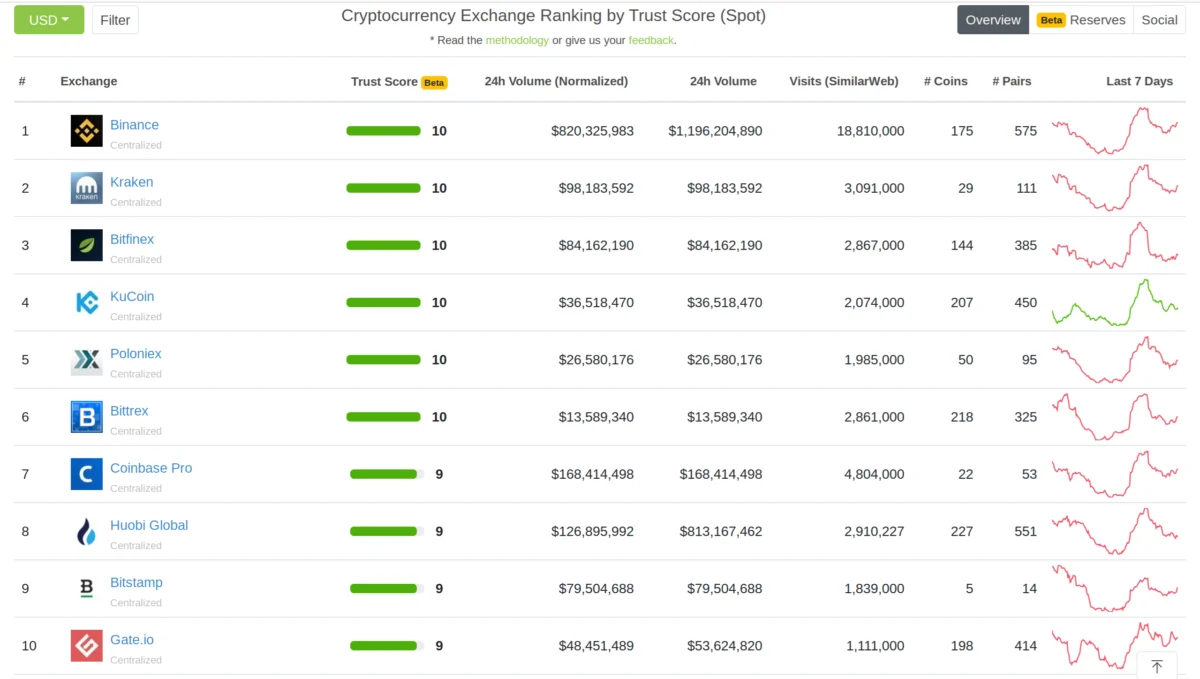
To combat the "volume-only" trap, CoinGecko launched its Trust Score algorithm. This metric is designed to be a multi-dimensional defense against manipulation. Rather than taking an exchange’s self-reported data at face value, the Trust Score weighs three critical factors:
- Reported Trading Volume: While still a data point, it is no longer the sole arbiter of rank.
- Web Traffic Analysis: By cross-referencing trading volume with actual user engagement (visits, time on site, and bounce rates), CoinGecko can identify anomalies—such as exchanges that claim billions in volume but have negligible web traffic.
- Order Book Depth: This measures the ability of an exchange to absorb large orders without causing significant price slippage. A thin order book with high reported volume is a classic "smoking gun" for wash trading.
Currently, industry titans like Binance and Kraken have maintained high scores, but the gap between these leaders and the long tail of offshore, unregulated exchanges remains a chasm.

The Case for Regulated Exchanges
Bobby Ong’s advice to the average investor is clear: Stick to the regulated space.
"If you really want to get real 24-hour trading volume, I think the only real way is to look at volume from regulated exchanges such as those in the US, in Japan—those licensed exchanges," Ong stated in his interview with BlockTV.
Regulated exchanges like Coinbase and Gemini operate under the watchful eye of bodies like the SEC, the NYDFS, and Japan’s FSA. These entities are subject to rigorous audits, anti-money laundering (AML) protocols, and "Know Your Customer" (KYC) requirements. In these environments, the cost of wash trading—fines, license revocation, and criminal liability—far outweighs the potential benefits of faking volume.
Conversely, the unregulated space remains a "black box." For many offshore exchanges, the primary business model is not facilitating trade, but "listing fees" for new projects. By faking high volumes for these projects, exchanges make the tokens appear more attractive, allowing them to charge higher listing fees to desperate, often inexperienced, project founders.
Implications for the Broader Crypto Ecosystem
The persistence of wash trading has profound implications for the maturation of the cryptocurrency industry.
1. Distorted Price Discovery
When a significant portion of trading volume is fake, price discovery—the process by which the market determines the "fair value" of an asset—is compromised. This leads to increased volatility and irrational market movements that can punish retail investors.
2. The Barrier to Institutional Entry
Institutional investors require clean, reliable, and audited data. As long as wash trading remains rampant in the spot markets, institutional players will remain hesitant to allocate significant capital. The lack of reliable data is one of the primary reasons why some institutional-grade financial products have struggled to gain traction.
3. Regulatory Pressure
The unchecked nature of wash trading provides fuel for regulators who argue that the crypto industry is fundamentally unsafe. By failing to self-regulate, the industry invites heavy-handed oversight that could stifle innovation and fragment global liquidity.
4. The Erosion of Investor Trust
Ultimately, the victim of wash trading is the retail participant. When a user loses money because they were lured by fake volume, their trust in the entire ecosystem is diminished. If the industry wants to achieve mainstream adoption, it must purge these deceptive practices.
Moving Toward a Transparent Future
The battle against wash trading is a race between the sophistication of manipulators and the transparency of data aggregators. While the situation may appear to be "getting worse" due to the sheer number of new exchanges and tokens entering the market, the tools for detecting such behavior are becoming more robust.
The industry is reaching a tipping point. As more countries introduce clear regulatory frameworks for digital assets, the space for wash trading will continue to shrink. Exchanges that prioritize transparency and security will eventually outlast those that rely on the smoke and mirrors of fabricated data.
For the individual investor, the message is simple: Due diligence is not optional. Relying on a single metric—like 24-hour volume—is a recipe for disaster. Investors must look for exchanges with proven track records, robust regulatory compliance, and transparent data practices.
As Bobby Ong noted, the distinction between the real and the fake is often difficult to discern, but by favoring regulated, audited platforms, investors can protect themselves from the worst of the market’s excesses. The future of crypto does not lie in artificial volume, but in the genuine liquidity and trust that only a transparent market can provide.
Disclaimer: Opinions expressed at The Daily Hodl are not investment advice. Investors should do their due diligence before making any high-risk investments in Bitcoin, cryptocurrency, or digital assets. Please be advised that your transfers and trades are at your own risk, and any losses you may incur are your responsibility. The Daily Hodl does not recommend the buying or selling of any assets, including cryptocurrencies, nor is The Daily Hodl an investment advisor. Please note that The Daily Hodl participates in affiliate marketing.