
Institutional Confidence Surges: Crypto Markets Defy Initial Rate-Cut Jitters with $1.9 Billion Inflow
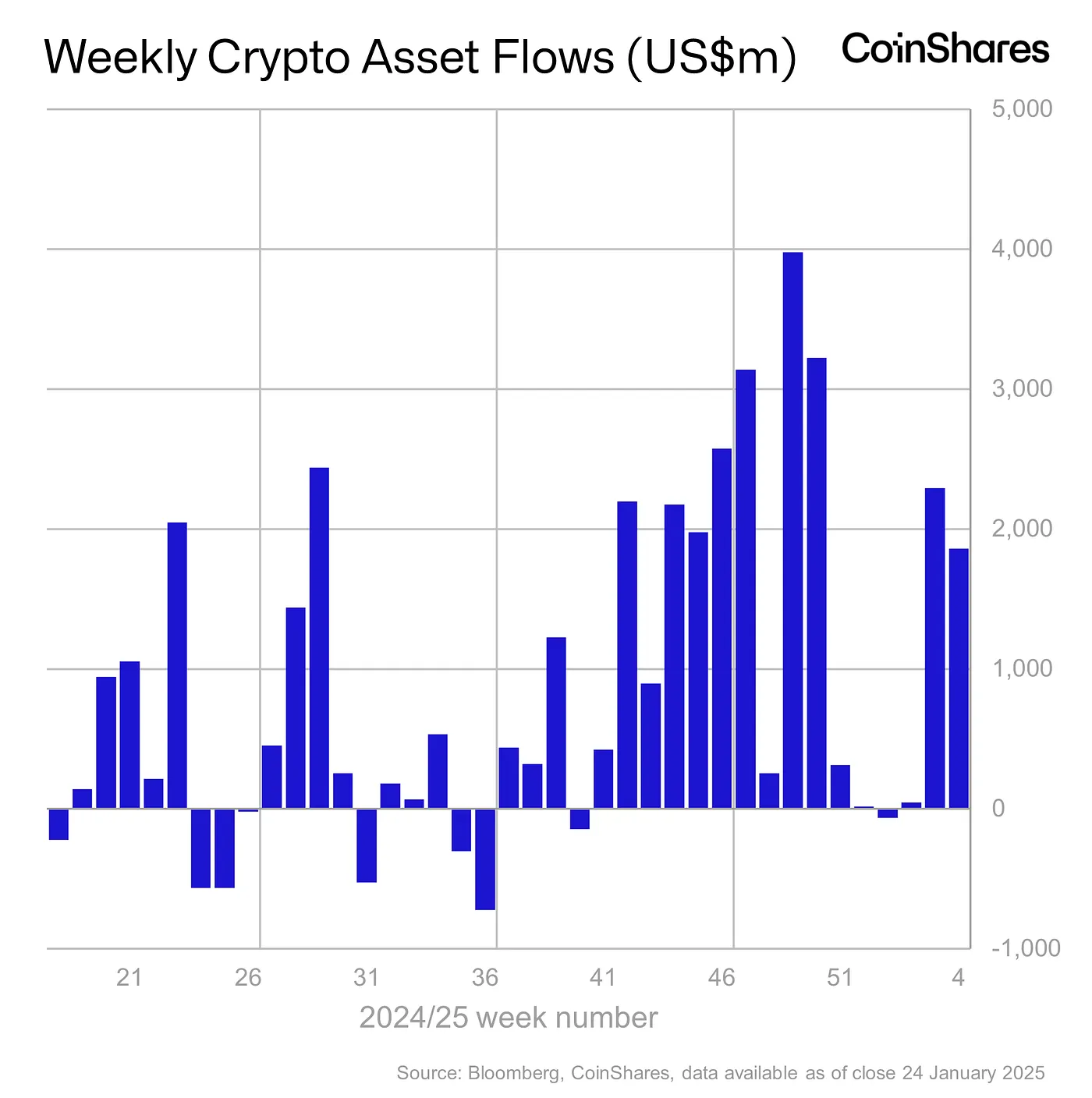
The landscape of digital asset investment has witnessed a dramatic shift in momentum, as institutional investors signaled a robust vote of confidence in the cryptocurrency market following the Federal Reserve’s landmark decision to slash interest rates. According to the latest "Digital Asset Fund Flows Weekly Report" from industry giant CoinShares, the global crypto market recorded a substantial $1.9 billion in inflows over the past week, marking the second consecutive week of positive sentiment.
While the market initially displayed a tremor of hesitation in the face of the Federal Reserve’s "hawkish cut," the subsequent recovery demonstrates a sophisticated understanding of macroeconomic shifts. As liquidity conditions evolve, institutional capital appears to be aggressively repositioning into digital assets, viewing the Fed’s pivot as a long-term tailwind for risk-on assets.
The Chronology: From Hesitation to Aggressive Accumulation
The narrative of the past week was defined by a volatile reaction to the Federal Reserve’s monetary policy announcement. For months, the market had priced in various scenarios, but the reality of the rate cut—characterized by some analysts as "hawkish"—initially triggered a period of uncertainty.
Early Week Caution
When the Federal Open Market Committee (FOMC) delivered the decision, the immediate reaction in digital asset exchange-traded products (ETPs) was one of tempered optimism. Institutional investors, wary of the complex language surrounding the Fed’s future trajectory, adopted a "wait and see" approach. The initial hours post-announcement were marked by stagnant flows as market participants parsed the implications of a cut that was coupled with projections suggesting a slower pace of easing than some ultra-dovish market participants had hoped for.
The Thursday-Friday Surge
As the market digested the data, the sentiment shifted decisively. By Thursday and Friday, the initial caution evaporated, replaced by a wave of capital allocation. CoinShares data highlights that $746 million of the total $1.9 billion inflow occurred specifically during the final two trading days of the week. This late-week surge suggests that institutional desks concluded that the Fed’s move—regardless of its hawkish framing—represented the beginning of a cycle of monetary easing that historically benefits non-sovereign stores of value like Bitcoin.
Supporting Data: A Global Inflow Breakdown
The surge in capital was not merely a U.S.-centric phenomenon, though the United States remained the undisputed epicenter of this momentum.
Geographic Distribution
- The United States: Leading the pack by a significant margin, U.S.-based investment vehicles saw $1.8 billion in net inflows. This concentration underscores the dominance of the spot Bitcoin ETFs and the growing institutional acceptance of crypto as a primary asset class in the American financial system.
- European and Emerging Markets: Germany followed with $51.6 million in inflows, while Switzerland added $47.3 million. Brazil also joined the trend with $9.3 million, signaling a growing appetite for institutional-grade crypto exposure in South America.
- The Hong Kong Exception: Conversely, Hong Kong experienced a minor contraction, seeing outflows totaling $3.1 million. While statistically minor compared to the global influx, it serves as a reminder of the regional regulatory divergence currently influencing global capital flows.
Asset-Specific Performance
The inflows were not evenly distributed, with investors showing a clear preference for established market leaders:
- Bitcoin (BTC): As the primary beneficiary, Bitcoin captured $977 million in inflows. This confirms that despite volatility, institutional interest remains tethered to the "digital gold" narrative.
- Short-Bitcoin Products: In a telling sign of shifting sentiment, short-bitcoin investment products continued to face systemic abandonment, recording $3.5 million in outflows. The total Assets under Management (AuM) for short-bitcoin products have now slumped to a multi-year low of just $83 million, suggesting that "the bears" are increasingly capitulating.
- Ethereum (ETH): Ethereum saw a significant revival, drawing in $772 million. This rebound is particularly notable given the recent lukewarm reception of spot Ethereum ETFs in the U.S.
- Altcoin Strength: Solana (SOL) and XRP continued their role as institutional favorites, securing $127.3 million and $69.4 million in inflows, respectively.
Institutional and Market Perspectives
The "hawkish cut" paradox—where the Fed lowers rates but signals caution regarding future speed—has become a focal point for macro analysts.
Why the "Hawkish" Framing Matters
Market analysts at CoinShares noted that the initial hesitation stemmed from fears that the Fed might be signaling a weakening economy rather than simply normalizing policy. However, the pivot to aggressive buying late in the week implies that institutional investors view the "hawkish" component of the cut as a signal that the Fed is committed to balancing inflation control with economic stability.
For the digital asset sector, this is a "Goldilocks" scenario: lower interest rates reduce the opportunity cost of holding non-yielding assets like Bitcoin, while the expectation of a controlled economic environment prevents a total market panic.

The Death of the "Short" Thesis
The shrinking AuM in short-bitcoin products is perhaps the most critical indicator of institutional long-term planning. When hedge funds and institutional desks liquidate short positions, it removes a layer of "sell pressure" that often exacerbates volatility. The fact that these products are hitting multi-year lows suggests that the institutional "smart money" is no longer betting against the fundamental value proposition of digital assets.
Implications: The Road Ahead
The data released by CoinShares points to several profound implications for the remainder of the year and into 2025.
1. The Normalization of Crypto in Portfolios
The sheer volume of $1.9 billion in a single week suggests that cryptocurrency is no longer a "fringe" allocation. It is increasingly being treated as a standard component of institutional portfolio construction, alongside equities, bonds, and commodities. The cross-border nature of these flows indicates that major financial hubs are now synchronized in their acceptance of digital asset ETPs.
2. Macroeconomic Sensitivity
The market’s sensitivity to the Federal Reserve highlights that crypto has entered a new phase of macro-correlation. While crypto was once seen as an asset that existed in a vacuum, it is now clearly influenced by, and responsive to, global monetary policy. This transition from "retail-driven speculation" to "macro-responsive investment" is a hallmark of a maturing asset class.
3. The Impact of Regulatory Certainty
The regional data, particularly the dominance of U.S. inflows, suggests that regulatory clarity—or at least the stability of existing frameworks—is a major driver of capital. Investors are moving toward jurisdictions where they feel the legal status of digital assets is secure. As the U.S. continues to refine its stance on digital assets, the $1.8 billion influx acts as a validation of the current institutional-friendly climate.
4. Outlook for Q4
With the Federal Reserve signaling that this rate cut is likely the start of a longer-term easing cycle, analysts are projecting that the current trend of inflows could accelerate. If the macroeconomic environment remains stable, and inflation continues to trend toward the Fed’s 2% target, the conditions for a continued bull run are historically favorable.
Conclusion
The latest report from CoinShares serves as a powerful indicator that the institutional appetite for digital assets remains remarkably resilient. Despite the initial confusion regarding the Federal Reserve’s "hawkish" stance on interest rates, the swift return of capital demonstrates a firm conviction among institutional investors.
By prioritizing Bitcoin and Ethereum while abandoning bearish short positions, the market is positioning itself for a new era of growth. As we move further into the final quarter of the year, the combination of lower borrowing costs and sustained institutional interest provides a robust foundation for the crypto market, setting the stage for what many hope will be a transformative period for the entire digital asset ecosystem.
Disclaimer: This report is for informational purposes only and does not constitute financial or investment advice. The cryptocurrency market is subject to high volatility and risk. Investors should conduct their own thorough due diligence before participating in digital asset markets. The Daily Hodl and its contributors are not responsible for any financial losses incurred through investment decisions.