Jumper Breaks Away from LI.FI to Become Independent, Announces First-Ever JUMP Token Sale via Legion
BRITISH VIRGIN ISLANDS — In a landmark development for the decentralized finance (DeFi) sector, Jumper, a leading consumer-facing application for onchain asset management and cross-chain trading, has officially announced its transition into an independent corporate entity. Alongside this structural autonomy, the platform has revealed plans for its inaugural JUMP token sale, hosted through the Legion launchpad.
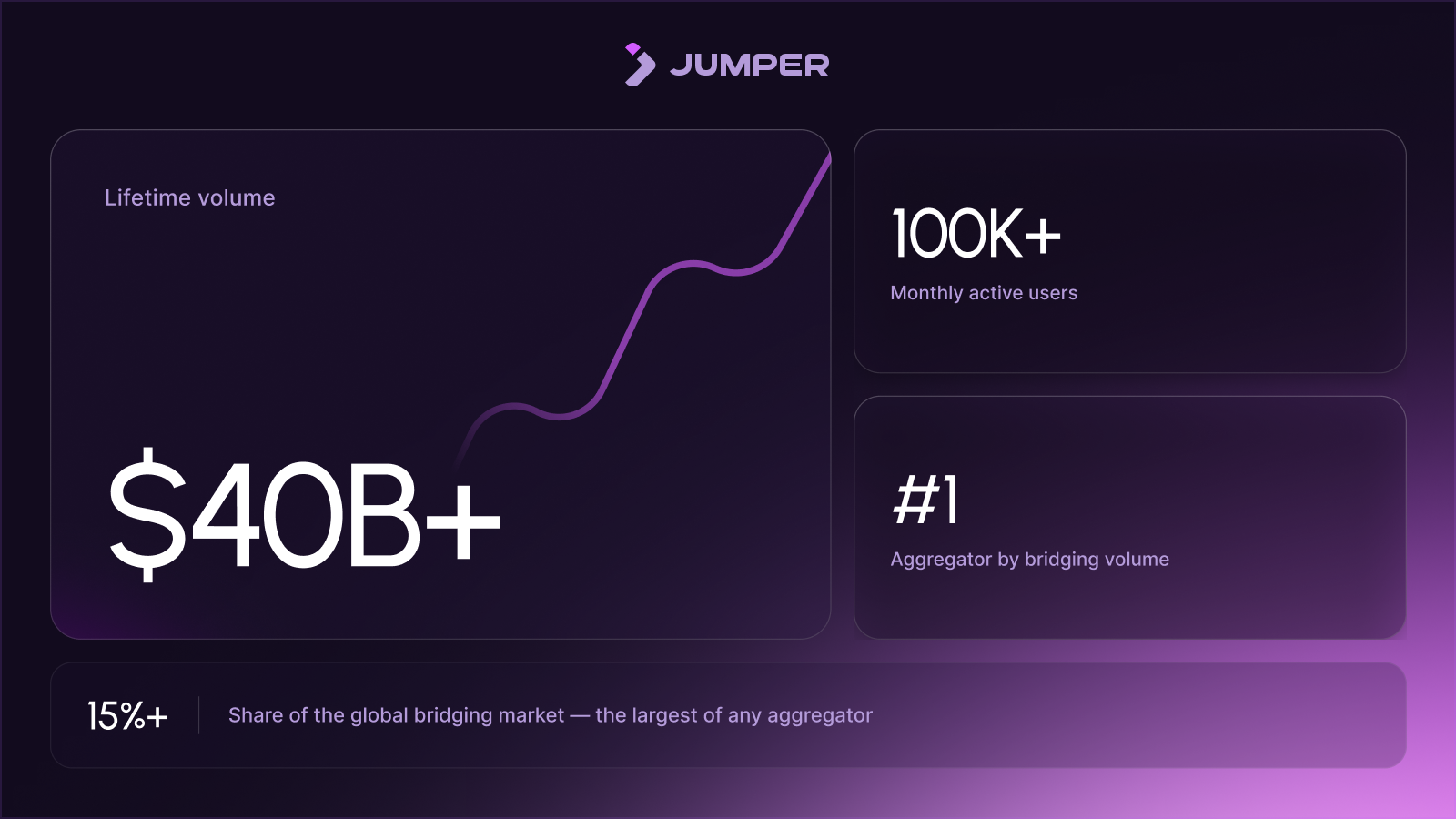
Boasting an impressive operational history that includes over $40 billion in cumulative lifetime trading volume and more than 100,000 monthly active users, Jumper is shedding its incubation status under LI.FI. The move marks a pivotal turning point for the protocol as it scales its operations, diversifies its product offerings, and champions a novel "token-first" ownership model designed to align the interests of users, developers, and investors alike.
Main Facts
The announcement details a comprehensive corporate and economic overhaul for Jumper:
- Independence from LI.FI: Originally conceived and incubated within LI.FI, Jumper is now operating as a fully standalone venture, complete with dedicated leadership, independent capital allocation, and an autonomous product roadmap.
- The JUMP Token Sale: Jumper is launching its first-ever capital raise via a JUMP token sale hosted on the Legion platform.
- Unified Ownership Structure: Breaking away from traditional dual-tier models (where venture capitalists hold equity and retail users hold utility tokens), Jumper is eschewing traditional equity financing entirely. The JUMP token will serve as the sole instrument of ownership and value accrual.
- Core Metrics: The platform currently commands over 15% of the market share in cross-chain bridging volume, making it the premier bridging aggregator globally, anchored by its $40 billion lifetime volume milestone.
- Super-App Ambitions: Moving beyond simple cross-chain swaps, Jumper is rapidly evolving into a comprehensive financial super-app that encompasses perpetual futures, real-world assets (RWAs), and decentralized yield generation.
Chronology: From Incubation to Independence
To understand the gravity of Jumper’s current market position, it is essential to examine the timeline of its growth and the strategic pivot toward complete autonomy.
The Early Era: Incubation within LI.FI
Jumper was originally developed as a flagship consumer interface under the umbrella of LI.FI, an advanced cross-chain liquidity orchestration layer. While LI.FI focused heavily on building the foundational plumbing—connecting disparate blockchain networks through robust routing and bridging infrastructure—it became clear that the end-user experience required a dedicated, streamlined front-end interface. Jumper was born to fill that gap, serving as an intuitive gateway for retail traders navigating the multi-chain universe.
Scaling to Dominance
Over the subsequent months and years, Jumper rapidly captured the attention of the DeFi community. By abstracting away the tedious complexities of manual bridging, gas fee management, and protocol fragmentation, the application scaled aggressively. It crossed major operational milestones, amassing over $40 billion in lifetime volume and securing its spot as the undisputed market leader in bridging volume, capturing upwards of 15% of the total sector market share.
The Spin-Out and Upcoming Jumper Perps Launch
Recognizing its massive consumer footprint and distinct product-market fit, leadership determined that Jumper had outgrown its incubation phase. The decision was made to carve Jumper out into an independent company.
Concurrently, the platform has maintained an aggressive development schedule. In the coming weeks, Jumper is slated to launch Jumper Perps, a specialized product that aggregates perpetual futures trading venues into a single, cohesive user experience. This launch represents a crucial step in transforming Jumper from a single-purpose bridge into an all-encompassing financial hub.
Supporting Data and Market Metrics
The financial and operational health of Jumper underscores why industry analysts are watching this spin-off closely:
- $40+ Billion in Lifetime Volume: This staggering figure places Jumper among the elite tier of decentralized consumer applications, demonstrating consistent user trust and deep liquidity access.
- 100,000+ Monthly Active Users (MAUs): A robust, recurring active user base indicates that Jumper is not merely a transactional tool used out of necessity, but a preferred daily driver for multi-chain participants.
- 15% Market Share in Bridging: As the #1 aggregator by bridging volume, Jumper sits at a critical chokepoint of cross-chain liquidity flows, positioning it ideally to upsell advanced financial products to its existing user base.
- Evolving Asset Classes: The platform already supports everything from blue-chip cryptocurrencies and high-beta memecoins to emerging tokenized stocks and other real-world assets (RWAs), bridging traditional finance (TradFi) primitives with native decentralized finance (DeFi).
Official Responses and Visionary Statements
The leadership team behind Jumper has been vocal about the strategic rationale driving both the corporate split from LI.FI and the unique structure of the upcoming JUMP token sale.
Marko Jurina, CEO of Jumper, emphasized the natural evolution of the platform in a recent statement:
"Bridging was the starting point for Jumper, and we’ve grown into the #1 aggregator by bridging volume with more than 15% market share. As more financial assets move onchain, the opportunity gets much bigger than bridging. We want Jumper to be the application users open whenever they want to trade, invest, or move value onchain."
Addressing the structural relationship between Jumper and its infrastructure provider, Jurina noted that the two entities will continue to target the multi-chain ecosystem from complementary angles: LI.FI will maintain its focus on backend orchestration infrastructure, while Jumper will push forward as the premier consumer-facing application.
Perhaps the most disruptive element of the announcement is Jumper’s rejection of traditional venture capital equity rounds in favor of a unified token model. Jurina elaborated on this philosophy:
"We believe the token should be the only way to have ownership and exposure to the value being created by Jumper. There shouldn’t be one group holding equity and another group holding a token. JUMP is intended to be the only way users, contributors, and investors participate in Jumper’s growth, so the value created by Jumper is aligned with tokenholders."
Jurina further challenged prevailing industry norms regarding token economics:

"Getting here has meant pushing against a lot of incumbent processes and thinking that still treat the token as something separate from the underlying business. We think that model needs to change. If crypto is serious about creating new forms of ownership, the people who use, support, and build these businesses should be able to participate directly in the value they help create. We want Jumper to be at the forefront of that shift. We believe token-first ownership should become an industry standard, and we want to help lead that change."
Implications for the DeFi and Multi-Chain Ecosystem
Jumper’s transition into an independent entity and its pioneering tokenomics carry profound implications for the broader blockchain industry.
1. Redefining Startup Capital Formation
For years, the standard playbook for Web3 startups involved raising seed and series rounds via equity sales to venture capitalists, followed much later by a secondary token generation event (TGE) where retail participants were often left as exit liquidity. By skipping equity financing entirely and tying all forms of institutional and retail participation directly to the JUMP token, Jumper is attempting to rewrite the social contract of crypto fundraising. If successful, this model could pressure future protocols to adopt fairer, more transparent ownership structures.
2. The Rise of the Onchain Super-App
The fragmentation of liquidity across dozens of layer-1 blockchains, layer-2 rollups, and application-specific chains has created an immense user-experience bottleneck. Applications like Jumper that successfully abstract away this complexity—bundling bridging, swapping, perpetual trading, and real-world assets into a single interface—are capturing the most valuable real estate in crypto: the user’s attention. As Jumper Perps and future products roll out, users will have fewer incentives to interact with fragmented native protocols directly.
3. Strengthening the Modular Stack
The formal separation of LI.FI and Jumper highlights a maturing trend in Web3: the unbundling of infrastructure and applications. Just as traditional tech markets saw infrastructure providers (like AWS) separate from consumer software giants, the blockchain space is witnessing a clean division where specialized orchestration layers power decoupled, high-performance consumer applications. This symbiosis allows each entity to hyper-focus on its core competency without internal conflicts of interest.
Conclusion
As Jumper prepares for its debut JUMP token sale on Legion, the crypto community is watching closely to see how this bold experiment in token-first equity alternative plays out. Armed with $40 billion in historical volume, a loyal user base, and an aggressive roadmap that includes perpetual futures and real-world assets, Jumper is no longer just a bridge—it is positioning itself as the undisputed financial super-app of the multi-chain future.