Dogecoin’s Path to $20? Analyzing the Macro Patterns Behind Crypto’s Original Meme Coin
WASHINGTON, D.C. — In a cryptocurrency market largely dominated by the liquidity gravity of Bitcoin, Ethereum, and XRP throughout 2026, the original meme coin has found itself fighting to stay relevant. Dogecoin (DOGE) has been trading below the $0.09 threshold, sitting more than 88% down from its May 2021 all-time high of $0.74.
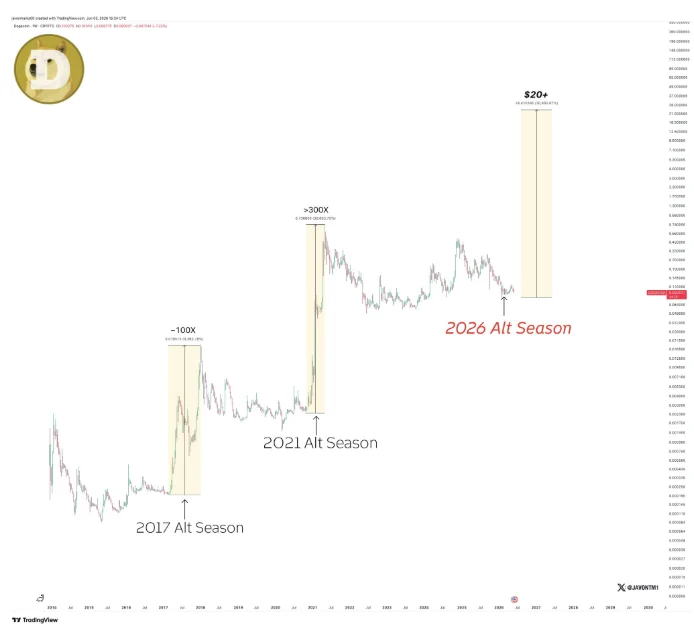
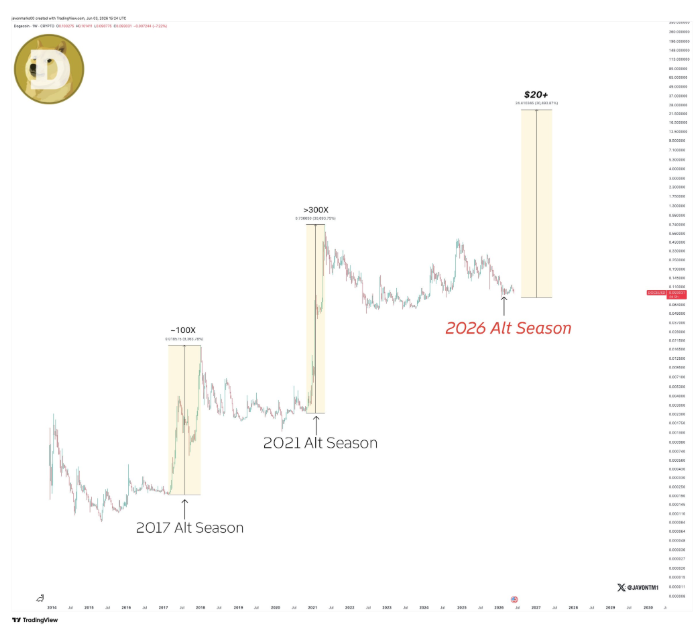
For the everyday retail trader watching short-term charts, DOGE can feel sluggish and sidelined. However, a closer look at multi-year macro structures reveals a different narrative. Prominent crypto analyst Javon Marks has identified a repeating historical pattern on Dogecoin’s long-term charts. According to his technical framework, DOGE is demonstrating a persistent cycle of expanding altcoin-season performance. If this historical blueprint holds true through the projected 2026 alt-season window, Marks argues that Dogecoin could target an extraordinary breakout above $20.
While a $20 price tag implies an astronomical valuation for a token that currently trades as loose change, analyzing the mechanics, historical milestones, and broader market prerequisites reveals why this audacious forecast is capturing the attention of technical analysts across the globe.
Main Facts: The Current State of Dogecoin
At the time of writing, Dogecoin changes hands at roughly $0.081. This valuation places the asset near its weakest technical standing since 2022, severely lagging behind large-cap altcoin peers that have experienced intermittent surges of capital rotation.
Despite this bearish immediate reality, the foundational thesis for a massive long-term reversal rests on exponential cycle scaling. Key metrics defining the current landscape include:
- Current Price: Hovering near $0.081, down over 88% from its 2021 peak of $0.74.
- Circulating Supply: Approximately 154.5 billion DOGE tokens as of June 2026.
- The Analyst Target: Technical projections from Javon Marks point to a potential 240x to 300x expansion, targeting price zones stretching from $20 to over $24.
- The Market Cap Implication: At a price of $20 per token, Dogecoin’s market capitalization would skyrocket to roughly $3 trillion, placing it on par with or eclipsing the entire crypto market valuation seen during past bull cycles.
Rather than looking at daily noise, the $20 thesis requires shifting the lens to macro-historical movements on weekly candlestick charts, examining how previous altcoin seasons set the precedent for exponential growth.
Chronology: Tracing Dogecoin’s Multi-Year Evolution
To understand how a sub-$0.10 asset could mathematically reach $20, market historians must look back at Dogecoin’s previous market cycles. DOGE’s price discovery has never followed a linear path; instead, it has exploded in violent, parabolic waves separated by grueling bear markets.
The 2017 Alt-Season Foundation
In the early years of its trading history, Dogecoin was largely dismissed as a novelty digital asset. However, the 2017 altcoin season changed the trajectory of the token forever. Surging from a deep, prolonged accumulation base, DOGE delivered a staggering 100x rally. This movement eventually topped out near the $0.018 mark. While modest by today’s standards, that cycle established a baseline technical structure proving that Dogecoin could absorb massive waves of speculative capital during broader altcoin expansions.
The 2021 Phenomenon
The subsequent cycle in 2021 shattered all previous expectations. Fueled by a potent mix of retail mania, social media virality, and high-profile endorsements, Dogecoin transitioned from an internet joke into a global financial phenomenon. Marks’ charts highlight that the 2021 alt season produced an even larger percentage move than 2017—surging by more than 300x. This explosive run carried DOGE from the lower range of its previous cycle all the way up to $0.74, cementing its place among the top-tier cryptocurrencies by market capitalization and fostering an active, enduring community of developers and investors.
The 2026 Landscape
Fast-forwarding to 2026, Dogecoin has spent years consolidating within a descending channel structure, testing lower bounds and frustrating short-term holders. Yet, according to technical analysts tracking the weekly timeframe, this multi-year consolidation mirrors the accumulation phases that preceded both the 2017 and 2021 explosions. The projected alt-season window for 2026 serves as the next logical crucible for this repeating macro pattern.
Supporting Data: The Mathematics Behind the $20 Target
The feasibility of a $20 Dogecoin requires a deep dive into percentage expansions, historical higher highs, and supply dynamics.
Stepping Stones of Higher Highs
A critical observation of Dogecoin’s historical price action reveals an undeniable structural trend: every cycle has achieved a higher high than the one before it.
- 2017 Cycle High: ~$0.0025
- 2018 Relief Peak: ~$0.069
- 2020 Minor Peak: ~$0.017
- 2021 All-Time High: $0.74
Marks’ hypothesis posits that if Dogecoin’s alt-season behavior continues to outperform previous cycles rather than diminishing in percentage gains (a common trait of maturing assets), the next major impulse wave could easily match or exceed a 300x expansion. Applying a 300x multiplier to current baseline support levels projects a price zone stretching comfortably past $20, with visual extensions on charting platforms pointing as high as $24.
Overcoming Technical Roadblocks
Before investors can seriously entertain double-digit price targets, Dogecoin faces a mountain of technical hurdles. The asset is currently fighting to maintain its footing near $0.081. To spark a macro reversal, DOGE must methodically reclaim lost psychological and structural zones:
- Reclaiming $0.10: The immediate psychological floor and short-term resistance.
- The $0.20 – $0.30 Thresholds: Mid-range zones that historically acted as heavy distribution areas.
- The December 2024 Rejection Zone ($0.49): A critical ceiling that previously halted bullish momentum.
- The 2021 All-Time High ($0.7316 – $0.74): The ultimate gateway to unchartered price discovery.
Official Responses and Market Perspectives
Crypto analysts and community leaders hold divided views on whether historical patterns can reliably forecast such an extreme outlier event for a meme coin.
The Technical Analyst View: Pattern Continuity
Proponents of the bullish thesis, led by analysts like Javon Marks, emphasize that market psychology repeats itself. In technical analysis, assets that have historically demonstrated explosive beta against Bitcoin often experience massive, compressed periods of accumulation followed by vertical expansions. From this viewpoint, the structural compression seen throughout 2026 is not a sign of death for Dogecoin, but rather a coiled spring waiting for market conditions to shift.
The Skeptics’ View: Market Cap Realities
Conversely, traditional financial analysts and pragmatic crypto veterans urge extreme caution. The primary argument against a $20 Dogecoin is simple macroeconomics: market capitalization.
With a circulating supply of roughly 154.5 billion tokens, a $20 valuation per DOGE translates to a total market capitalization of approximately $3 trillion. To put that into perspective, $3 trillion exceeds the entire market capitalization of all cryptocurrencies combined during many historical phases, and rivals the valuation of the world’s largest mega-cap technology corporations (such as Apple or Microsoft). Critics argue that injecting that amount of capital into a meme coin with an inflationary supply model stretches the bounds of probability, even within a hyper-bullish crypto market.
Implications: What a Macro Alt-Season Means for DOGE
For a target like $20 to materialize, the inner workings of the broader digital asset ecosystem would need to undergo a massive structural shift.
The Necessity of Capital Rotation
Dogecoin cannot achieve a multi-trillion-dollar valuation in a vacuum. Marks’ projection is explicitly tied to the arrival of a full-fledged altcoin season. Historically, alt-seasons are triggered when Bitcoin reaches cycle maturity, prompting institutional and retail investors to rotate profits out of BTC and into risk-on, high-beta altcoins. If capital fails to rotate away from Bitcoin, Ethereum, and XRP, Dogecoin’s macro pattern will remain unfulfilled.
Retail Sentiment and Community Strength
Unlike utility-driven layer-1 blockchains or decentralized finance (DeFi) protocols, Dogecoin’s value proposition has always been anchored by its brand, cultural footprint, and passionate global community. A run toward $20 would require an unprecedented wave of global retail participation, mainstream media attention, and potentially renewed corporate integration (such as merchant payment adoption).
Conclusion
Dogecoin trading below $0.09 in 2026 feels a world away from its glory days of 2021. Yet, the history of cryptocurrency is written by unexpected rallies and parabolic extensions that defy traditional financial logic. While a $20 target requires overcoming staggering technical resistance and confronting monumental market capitalization realities, Javon Marks’ analysis serves as a reminder that in crypto, repeating historical cycles can sometimes produce astonishing results. Whether DOGE is merely suffering through a prolonged winter or quietly coiling for its largest cycle yet remains one of the most fascinating storylines to watch in the modern digital asset landscape.