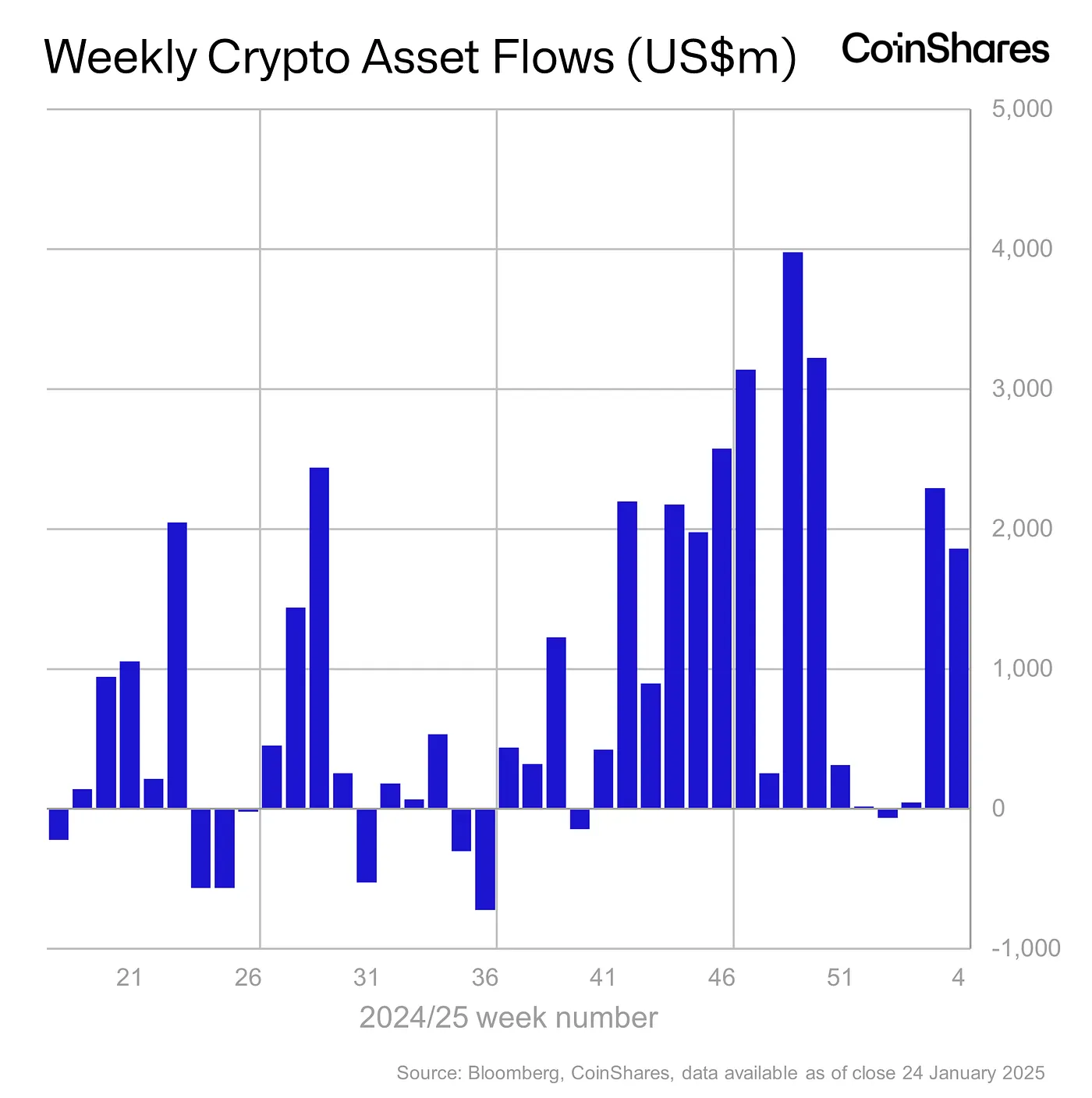
Institutional Appetite Surges: Crypto Markets Defy "Hawkish Cut" Anxiety with $1.9 Billion Inflow
The landscape of digital asset investment has witnessed a dramatic shift in momentum. According to the latest "Digital Asset Fund Flows Weekly Report" released by leading asset management firm CoinShares, the global cryptocurrency market experienced a robust infusion of institutional capital last week, totaling $1.9 billion. This surge, which marks the second consecutive week of positive inflows, suggests that institutional investors are increasingly viewing the Federal Reserve’s recent monetary policy adjustments as a catalyst for growth rather than a source of volatility.
The Fed’s Pivot: A Market Calibration
The primary driver of market sentiment throughout the past week was the U.S. Federal Reserve’s long-anticipated interest rate decision. Following months of speculation regarding the timing and scale of potential cuts, the Federal Open Market Committee (FOMC) initiated a rate reduction cycle. However, the market’s initial reaction was defined by hesitation.
Financial analysts characterized the Fed’s announcement as a "hawkish cut"—a move that lowered borrowing costs while simultaneously signaling that the central bank intends to remain vigilant against inflationary pressures. For institutional traders, who prioritize macroeconomic stability, this created a brief window of uncertainty. Early-week trading sessions saw a cautious retreat as investors assessed the implications of the Fed’s messaging.
Yet, as the week progressed, the narrative shifted from skepticism to strategic accumulation. By Thursday and Friday, the market sentiment flipped decisively, with $746 million pouring into digital asset exchange-traded products (ETPs) in those 48 hours alone. This late-week rally underscored a growing consensus among institutional players that the era of "higher-for-longer" interest rates is effectively ending, creating a more favorable environment for risk-on assets like Bitcoin and Ethereum.
Chronology of the Weekly Surge
To understand the velocity of this institutional inflow, one must look at the day-by-day progression of market activity following the FOMC announcement:
- Monday and Tuesday (The Wait-and-See Period): As the Fed decision loomed, trading volumes remained subdued. Institutional desks reported lower-than-average activity as portfolio managers adjusted their hedges in anticipation of the FOMC statement.
- Wednesday (The Immediate Reaction): Following the announcement of the rate cut, the market experienced a "digestive" phase. The "hawkish" undertone of the Fed’s commentary caused a brief dip in sentiment, with some outflows noted as traders locked in profits or rebalanced their risk exposure.
- Thursday and Friday (The Acceleration): Once the implications of the lower rates were fully processed, the market saw a sharp pivot. Investors began pricing in the reality of cheaper liquidity. This period saw the majority of the week’s $1.9 billion inflow, proving that the market’s underlying bullish thesis remains intact despite macro-economic noise.
Global Distribution: Who is Buying?
While the cryptocurrency market operates globally, the influence of the United States remains paramount. The U.S. market accounted for the overwhelming majority of the inflows, capturing $1.8 billion of the total $1.9 billion reported by CoinShares. This confirms that the approval and maturation of spot Bitcoin and Ethereum ETFs in the U.S. have turned the country into the primary engine for global crypto liquidity.
Europe and South America also played a notable, albeit smaller, role in the weekly rally:
- Germany: $51.6 million in inflows.
- Switzerland: $47.3 million in inflows.
- Brazil: $9.3 million in inflows.
Conversely, Hong Kong bucked the global trend, reporting minor outflows of $3.1 million. This regional divergence highlights that while the institutional hunger for digital assets is a global phenomenon, the pace of adoption is currently dictated by the regulatory and economic climate in Western markets.
Supporting Data: Bitcoin and Altcoin Performance
The distribution of capital across specific assets provides a clear picture of institutional preferences. Bitcoin, the industry benchmark, remains the primary focus of institutional portfolios, though "Altcoin" interest is clearly expanding.
The Bitcoin Dominance
Bitcoin attracted $977 million in inflows, maintaining its status as the "digital gold" of choice for institutional entities. Interestingly, the data surrounding short-Bitcoin investment products tells a story of defeat for the bears. Short-Bitcoin ETPs saw $3.5 million in outflows, bringing their total Assets under Management (AuM) to a multi-year low of just $83 million. This liquidation of short positions suggests that institutional sentiment is overwhelmingly tilted toward a long-term appreciation of the asset.
The Rise of Ethereum and Altcoins
The second-largest cryptocurrency by market capitalization, Ethereum, saw a substantial influx of $772 million. This massive inflow serves as a strong vote of confidence for Ethereum, particularly following the launch of its own spot ETFs in the U.S. earlier this year.

Further down the market cap ladder, Solana (SOL) and XRP continue to capture significant institutional attention. Solana recorded $127.3 million in inflows, while XRP secured $69.4 million. These figures indicate that institutional investors are diversifying their portfolios beyond the two "blue-chip" assets, seeking yield and utility in high-performance blockchains and payment-focused protocols.
Institutional Implications: What Happens Next?
The implications of these inflows are profound. For years, the argument against crypto was that it lacked "institutional-grade" infrastructure. With the current level of capital flow, that argument has effectively been rendered obsolete.
1. The Impact of Liquidity
The Federal Reserve’s pivot to interest rate cuts signals a broader shift toward easier monetary policy. Historically, low interest rates correlate with increased liquidity in global markets. As capital becomes cheaper to borrow, investors move further out on the risk curve, seeking higher returns than those offered by traditional bonds or savings accounts. Digital assets are uniquely positioned to benefit from this rotation.
2. Market Maturity
The transition from speculative retail-driven peaks to consistent institutional inflows suggests that the market is entering a phase of maturity. Institutional investors, characterized by their longer time horizons and risk-mitigation strategies, act as a stabilizing force. The sustained growth in AuM for crypto ETPs provides a buffer against the extreme volatility that previously defined the sector.
3. Future Regulatory Sentiment
The success of these investment products will likely put pressure on regulators in jurisdictions that have been slower to adopt digital assets. As the U.S. and Europe continue to capture billions in institutional capital, other nations may feel compelled to clarify their own regulatory frameworks to avoid "capital flight" to more crypto-friendly jurisdictions.
Analyst Perspectives
Market observers point to the recent data as a sign that the "crypto winter" is well and truly in the rearview mirror. Analysts at Rekt Capital, who closely track market cycles, have noted that the current flow patterns mirror previous pre-bull-market phases. The ability of the market to shrug off a "hawkish" rate cut is a signal of inherent strength.
However, caution remains a watchword for institutional desks. As one analyst noted, "The Fed has provided a tailwind, but inflation data will remain the ultimate arbiter of how quickly those rates fall. Institutional investors are buying, but they are buying with a close eye on the CPI and employment numbers."
Conclusion: A New Era for Digital Assets
The $1.9 billion inflow represents more than just a weekly statistic; it represents a fundamental change in how global finance interacts with decentralized technology. By embracing digital assets as a legitimate component of a diversified portfolio, institutions have provided a level of validation that the crypto sector has spent over a decade seeking.
As the Federal Reserve continues its delicate balancing act of managing inflation while preventing a recession, the cryptocurrency market is proving to be a resilient, if not essential, asset class. Investors are no longer merely "betting" on crypto; they are strategically allocating capital to it. For the coming quarter, the trajectory of these inflows will be the primary indicator to watch, as the market looks to see if this institutional momentum can sustain itself through the end of the year.
Disclaimer: The information provided in this report is for informational purposes only and does not constitute financial, investment, or legal advice. Digital assets carry a high level of risk and are subject to extreme volatility. Always conduct your own research and consult with a certified financial advisor before making any investment decisions. The publisher of this article may hold positions in the assets mentioned.