Institutional Crypto Inflows Surge: Investors Bet Big Following Landmark US Executive Orders
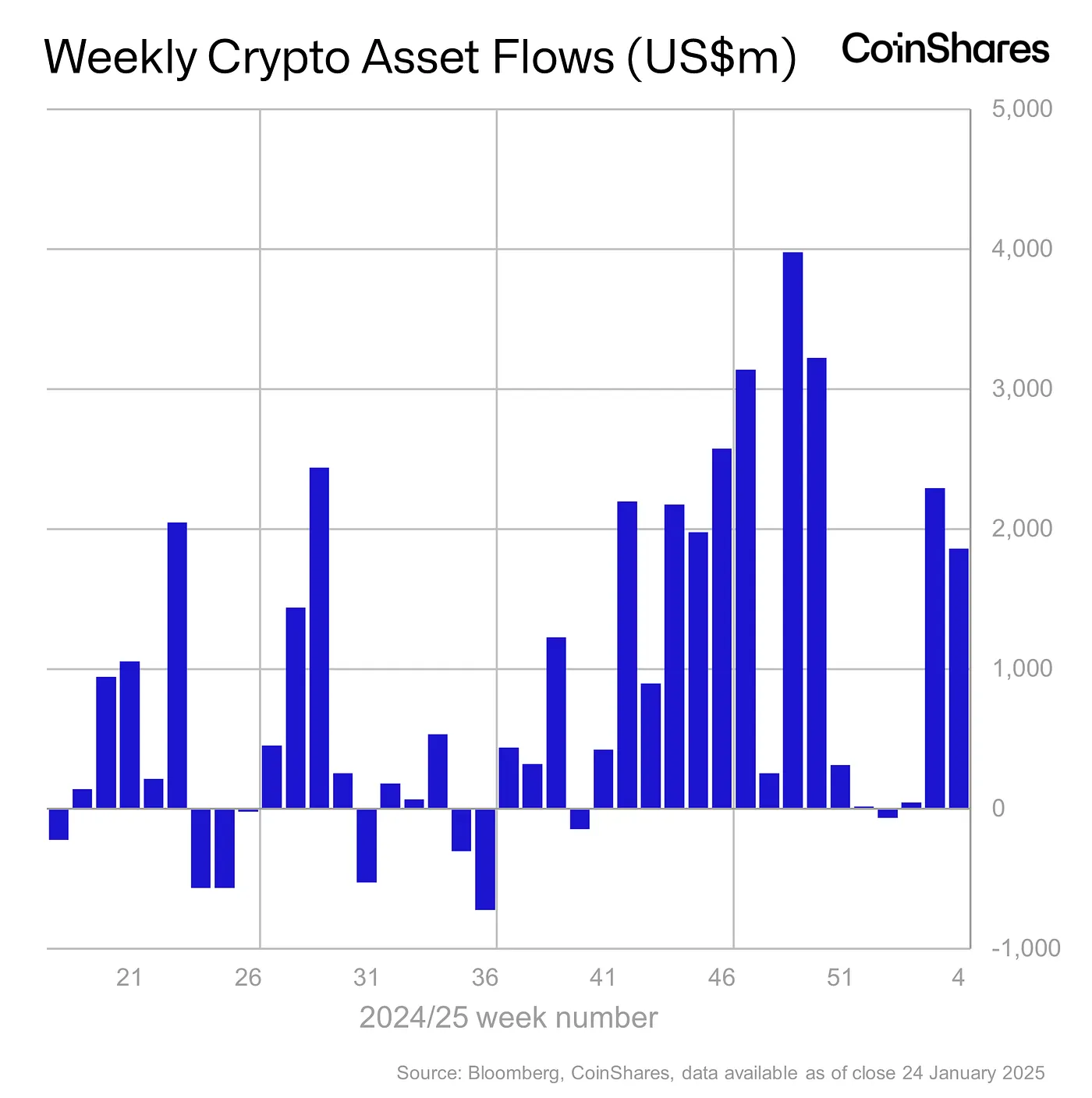
In a definitive signal of shifting market sentiment, institutional investors have flooded the digital asset space with nearly $2 billion in capital over the past week. According to the latest "Digital Asset Fund Flows" report released by leading crypto asset manager CoinShares, this massive wave of investment is largely being attributed to the cooling of regulatory uncertainty in the United States and the prospect of strategic shifts in national economic policy under the Trump administration.
Main Facts: A Billion-Dollar Influx
The crypto market has witnessed a significant liquidity event. CoinShares reports that institutional investment vehicles—which provide regulated exposure to digital assets for large-scale players—saw total inflows of $1.9 billion last week alone. This staggering figure brings the year-to-date (YTD) inflows to a remarkable $4.8 billion.
The primary catalyst for this surge appears to be a direct reaction to recent presidential executive orders. These directives have signaled a potential pivot toward integrating digital assets into the national financial framework, most notably through discussions surrounding the creation of a strategic Bitcoin reserve.
Despite a period of relatively stagnant price action, trading volumes remained robust, reaching $25 billion for the week. Perhaps most telling of the institutional commitment is that this activity accounted for 37% of all trading volumes on trusted, regulated crypto exchanges, underscoring that the current momentum is driven by serious capital rather than retail speculation.
Chronology of Recent Developments
The path to this record-breaking week began with a series of high-level administrative signals that moved the needle for institutional allocators.
- Early Pre-Inauguration Rally: Leading up to the latest policy announcements, Bitcoin reached new all-time highs, signaling a market anticipation of a pro-crypto shift in Washington.
- Executive Order Announcement: The issuance of formal executive orders focused on the digital asset industry served as the "green light" for sidelined institutional capital. By explicitly mentioning the potential for a strategic Bitcoin reserve, the administration effectively transformed Bitcoin from a fringe hedge asset into a potential pillar of national financial policy.
- Weekly Flow Spike: Following these announcements, the mid-week period saw a sharp uptick in capital allocation to institutional products, primarily through ETFs and regulated investment trusts.
- Consolidation of Gains: By the close of the week, the data confirmed that the trend was not merely a momentary fluke but a broad-based institutional reallocation of assets into the crypto sector.
Supporting Data: Regional and Asset-Specific Breakdown
The data provided by CoinShares offers a granular view of where this money is coming from and where it is being directed.
Regional Dominance
The United States is unequivocally leading the global charge. Of the $1.9 billion in total inflows, $1.7 billion originated from the US market. This dominance suggests that the domestic regulatory environment is currently viewed as the most favorable in the world for institutional crypto participants. Other jurisdictions saw moderate, though significant, activity:
- Switzerland: $35 million
- Canada: $31 million
- Germany: $23 million
Asset Allocation
Bitcoin continues to command the vast majority of institutional interest.
- Bitcoin (BTC): With $1.6 billion in inflows, Bitcoin accounted for approximately 92% of all institutional activity. This highlights that for institutional allocators, Bitcoin remains the "digital gold" standard, serving as the primary vehicle for entering the asset class. Interestingly, the report also noted that short-Bitcoin ETFs saw inflows of $5.1 million, suggesting that while the long-term outlook is bullish, some institutional traders are hedging against volatility in the wake of the asset’s recent record-breaking price run.
- Ethereum (ETH): Ethereum saw a significant revival, capturing $205 million in inflows. This is a crucial data point, as it suggests that institutional interest is beginning to broaden beyond Bitcoin into the smart-contract layer, despite previous concerns regarding regulatory clarity for altcoins.
- Altcoin Sentiment: With the exception of Cardano (ADA), which saw minor outflows, the rest of the altcoin market remained resilient, indicating that institutional capital is not currently looking to "rotate out" of the ecosystem, but rather is accumulating across the board.
Official Responses and Industry Sentiment
While the administration’s specific intentions regarding a "strategic reserve" remain in the early planning stages, the impact on market psychology has been profound. Industry analysts suggest that the mere mention of a government-backed Bitcoin reserve has fundamentally changed the risk-reward calculation for institutional pension funds and asset managers.
"The executive orders have provided a narrative shift," noted a lead analyst at CoinShares. "When a government elevates a digital asset to the level of a strategic reserve, it legitimizes the asset class in the eyes of institutional compliance and risk management departments. We are seeing the result of that validation in these flow numbers."

Market commentators argue that the high trading volumes—comprising over a third of all trusted exchange activity—indicate that institutional desks are not just buying and holding, but actively trading to balance their portfolios in anticipation of further regulatory clarity.
Implications for the Global Financial Landscape
The current inflow surge carries several far-reaching implications for the future of finance:
1. The Institutionalization of Bitcoin
For years, Bitcoin was characterized by its volatility and its reliance on retail "HODLers." The transition toward institutional ownership is expected to change the market’s behavior. Large-scale institutional holdings typically lead to lower relative volatility over the long term, as these entities tend to have longer time horizons and more stringent risk-management protocols compared to individual day traders.
2. A Shift in Global Regulatory Competition
The massive inflow into the US market relative to Europe and Canada indicates that the United States is successfully reclaiming its position as the global hub for digital asset innovation. If this trend continues, other jurisdictions may feel compelled to accelerate their own legislative efforts to remain competitive in the race for digital capital.
3. The "Strategic Reserve" Narrative
If the United States successfully moves forward with any form of strategic Bitcoin reserve, it will mark the most significant integration of decentralized technology into sovereign finance in history. This would likely force central banks globally to reassess their stance on digital assets, potentially sparking a "digital gold rush" among nations looking to diversify their treasury holdings.
4. Market Maturity
The fact that Ethereum and other assets are seeing sustained inflows suggests that institutional investors are moving beyond the "Bitcoin-only" phase of the crypto cycle. As institutional portfolios become more diversified, the infrastructure supporting these assets—custody, clearing, and settlement—will likely see a surge in development, further maturing the asset class.
Conclusion: A New Era of Capital Allocation
The data provided by CoinShares paints a picture of a market in the midst of a fundamental transformation. We are no longer observing a niche asset class driven by grassroots adoption; we are witnessing the integration of digital assets into the bedrock of the global institutional investment apparatus.
While the volatility inherent in the crypto market remains a reality, the record-shattering inflows of $1.9 billion in a single week signal that the "smart money" is betting on the long-term survival and prosperity of digital assets. As the industry watches for further details on the proposed US strategic reserve, one thing remains clear: the barrier between traditional institutional finance and the crypto ecosystem has never been thinner. Investors, regulators, and market participants are now bracing for the next phase of this evolution, where digital assets move from the periphery to the very center of the global financial conversation.
Disclaimer: The information provided in this article is for educational and informational purposes only and does not constitute financial, investment, or legal advice. Digital assets are high-risk investments, and past performance is not indicative of future results. Investors should conduct their own thorough research and consult with a professional financial advisor before making any investment decisions. The Daily Hodl does not endorse any specific financial products or services mentioned in this report.