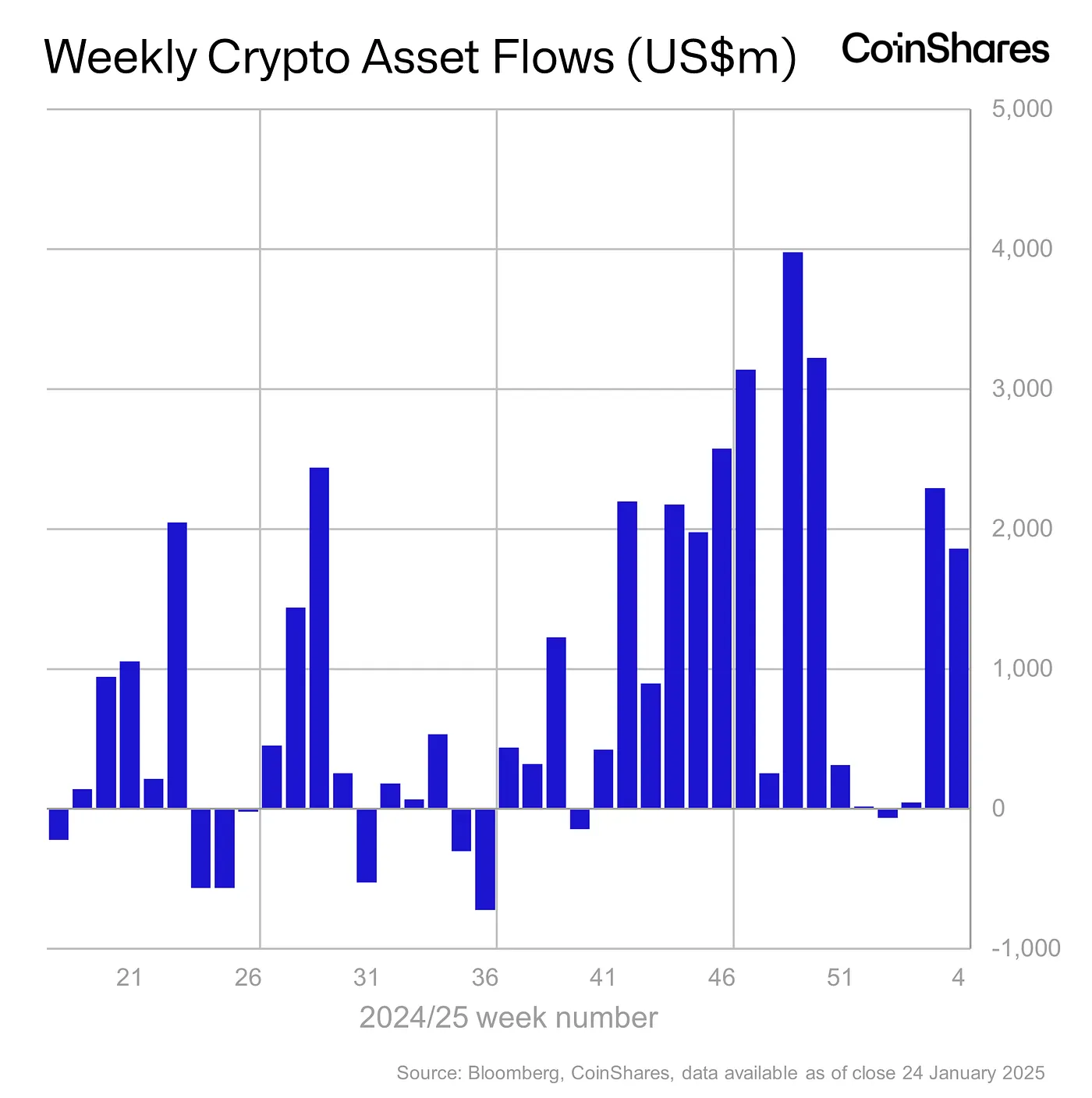
Institutional Appetite Surges: Crypto Investment Products Near Record-Breaking Yearly Inflows
The landscape of institutional digital asset investment is witnessing a seismic shift. According to the latest Digital Asset Fund Flows Weekly Report published by CoinShares, the leading European digital asset management firm, institutional investors are pouring capital into crypto-backed exchange-traded products (ETPs) at a rate not seen since the early months of 2024. This wave of institutional interest signals a renewed confidence in the sector, driven by complex macroeconomic variables and a fundamental pivot in how sovereign entities perceive Bitcoin.
Main Facts: A Billion-Dollar Week
The digital asset market has experienced a fourth consecutive week of robust capital inflows. Global investment products saw a staggering $882 million in new capital allocated during the most recent reporting period. This performance has brought the total year-to-date (YTD) inflows to $6.7 billion, placing the market in striking distance of the annual peak of $7.3 billion recorded in early February.
The United States continues to serve as the primary engine of this growth. Accounting for $840 million of the weekly total, American investors have solidified the U.S. market’s position as the global hub for regulated crypto-investment vehicles. While secondary markets like Germany ($44.5 million) and Australia ($10.2 million) contributed positively, outflows from Canada ($8 million) and Hong Kong ($4.3 million) provided a slight offset to the otherwise bullish global momentum.
Chronology: The Road to Current Inflows
The trajectory of 2024 has been defined by distinct phases of institutional sentiment. The year began with high anticipation surrounding the approval of spot Bitcoin ETFs in the United States. Following the January launch, the market witnessed an initial surge of activity that peaked in early February, pushing net inflows to an all-time high of $61.6 billion.
However, the subsequent months saw a period of volatility and market correction, causing inflows to flatten as investors navigated high interest rates and regulatory uncertainty. By mid-year, the narrative shifted toward the resilience of these products during market dips.
The most recent four-week streak represents the latest chapter in this chronology. This period is characterized not merely by price appreciation but by a fundamental change in the "macro-narrative" surrounding crypto. Investors have moved beyond the "hype" phase, transitioning into a phase of strategic asset allocation, viewing Bitcoin as a necessary hedge against systemic financial risks.
Supporting Data: Bitcoin’s Hegemony and Emerging Altcoins
Bitcoin remains the undisputed anchor of institutional digital asset portfolios. Last week alone, Bitcoin-focused investment products attracted $867 million globally. A significant milestone was achieved during this period: cumulative net inflows for U.S.-listed spot Bitcoin ETFs officially reached $62.9 billion since their inception in January. This figure effectively eclipses the previous high of $61.6 billion, signaling that the appetite for Bitcoin as a "digital gold" has returned with greater intensity.
While Bitcoin dominated the flows, interest in alternative assets—often referred to as "altcoins"—showed signs of life. SUI-based investment products recorded $11.7 million in inflows, demonstrating that investors are beginning to rotate capital into high-performance Layer-1 ecosystems. Conversely, Ethereum products saw a more modest intake of $1.5 million. This disparity highlights a current institutional preference for the security and historical performance of Bitcoin, alongside selective bets on newer, technologically robust blockchain networks.
Macroeconomic Drivers: Why Now?
CoinShares analysts identify three primary catalysts for this surge, moving away from purely speculative price action toward a more grounded macroeconomic rationale:
1. The Global M2 Money Supply Expansion
The global M2 money supply—a measure of the total amount of money in circulation—has begun to rise again. Historically, an expansion in the money supply correlates with the devaluation of fiat currencies. Institutional investors are increasingly utilizing digital assets as a store-of-value mechanism to protect against the inflationary pressures inherent in the expansion of the money supply.
2. Stagflationary Risks in the United States
Stagflation—a combination of stagnant economic growth and high inflation—presents a unique challenge to traditional portfolios. Bonds and equities often struggle in such an environment. Bitcoin, which operates independently of traditional central banking policies, is increasingly being viewed by portfolio managers as a "non-correlated" asset that can provide defensive utility during periods of stagflation.
3. Bitcoin as a Strategic Reserve Asset
Perhaps the most transformative factor is the shift in geopolitical perception. Several U.S. states have initiated legislative discussions or passed resolutions exploring the inclusion of Bitcoin as a strategic reserve asset. This institutionalization at the state and municipal levels provides a level of legitimacy that was previously absent, effectively de-risking the asset class for risk-averse institutional capital.
Implications: The Future of Digital Asset Management
The rapid growth in fund flows carries significant implications for the broader financial system and the crypto industry at large.
Implications for Market Volatility
As more capital flows through regulated ETPs, the crypto market is likely to see a decrease in retail-driven "panic" volatility and an increase in institutional-driven liquidity. Large, institutional holders (often referred to as "whales") tend to employ long-term investment horizons. This could stabilize the market in the long run, though it may also lead to price movements that are more tightly coupled with global macroeconomic data releases, such as the U.S. Consumer Price Index (CPI) or Federal Reserve interest rate announcements.
The Role of Financial Intermediaries
The success of these investment products necessitates a more sophisticated infrastructure from financial intermediaries. Banks, brokerages, and pension funds are being forced to upgrade their custodial capabilities to manage digital assets effectively. This evolution is likely to lead to a more integrated financial ecosystem where the barrier between traditional finance (TradFi) and decentralized finance (DeFi) continues to dissolve.
Regulatory Pressure and Compliance
With billions of dollars flowing into these products, the regulatory spotlight will intensify. The SEC and other global regulators are likely to monitor these fund flows closely to ensure that the underlying assets are properly custodied and that investors are protected. This creates a feedback loop: increased investment leads to higher regulatory scrutiny, which in turn leads to a more robust and secure market environment, attracting further institutional capital.
Conclusion: A New Era of Institutional Adoption
The latest data from CoinShares confirms that we are no longer in the early "experimental" stage of digital asset adoption. The current $6.7 billion in year-to-date inflows represents a calculated, strategic response to a changing economic environment.
As Bitcoin breaks cumulative net inflow records and investors begin to diversify into emerging blockchain ecosystems, the narrative of crypto as a "fringe" asset is rapidly becoming obsolete. Instead, it is being cemented as a foundational component of modern diversified portfolios. Whether this momentum can be sustained depends on the continuation of the current macroeconomic trends, but the evidence suggests that institutional appetite for digital assets is currently at a historic, unprecedented high.
Disclaimer: The information provided in this article is for educational and informational purposes only and does not constitute financial, investment, or legal advice. Digital assets are highly volatile and carry a significant risk of loss. Always conduct your own research and consult with a qualified financial advisor before making any investment decisions.