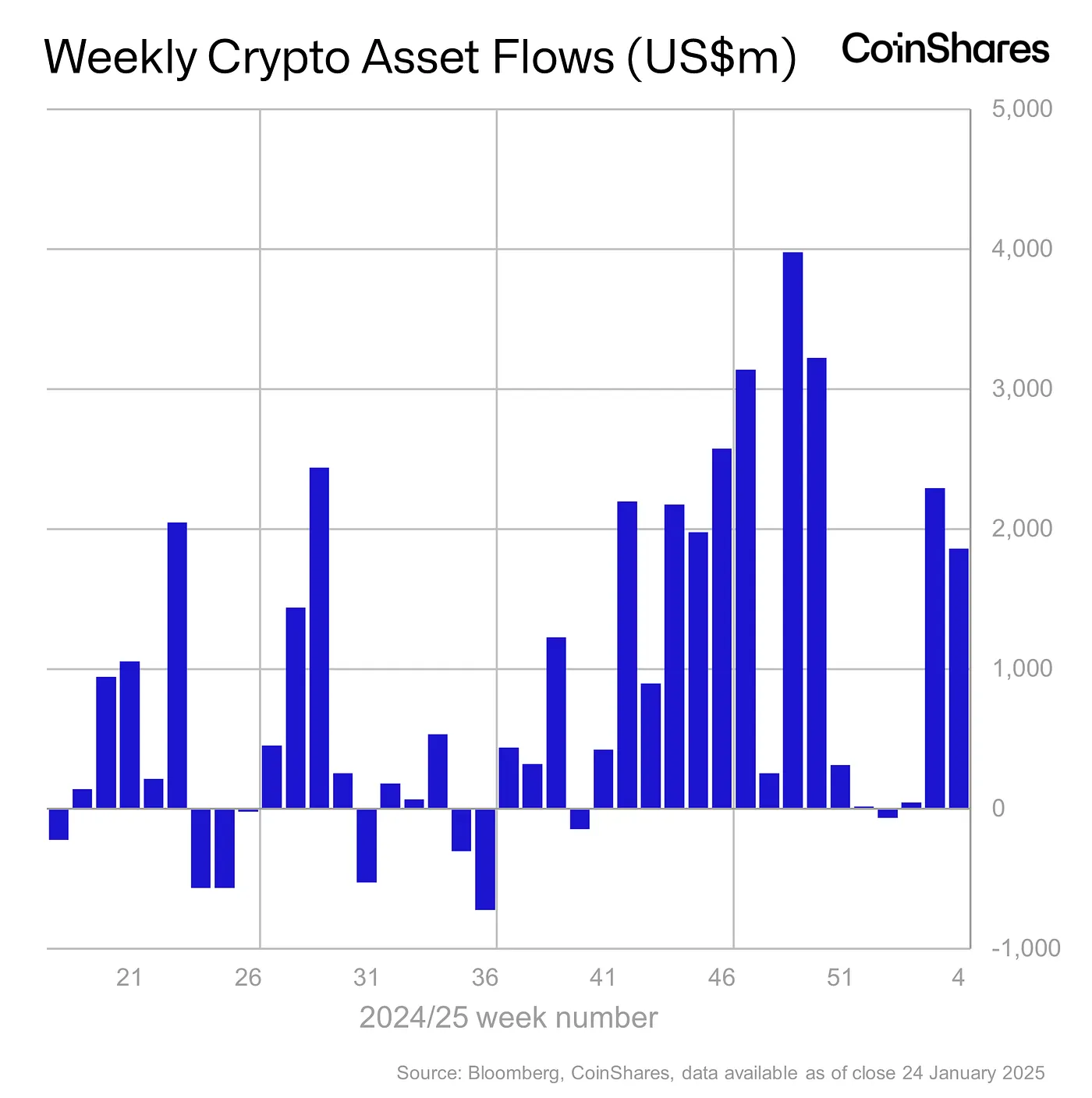
Institutional Capital Returns: Crypto Investment Products Kick Off 2026 with $582 Million Surge
As the financial world pivots toward the new fiscal cycle of 2026, institutional sentiment toward digital assets has signaled a robust recovery. According to the latest data from CoinShares, institutional investors have returned to the crypto markets with significant conviction, injecting $582 million in net inflows into digital asset investment products over the first week of the new year.
This development follows a period of volatile trading and serves as a bellwether for how large-scale capital allocators are positioning their portfolios amidst evolving macroeconomic conditions. While the week began with minor outflows, a massive surge on the final Friday of the period—totaling $671 million—effectively erased early losses and set a bullish tone for the months ahead.
The Core Data: A Strong Start to 2026
The initial data for 2026 suggests that the institutional appetite for digital assets remains resilient. After a cooling period in the final days of the previous year, the market witnessed a rapid pivot back into high-conviction assets.
Weekly Performance Breakdown
- Bitcoin (BTC): Led the charge with $512 million in fresh inflows, solidifying its status as the primary gateway for institutional entry into the crypto ecosystem.
- Ethereum (ETH): Followed with a notable $119 million in inflows, demonstrating renewed interest in the world’s leading smart contract platform.
- XRP: Attracted $10.7 million, continuing its trend of institutional adoption despite broader market fluctuations.
- Solana (SOL): Experienced a temporary setback with $30 million in outflows, highlighting a divergence in investor sentiment regarding layer-1 scaling solutions.
The rapid recovery from early-week outflows to a net positive of $582 million underscores a "buy-the-dip" mentality among institutional desks, who appear eager to deploy capital at the start of the new financial calendar.
Chronology of Institutional Flows (2025–2026)
To understand the current momentum, it is essential to contextualize the year that just concluded. 2025 was a year of near-record activity for the crypto sector, characterized by a massive influx of capital that rivaled the all-time highs of 2024.
The 2025 Landscape
Global digital asset products concluded 2025 with an aggregate inflow of $47.2 billion, coming within striking distance of the $48.7 billion record established in 2024.
- Q1–Q3 2025: The United States dominated the landscape, contributing $44.5 billion to the total. While this represented a 12% year-over-year decline for the region, it remained the epicenter of global crypto investment.
- The Global Turnaround: While the U.S. remained the primary market, international regions showed significant growth. Germany, in particular, underwent a dramatic reversal, moving from outflows in 2024 to an impressive $2.5 billion in inflows throughout 2025. Similarly, Canada added $1.1 billion to its institutional crypto holdings, while Switzerland recorded $775 million.
- Asset-Specific Growth: 2025 saw a massive divergence in performance. Ethereum led the charge in growth, posting $12.7 billion in inflows—a 138% increase over the previous year. XRP and Solana saw astronomical growth in interest, with inflows of $3.7 billion and $3.6 billion, respectively, representing percentage increases of 500% and 1,000% compared to their 2024 performance.
Supporting Data: The Shift in Market Sentiment
The data provided by CoinShares serves as more than just a ledger of inflows; it acts as a thermometer for institutional confidence. The trend toward Bitcoin, Ethereum, and XRP suggests that institutional portfolios are increasingly focusing on assets with clear regulatory clarity or established utility.
Bitcoin’s Dominance vs. Altcoin Volatility
While Bitcoin remains the bedrock of institutional portfolios, with $26.9 billion in total inflows for 2025, it is not the only asset class seeing action. Short-Bitcoin products—used by institutions to hedge against volatility or bet on market downturns—attracted $105 million. While this is a small fraction of the total market, it indicates that sophisticated investors are increasingly using these tools to manage risk in a highly unpredictable environment.
Conversely, the broader "altcoin" segment saw sentiment soften, with total inflows falling by 30% year-over-year. This suggests that while institutions are doubling down on "Blue Chip" crypto assets, they are becoming increasingly selective regarding smaller-cap digital assets, preferring the liquidity and stability of the top-tier tokens.
Official Perspectives and Market Implications
Industry analysts are viewing these inflows as a direct response to both macroeconomic stability and the maturation of crypto-financial products.
Implications for Market Liquidity
The influx of nearly $600 million in a single week creates significant buy-side pressure on crypto exchanges. As institutional products (such as ETPs and ETFs) receive new capital, the underlying assets must be purchased and held in custody. This "institutional demand squeeze" often serves to support price floors during periods of retail volatility.
The Regulatory Factor
The geographic distribution of these inflows—specifically the resurgence in Germany and the consistent interest in the U.S.—speaks to the importance of regulatory clarity. As jurisdictions provide clearer frameworks for custodial services and tax treatment of digital assets, capital flows have become more predictable. The decline in U.S. inflows compared to 2024 is often attributed by analysts to lingering uncertainty regarding the long-term regulatory approach of domestic agencies, though the volume remains high enough to dictate market trends globally.
Future Outlook: What to Watch in 2026
As we move deeper into the first quarter of 2026, several key variables will likely determine whether the current momentum is sustainable:
- Macroeconomic Policy: Changes in interest rates and inflationary pressures will remain the primary driver for "risk-on" assets. If global central banks signal a pivot toward looser monetary policy, institutional crypto inflows could accelerate further.
- Asset Rotation: The current discrepancy between Ethereum’s popularity and Solana’s recent outflows suggests a potential rotation in capital. Institutional investors often rotate between layer-1 protocols based on development milestones and network upgrades.
- The Rise of Derivatives: With the success of short-Bitcoin products, we can expect to see an expansion in the suite of derivative products offered to institutional clients, potentially including options and structured products for Ethereum and XRP.
Investor Caution
Despite the bullish data, it is vital to remember the inherent risks of the cryptocurrency market. The Daily Hodl and other industry observers maintain a strict stance: these inflows represent institutional sentiment, not a guarantee of price appreciation. Digital assets remain highly volatile, and high-risk investments should only be made after thorough due diligence. Institutional players have the luxury of multi-year time horizons and risk-mitigation desks; individual investors must exercise the same level of discipline.
Conclusion
The first week of 2026 has provided a clear signal: the institutional "whale" is back in the water. With $582 million in net inflows to kick off the year, the appetite for crypto exposure remains fundamentally strong. While the market continues to grapple with regulatory shifts and macroeconomic headwinds, the consistent movement of capital into Bitcoin, Ethereum, and XRP suggests that digital assets have firmly cemented their place in the modern institutional portfolio.
As the year progresses, the industry will watch closely to see if the U.S. regains its lead in capital accumulation and whether the altcoin segment can recover from its recent cooling period. For now, the narrative is one of cautious optimism, anchored by the reality of billions of dollars moving from traditional finance into the blockchain-based economy.
Disclaimer: The information provided in this report is for educational purposes only and does not constitute financial advice. Investors are strongly encouraged to conduct their own due diligence before investing in cryptocurrencies. The Daily Hodl is not an investment advisor and is not responsible for any losses incurred through trading activities.