Shiba Inu Bloodbath: Long Traders Wiped Out as Long-Dormant Whale Dumps Nearly 400 Billion SHIB Amid Market-Wide Slump
By Crypto Market Desk
Published: June 2026
Main Facts
The decentralized finance (DeFi) and cryptocurrency sectors are no strangers to extreme volatility, but the latest developments surrounding Shiba Inu (SHIB) have delivered a severe psychological blow to bullish market participants. Over the span of a single 24-hour trading window, the meme-coin-turned-ecosystem token witnessed a severe liquidity flush, resulting in the vaporization of more than $382,000 in futures positions.
The vast majority of the damage was absorbed by optimistic speculators betting on an upward price trajectory. According to derivatives tracking data, long traders bore 95.7% of the financial impact, with a staggering $365,660 in bullish bets liquidated. Conversely, short sellers accounted for a negligible $17,320 in losses, highlighting the absolute dominance of downward momentum.
Compounding this derivatives bloodbath was an on-chain event that instantly caught the attention of traders, quantitative analysts, and automated blockchain trackers alike: the abrupt resurrection of a multi-billion-token SHIB whale wallet that had remained completely dormant for nearly ten months. On-chain intelligence platforms flagged the movement of nearly 400 billion SHIB tokens out of a single address, a massive supply shift that coincided dangerously with a macro-level sell-off across the broader digital asset market.
The combination of forced liquidations, macro bearish pressure, and whale-sized wallet movements dragged SHIB down past critical psychological barriers, forcing the token to surrender the $0.000005 support level. As trading volumes spiked and panic sentiment settled over retail communities, the asset slid toward the lower boundary of the global top 30 cryptocurrencies by market capitalization, landing firmly at 29th place with a valuation hovering around $2.65 billion.
Chronology
To fully understand how Shiba Inu arrived at this precarious juncture, it is essential to trace the timeline of events that unfolded over the critical multi-day period leading to the latest market crash.
Phase 1: The Ten-Month Sleep
For approximately ten months, the wallet address 0x280a762bDDe5C4F62a49cE11F108A34A7a706f69 remained an undisturbed monument to early-cycle accumulation. Sitting quietly on the blockchain, the address held a massive cache of SHIB tokens acquired during previous market phases. While retail traders bought, sold, and traded through various micro-cycles, this whale remained entirely inactive, ignoring local peaks, ecosystem updates, and market corrections.
Phase 2: The Test Run
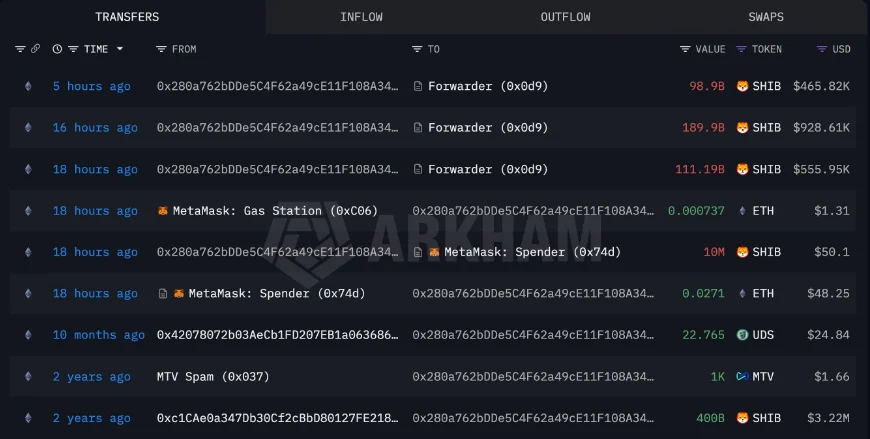
The first sign of life from the dormant account came via a quiet, calculated transaction. On-chain data retrieved via Arkham Intelligence indicates that the wallet initiator initiated a test run—a minor transfer of precisely 10 million SHIB routed through a MetaMask token swap. In the world of high-net-worth crypto management, these micro-transactions are standard operating procedure. They serve as a verification test to ensure that destination contracts, gas fees, and wallet permissions are functioning correctly before moving capital of a consequential magnitude.
Phase 3: The BitGo Outflow Cascade
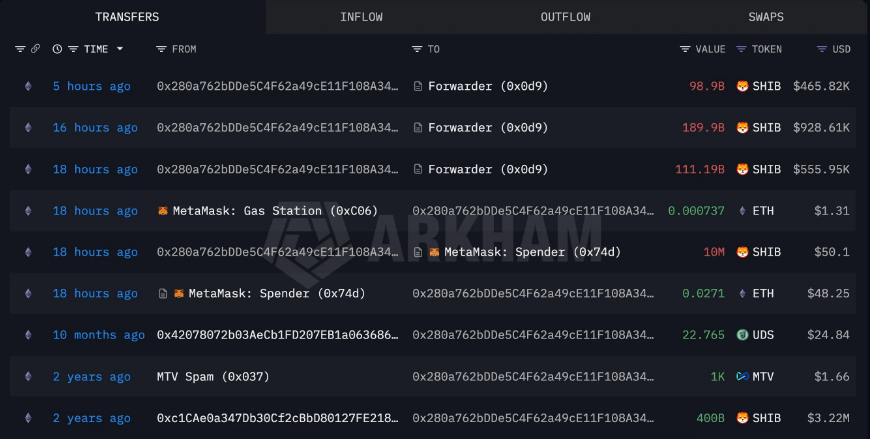
Following the successful test run, the whale wasted zero time executing a massive capital flight. The holder funneled nearly 400 billion tokens through BitGo’s Forwarder Smart Contract in three rapid-fire, successive tranches:
- The First Tranche: Nearly 112 billion SHIB moved out of the address.
- The Second Tranche: Almost 190 billion SHIB followed shortly after.
- The Final Tranche: A concluding batch of 99 billion SHIB drained the remaining major balance.
When the dust settled, the address that once commanded immense purchasing power was left holding a ghost balance of precisely 110 SHIB tokens. In total, 399,989,999,938 SHIB had been relocated out of the wallet within a matter of hours.
Phase 4: The Derivatives Cascade and Price Breakdown
As the on-chain transfers registered on public block explorers, sentiment across social media platforms shifted rapidly. Automated alert bots broadcasted the massive whale movement, triggering psychological anxiety among leveraged traders.
Simultaneously, the spot price of SHIB broke down through the crucial $0.000005 threshold. This technical breakdown acted as a tripwire for automated margin calls on centralized and decentralized derivatives exchanges. Long positions opened with high leverage were systematically unwound by risk engines, culminating in the $382,000 liquidation cascade within a single 24-hour cycle.
Supporting Data
A quantitative examination of the Arkham Intelligence logs, TradingView charts, and derivatives exchanges paints a stark picture of the market conditions surrounding Shiba Inu.
- Total Futures Liquidations: $382,000+ in a single day.
- Long Position Liquidations: $365,660 (representing ~95.7% of total wiped capital).
- Short Position Liquidations: $17,320 (representing ~4.3% of total wiped capital).
- Total SHIB Moved by Whale: 399,989,999,938 tokens.
- Weekly Price Performance: A steep 16% decline over seven days.
- 24-Hour Price Action: An additional 3.50% drop, bringing the token price down to $0.000004535.
- Market Capitalization: Contracted to approximately $2.65 billion.
- Global Market Rank: Pllipped to 29th position among all tracked cryptocurrencies.
[SHIB Liquidation Breakdown]
████████████████████████████████████████████████ Longs ($365,660 - 95.7%)
█ Shorts ($17,320 - 4.3%)
Institutional Infrastructure and Market Interpretation
The movement of nearly 400 billion SHIB tokens through BitGo’s Forwarder Smart Contract has sparked intense debate among on-chain analysts regarding the ultimate destination and intent of the assets.
Understanding BitGo’s Role
BitGo is an industry-standard institutional custodian, widely utilized by institutional investors, high-net-worth family offices, and crypto funds for enterprise-grade digital asset custody, Over-the-Counter (OTC) trade settlement, and secure cold storage provisioning.
Crucially, transfers directed into institutional custody infrastructure or OTC settlement channels do not automatically register as immediate retail sell orders on order-book exchanges like Binance, Coinbase, or Kraken. Unlike a direct deposit to an exchange hot wallet—which typically signals an imminent intention to liquidate holdings for stablecoins or fiat currency—moving assets into a custody infrastructure provider like BitGo suggests several alternative possibilities:
- Over-the-Counter (OTC) Sales: The whale may have negotiated a private, off-market block sale with an institutional buyer or market maker, thereby avoiding the severe slippage that dumping 400 billion tokens directly onto public spot order books would cause.
- Cold Storage Migration: The entity controlling the keys may be reorganizing their asset architecture, moving holdings from a vulnerable hot or warm operational wallet into multi-signature institutional cold storage for long-term security preservation.
- Collateralization for Structured Financial Products: Institutional entities frequently move tokens into custody networks to utilize them as collateral for borrowing liquidity, participating in yield-generating enterprise programs, or structuring bespoke financial derivatives.
Despite these nuances, the market reaction was swift and unforgiving. Even if the transfer did not immediately equal a public dump, the sheer psychological weight of a dormant multi-million-dollar whale waking up during a broader market correction was more than enough to unnerve retail market participants.
Implications
The convergence of massive whale activity, institutional infrastructure routing, and a violent derivatives flush carries profound implications for the immediate and medium-term outlook of the Shiba Inu ecosystem.
1. Heightened Fragility in Meme-Coin Derivatives
The lopsided liquidation data—where long traders experienced 95% of the losses—demonstrates a dangerous disconnect between retail sentiment and prevailing market mechanics. Speculators continue to treat meme assets as high-beta plays primed for sudden bounces, often over-leveraging their positions without accounting for macro-driven downside risks. This incident serves as a brutal reminder that structural support levels can vanish rapidly when coupled with large-scale supply shifts.
2. Supply Concentration and Whale Vulnerability
Despite extensive efforts by the Shiba Inu core development team and community burn initiatives to reduce circulating supply over the years, the token remains heavily influenced by legacy whale accounts. The presence of single addresses holding tens or hundreds of billions of tokens creates an ongoing sword of Damocles over retail investors. Whenever a dormant whale stirs, the market enters a state of high alert, knowing that a single entity possesses the balance-sheet weight to alter local market dynamics entirely.
3. Testing the Limits of Community Resilience
As SHIB flirts with the absolute boundaries of the top 30 crypto assets by market capitalization—settling at position 29 with a $2.65 billion valuation—the community faces a crucial test of resilience. While long-term proponents often point to ecosystem expansions such as Shibarium (the Layer-2 scaling network) as fundamental long-term value drivers, short-term price discovery remains tethered to liquidity flows, macro risk appetite, and sentiment contagion.
Conclusion
The awakening of the 400-billion-token SHIB whale, paired with the subsequent wipeout of long derivatives traders, underscores the unforgiving nature of digital asset markets. Whether the transferred tokens ultimately find their way onto open order books or remain locked within institutional vaults, the event has permanently altered the technical landscape for SHIB, leaving bulls fighting an uphill battle to reclaim lost ground and restore market confidence.