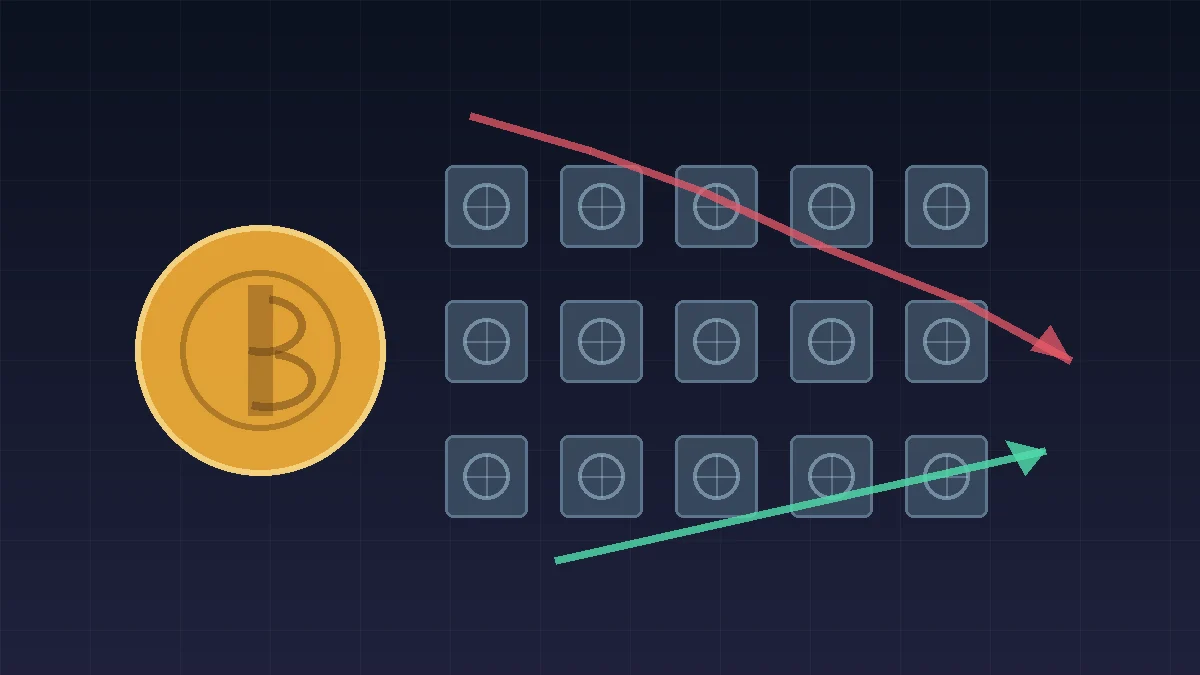
The Battle for the Blockchain: BIP-110 and the Renewed War Over Bitcoin’s Block Space
By the News Desk | Edited by Samuel Rae
Source: Bitcoin BIPs GitHub Repository
Main Facts
A fresh technical discussion is sweeping through the Bitcoin developer ecosystem, breathing new life into one of the most polarizing debates in the history of cryptocurrency: What is Bitcoin’s block space actually for?
At the center of this renewed controversy is BIP-110, a newly surfaced Bitcoin Improvement Proposal currently circulating among core developers and network participants. If advanced and ultimately adopted—a notoriously steep hurdle in Bitcoin’s conservative upgrade cycle—BIP-110 would seek to structurally restrict allowable transaction types on the network primarily to peer-to-peer monetary transfers and direct payments.
The immediate implication of such a policy would be a severe curb on "inscription-heavy" network activity, most notably the protocols that power Ordinals and Runes. These protocols have fundamentally transformed how data can be embedded into the Bitcoin blockchain, allowing users to attach digital artifacts, images, tokens, and arbitrary text directly to individual satoshis.
While BIP-110 remains strictly a conceptual proposal rather than a scheduled network upgrade or hard fork, it has reignited a philosophical civil war within the digital asset community. On one side are the "payment purists," who argue that non-monetary data bloats the ledger, drives up transaction fees, and drifts dangerously away from Satoshi Nakamoto’s original vision of a peer-to-peer electronic cash system. On the other side stand proponents of an open, permissionless network, who fiercely maintain that Bitcoin is a neutral, censorship-resistant settlement layer where any valid transaction—so long as it pays its way—has an absolute right to exist.
Chronology of a Division: How Bitcoin Got Here
To understand why BIP-110 carries such heavy weight, it is necessary to retrace how Bitcoin’s relationship with data inscription evolved from a niche technical workaround into a dominant economic force on the network.
1. The Pre-Ordinals Era: Keeping the Chain Lean
For the first decade of its existence, Bitcoin was viewed by the vast majority of its user base as a monetary network. While the underlying protocol (thanks to upgrades like Segregated Witness in 2017 and Taproot in 2021) technically allowed for arbitrary data to be pushed into witness data fields, this capability was used sparingly. Developers built secondary layers like the Lightning Network or sidechains like Liquid to handle complex logic, keeping the base layer focused entirely on financial settlement.
2. Early 2023: The Ordinals Explosion
The landscape shifted dramatically in early 2023 with the launch of the Ordinals protocol, developed by Casey Rodarmor. By leveraging the Taproot upgrade, Ordinals made it frictionless to inscribe arbitrary files—such as images, text, and videos—onto individual satoshis (the smallest unit of Bitcoin). Almost overnight, a vibrant digital art and collectibles ecosystem emerged natively on Bitcoin, shocking traditionalists and thrilling speculators.
3. Late 2023 to 2024: The Rise of Runes and Network Saturation
Following Ordinals came Runes, another protocol designed to allow fungible tokens to be issued efficiently on Bitcoin. As these inscription-based trends caught fire, they consumed unprecedented amounts of block space. Mempools congested, transaction fees spiked to multi-year highs, and regular users sending simple peer-to-peer payments found themselves priced out of timely confirmations unless they paid exorbitant fee rates.
4. Present Day: The Introduction of BIP-110
With inscription-related traffic routinely accounting for a massive share of daily transactions, developers began seeking structural solutions to what they perceive as network degradation. BIP-110 emerged out of these developer discussions on GitHub, formalizing the philosophical divide into a concrete technical proposition and thrusting the community back into an existential debate over Bitcoin’s identity.
Supporting Data: Block Space Economics and Network Traffic
To grasp the severity of the BIP-110 debate, one must examine the hard metrics driving the conflict between traditionalists and inscription proponents.
1. Traffic Dominance
According to historical mempool analytics and blockchain data aggregators, inscription-related transactions (Ordinals, Runes, and BRC-20 tokens) have frequently accounted for more than two-thirds (60% to 70%+) of total daily transactions on the Bitcoin network during peak market hype cycles. Even during periods of relative market cooling, these non-monetary data inclusions represent a persistent and substantial baseline of network demand.
2. The Economics of Block Space Scarcity
Bitcoin blocks are artificially constrained to a maximum weight limit (roughly 4MB post-SegWit/Taproot), creating a hyper-competitive fee market. Every byte of block space occupied by an image, text file, or token minting operation is a byte unavailable for a traditional monetary transfer.
Proponents of inscription activity point out a critical long-term economic reality: the Bitcoin block subsidy is halving every four years. As the subsidy approaches zero over the coming decades, network security will rely entirely on transaction fees to incentivize miners. Data from recent years shows that inscription booms temporarily skyrocketed miner revenues, providing a vital economic cushion at times when baseline financial transfer volume was flat.
Conversely, critics counter that artificially inflating fee markets via speculative data minting prices out everyday users in developing nations, undermining Bitcoin’s utility as a global currency for the unbanked.
Official Responses and Arguments from Both Sides
The discourse surrounding BIP-110 highlights a deep ideological schism within the global Bitcoin community. The arguments can be cleanly divided into two opposing camps.
The Payment Purist Argument
Advocates for restrictions like BIP-110 view Bitcoin through a strict, traditional lens:
- Preserving the Core Mission: Bitcoin was designed as "A Peer-to-Peer Electronic Cash System." Proponents argue that turning the base layer into a decentralized file storage or token-issuing platform dilutes its primary value proposition as pristine, censorship-resistant money.
- Mitigating Bloat and Centralization: Unchecked inscription data increases the physical size of the blockchain over time. Critics argue this makes running a full node more resource-intensive, potentially centralizing network validation in the hands of wealthy entities with massive storage capacities.
- Protecting Regular Users: When non-payment data floods the mempool, average users experience delayed settlement times and exorbitant fee spikes, driving them away from the network.
The Open Block-Space Argument
Opponents of BIP-110—largely comprising miners, developers of layer-2 protocols, and inscription enthusiasts—defend the network’s permissionless nature:
- Neutrality and Censorship Resistance: Bitcoin is, by design, amoral. It does not evaluate the meaning or intent of a transaction; it only verifies whether cryptographic rules and consensus parameters are met. If a transaction is valid and pays the required fee, supporters argue the network has no business censoring it.
- The Miner’s Bottom Line: Miners are rational economic actors who secure the network. If inscriptions generate higher fee revenue, miners will naturally prioritize them. Proponents argue that interfering with this free market distorts the economic security model that will sustain Bitcoin post-halving.
- Innovation Without Permission: The beauty of Bitcoin is that anyone can build on it without asking for permission from core developers. Imposing restrictions via BIP-110 sets a dangerous precedent of top-down censorship.
Implications: What BIP-110 Means for Bitcoin’s Future
While BIP-110 is currently just a proposal sitting in a GitHub repository, its broader implications ripple across the entire digital asset landscape.
1. The Slow, Conservative Nature of Bitcoin Governance
It is vital to reiterate that BIP-110 is not a scheduled hard fork, nor does it have consensus for deployment. Bitcoin’s development methodology is intentionally glacial and hyper-conservative. Implementing a change of this magnitude requires near-universal agreement among miners, node operators, developers, and economic nodes—a consensus threshold that has historically been nearly impossible to achieve for contentious changes. Thus, the immediate technical risk of the network breaking or splitting is virtually zero.
2. The Ongoing Identity Crisis
Even if BIP-110 never sees deployment, the mere fact that it is being actively debated proves that Bitcoin’s identity crisis is far from resolved. The community remains locked in a philosophical tug-of-war:
- Is Bitcoin strictly digital gold and a settlement layer for pure monetary value?
- Or is it a generalized, programmable data settlement ledger where any valid application can compete equally for block space?
3. Market Signals and Macro Context
For investors and market participants, tracking these developer debates is part of a broader analytical framework. Bitcoin’s health relies on a confluence of signals: spot market demand, exchange flows, derivatives positioning, and macroeconomic conditions. While technical proposals like BIP-110 generate significant media noise and community debate, seasoned market watchers know that the true trajectory of the network is forged where technical reality, economic incentives, and user adoption intersect.
As the debate over BIP-110 continues to unfold, it serves as a powerful reminder that Bitcoin is a living, evolving ecosystem—one where every byte of block space is fiercely contested, and the soul of the world’s premier cryptocurrency remains continuously up for debate.