Bitcoin Mining Crisis 2026: Public Miners Offload Record Holdings as 20% of the Industry Operates at a Loss
Main Facts
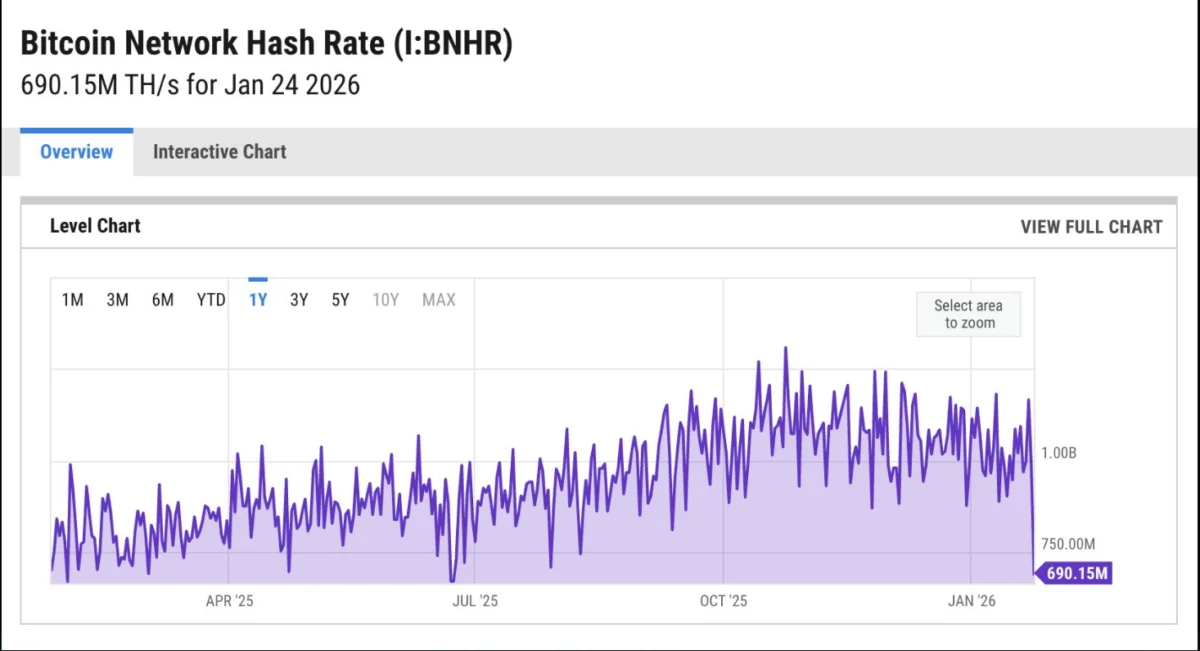
The global Bitcoin mining sector is undergoing its most severe financial strain in years. Driven by a toxic mix of plunging operational margins, rising network difficulty, and stagnant cryptocurrency prices, approximately 20% of the entire Bitcoin mining industry is currently operating at a net loss. This precarious financial footing has forced major institutional and publicly traded mining companies to aggressively liquidate their digital asset treasuries just to sustain daily operations and cover soaring overhead costs.
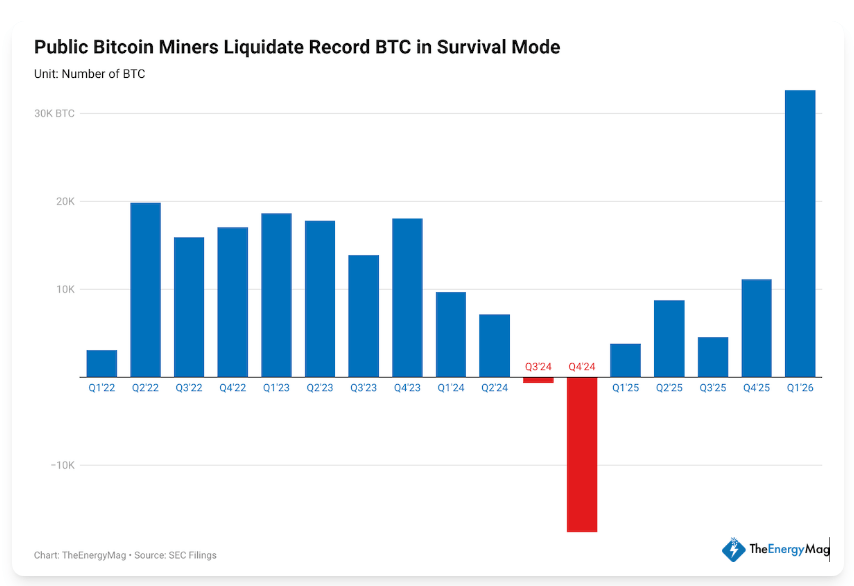
Data compiled by TheEnergyMag reveals that major publicly traded mining firms—including industry heavyweights MARA, CleanSpark, Riot, Cango, Core Scientific, and Bitdeer—collectively offloaded more than 32,000 BTC during the first three months of 2026. To put this massive sell-off into perspective, the volume liquidated in Q1 alone completely eclipses the total amount these same entities sold across all four quarters of 2025 combined. Furthermore, it shatters the previous quarterly liquidation record of roughly 20,000 BTC, which was established during the chaotic second quarter of 2022 in the wake of the catastrophic Terra-Luna ecosystem collapse.
While public miners scramble to liquidate their balance sheets to stay afloat, a stark divergence is occurring in the broader corporate ecosystem. Massive enterprise treasury buyers, led by institutional giants like Michael Saylor’s Strategy, are seizing the opportunity to accumulate discounted assets, absorbing the supply being dumped by distressed miners.
Chronology
The Descent: Mid-2025 to Early 2026
The structural roots of the current crisis stretch back to the middle of 2025. Since July of that year, hashprice—the foundational metric representing the daily expected revenue a miner earns per unit of computing power—has been on a relentless downward trajectory. As efficiency margins narrowed, the cushion protecting high-cost operations evaporated.

The Halving Aftermath and Mid-2025 Pressure
The market pressures were exacerbated by the delayed economic fallout of the previous Bitcoin halving event, which sliced block rewards in half. Combined with a continuously expanding network hashrate that intensified mining competition, revenues failed to keep pace with escalating hardware and energy demands.
Q1 2026: The Liquidation Wave
By the first quarter of 2026, the financial squeeze reached a boiling point. Facing imminent cash crunches, publicly traded mining corporations abandoned their long-held strategies of hoarding digital gold. Instead, they unleashed a historic wave of liquidations, dumping over 32,000 BTC onto the open market in rapid succession.
April 2026: Treasury Aggregation and Market Signals
By mid-April 2026, the market entered a phase of institutional polarization. While weak miners capitulated and downscaled, major corporate treasury buyers stepped into the market vacuum. MicroStrategy co-founder Michael Saylor signaled yet another massive corporate accumulation phase via social media, underscoring the deep division between distressed operational miners and cash-rich corporate buyers.
Supporting Data
The depth of the crisis is vividly illustrated by key metrics tracked across major blockchain analytics platforms:
- Hashprice Plunge: According to data provided by Hashrate Index, hashprice has dropped to roughly $33 per petahash per second per day.
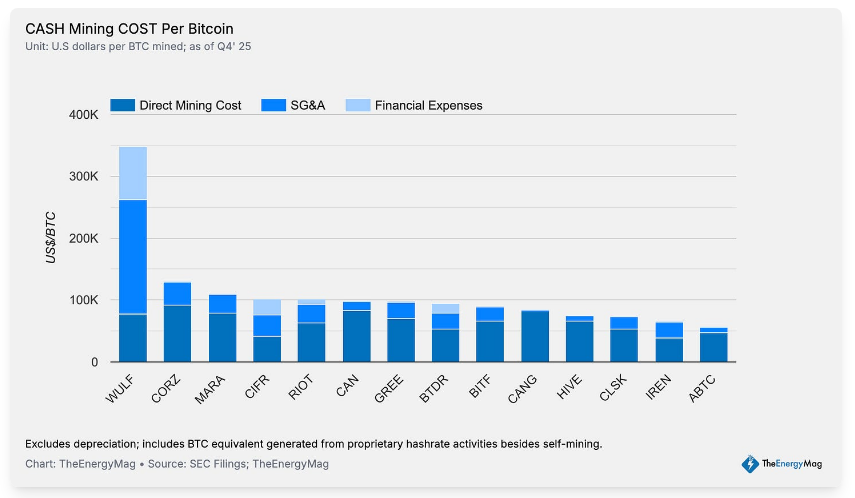
- The Breakeven Gap: The estimated breakeven point for a large segment of the mining industry—particularly those operating older-generation application-specific integrated circuit (ASIC) rigs—stands at approximately $35 per petahash per second per day. That $2 deficit per unit of computing power has pushed roughly 20% of the global network into negative cash flow.
- Record Quarterly Sales: Major public miners (MARA, CleanSpark, Riot, Cango, Core Scientific, and Bitdeer) liquidated over 32,000 BTC in Q1 2026, surpassing the previous record of 20,000 BTC set in Q2 2022.
- Depleted Reserves: CryptoQuant data highlights a multi-year drainage of miner reserves. Total miner holdings peaked above 1.86 million BTC at the close of 2023, but have steadily declined to approximately 1.8 million BTC, a downward trend accelerated by the Q1 2026 sell-off.
- Price Environment: Amid these liquidations, spot market benchmarks—such as BTC/USD trading near $74,993 on 24-hour charts—have failed to provide the necessary upward price momentum to offset the severe post-halving subsidy cuts.
Official Responses and Industry Analysis
Industry watchdogs and financial institutions have issued stark warnings regarding the near-term future of the sector. Asset manager CoinShares, in its comprehensive Q1 2026 Bitcoin Mining Report, cautioned that relief may not be immediate. The firm explicitly warned that higher-cost mining operators should prepare for continued capitulation throughout the first half of the year unless the spot price of Bitcoin stages a dramatic and sustained recovery.
Corporate leaders are responding to the macroeconomic environment through distinct strategic lenses. Michael Saylor, co-founder of Strategy, took to social media platform X in mid-April 2026 to signal the company’s unyielding appetite for accumulation. By sharing the firm’s historical Bitcoin acquisition chart accompanied by the directive to "Think bigger," Saylor signaled to global markets that institutional treasury buyers are more than willing to absorb the sell-pressure exerted by struggling miners, effectively shifting the distribution of Bitcoin from operational producers to long-term corporate holders.
Implications
The cascading effects of the 2026 mining crisis carry profound implications for the broader cryptocurrency ecosystem:
Centralization and Consolidation of Hashpower
The prolonged squeeze on profit margins disproportionately punishes smaller, independent, and high-cost miners. As these entities are forced to shut down unprofitable rigs or sell off hardware, market share is increasingly concentrated among mega-cap, publicly traded mining corporations with access to cheap, localized energy contracts and modern, energy-efficient ASIC hardware. This trend risks heightening corporate centralization within a network explicitly designed to be decentralized.
Shift in Market Dynamics
The massive influx of miner-forced selling acts as a temporary ceiling on Bitcoin’s price appreciation, as thousands of newly minted coins are immediately driven onto order books to pay for electricity and debt servicing. However, once these distressed reserves are fully depleted or absorbed by deep-pocketed corporate treasuries, the removal of this persistent sell-pressure could pave the way for a major supply shock.
Evolution of Mining Business Models
To survive future halving cycles and fluctuating hashprices, mining companies are being forced to aggressively innovate. Diversification into high-performance computing (HPC) and artificial intelligence (AI) data center hosting has emerged as a crucial lifeline for miners seeking stable, fiat-denominated revenue streams independent of Bitcoin’s volatile price action and network difficulty adjustments.