
Bitcoin’s Mining Paradox: Record Difficulty Meets Market Volatility as Miners Face Profitability Squeeze
The Bitcoin network is currently navigating a complex period of technical and financial recalibration. This week, the decentralized ledger reached a historic milestone as mining difficulty surged to an all-time high of 127.6 trillion. Simultaneously, the cryptocurrency market experienced a notable contraction, with Bitcoin’s price slipping by 3% to touch an intraday low of $113,005. While the network continues to prove its resilience through its automated self-correction mechanisms, the current alignment of record-high difficulty and cooling price action has created an increasingly precarious environment for global mining operations.
Main Facts: The Intersection of Hashrate and Price
At its core, Bitcoin mining is a competitive race to secure the network. The "difficulty" metric is an ingenious protocol feature that ensures blocks are produced at a consistent rate—approximately every 10 minutes—regardless of how many miners are competing for the block reward. When more computational power (hashrate) enters the network, the difficulty rises to prevent blocks from being produced too quickly. Conversely, when miners exit the space, the difficulty adjusts downward.
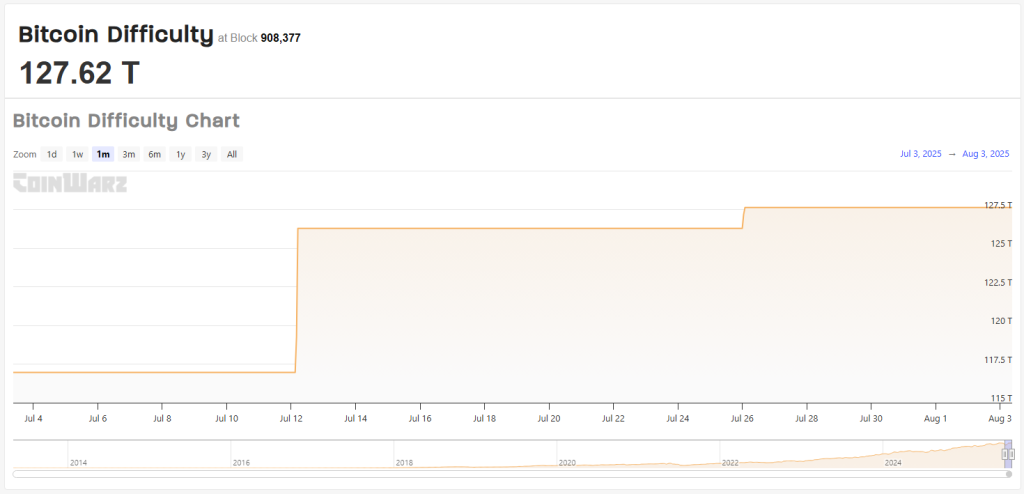
Recent data from CoinWarz indicates that the network’s security, measured by this difficulty metric, has reached an unprecedented peak of 127.6 trillion. This surge reflects a massive influx of hashing power, suggesting that, despite market fluctuations, mining infrastructure globally continues to expand. However, the economic reality for miners is diverging from the network’s technical performance. As Bitcoin’s price retreated to the $113,000 range, the cost of production—defined by electricity expenses and hardware efficiency—has begun to outpace the revenue generated by block subsidies and transaction fees.
Chronological Evolution of Mining Dynamics
To understand the current state of the network, one must look at the recent trajectory of mining cycles.
- June 2025: The network experienced a period of relative ease, with mining difficulty sliding to a low of 117 trillion. During this window, lower operational overheads allowed a broader range of miners to remain profitable.
- Late July 2025: A clear trend reversal began as hash rate began to climb aggressively, pushing the difficulty back toward historical peaks.
- Early August 2025: The network reached its current record of 127.6 trillion. This rapid ascent in just over a month highlights the intense capital expenditure currently occurring in the mining sector.
- Upcoming Adjustment (August 9, 2025): Market analysts expect a roughly 3% downward adjustment in difficulty, bringing it to approximately 124 trillion. This shift is a programmed response to the current pace of block production, which has drifted slightly to an average of 10 minutes and 20 seconds.
Supporting Data and Technical Analysis
The relationship between price and difficulty is often cyclical. When mining becomes too difficult, miners with higher operational costs—often those using older-generation ASIC hardware—are forced to power down their rigs. This "capitulation" leads to a drop in the total hash rate, which subsequently triggers a downward adjustment in difficulty.

The current technical data reveals:
- Block Time Variance: The network is currently operating at an average block time of 10 minutes and 20 seconds. While seemingly negligible, this deviation from the 10-minute target is the primary driver for the protocol’s upcoming 3% downward difficulty correction.
- Market Sentiment: Bitcoin’s price drop to $113,005, followed by a stabilization at $113,250, reflects a period of consolidation. Traders and institutional investors are closely monitoring whether this price level will act as a support floor or if further downside pressure will trigger a broader miner sell-off.
- Hashrate Correlation: The persistent climb in difficulty despite recent price volatility suggests that institutional miners, who typically operate on long-term time horizons and fixed-cost energy contracts, are not currently deterred by short-term market dips.
The Miner’s Dilemma: Operational Implications
The "squeeze" currently felt by the mining industry is a classic example of the break-even point shifting upward. In the world of Bitcoin mining, profitability is a function of the price of BTC, the electricity rate per kilowatt-hour, and the efficiency of the mining equipment (Joules per Terahash).
The Efficiency Gap
As difficulty hits record highs, the "hash-per-watt" ratio becomes the most important metric for survival. Older models, such as the Bitmain Antminer S19 series, are increasingly becoming liabilities rather than assets for large-scale operations. Modern, more efficient rigs are required to extract the same amount of Bitcoin as the difficulty increases. Consequently, firms are undergoing a "hardware arms race," constantly upgrading to the latest, most energy-efficient chips to maintain margins.
Financial Pressure and Liquidity
For mining companies, this is a delicate balancing act. Many firms carry significant debt to fund the purchase of new hardware. If the price of Bitcoin stays suppressed while difficulty remains at record levels, these companies face a cash-flow crunch. They may be forced to liquidate their existing Bitcoin holdings to cover operational expenses, which can create a self-reinforcing cycle of downward price pressure.
The Role of Energy Costs
Miners with access to "stranded energy"—such as excess hydroelectric power or flared natural gas—remain the most resilient players. These entities are shielded from the volatility of retail electricity markets and can continue to operate profitably even when difficulty is at its peak. However, for miners relying on grid-purchased electricity, the current climate is one of extreme caution.
Implications for the Future
The upcoming 3% decrease in difficulty is expected to provide a temporary reprieve for marginal miners. This adjustment acts as an automatic safety valve, recalibrating the network to ensure that security remains high without rendering the entire ecosystem unprofitable.
However, looking ahead, the industry is preparing for a period of consolidation. Market analysts suggest that:
- Increased Centralization: We may see a trend where larger, better-capitalized mining operations acquire the assets of smaller, less efficient firms that can no longer afford to operate.
- Technological Innovation: The pressure to remain profitable is accelerating the development of cooling technologies (such as immersion cooling) and more efficient chip architectures.
- Market Sensitivity: Investors should expect continued volatility. As miners become more sensitive to price, their "sell pressure" could become a more significant factor in short-term market movements.
In conclusion, while the record difficulty of 127.6 trillion serves as a testament to the unparalleled security and computing power of the Bitcoin network, it also signals a challenging chapter for the miners who sustain it. The next few weeks will be critical in determining whether the price can reclaim higher ground or if the network will enter a phase of cooling where only the most efficient operations survive. Investors and stakeholders should watch the August 9th difficulty adjustment closely, as it will serve as the first major indicator of how the network balances its security with the economic realities of its participants.