
Crypto Exchange Volumes Slump in April, Breaking Six-Month Bullish Streak as Market Shifts Focus to Niche Sectors
LONDON — After a blistering six-month rally that captured the attention of global financial markets, the momentum powering centralized cryptocurrency exchanges (CEXs) abruptly stalled in April. New data compiled by prominent blockchain and digital asset research firm CCData reveals a dramatic contraction in trading activity, snapping one of the longest consecutive periods of growth the sector has witnessed in recent years.
While the broader digital asset ecosystem continues to mature and find institutional backing, April served as a stark reminder of the inherent volatility and cyclical nature of crypto markets. As spot and derivatives trading volumes plummeted by nearly half, market participants are left dissecting the underlying causes of the slowdown, evaluating the performance of top-tier platforms, and analyzing shifting capital flows toward alternative crypto sectors such as artificial intelligence, gaming, and meme tokens.
Main Facts: A Steep Correction in CEX Volumes
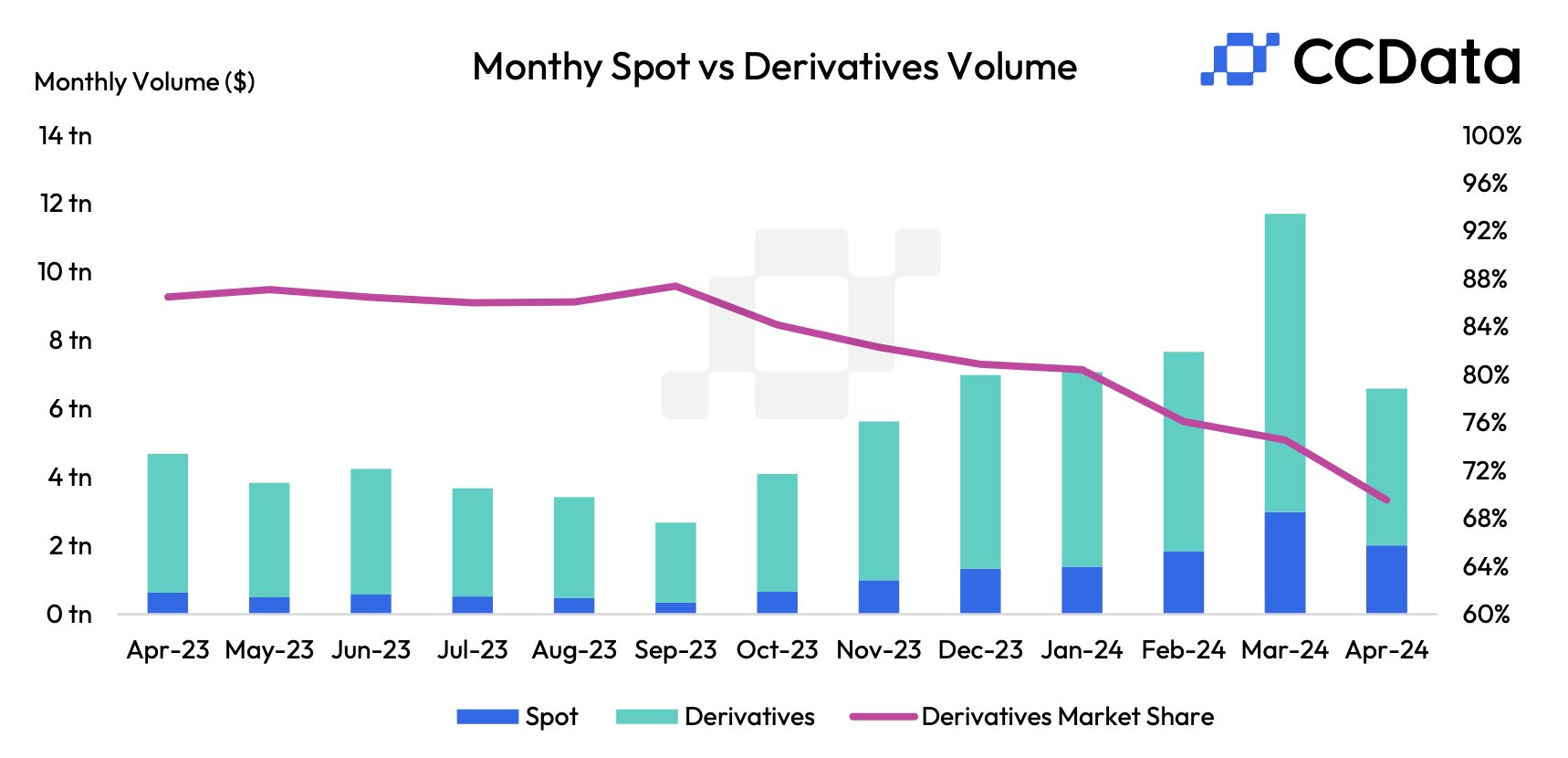
According to the comprehensive market report published by CCData, the combined trading volume of spot markets and derivatives across all major centralized cryptocurrency exchanges fell by a staggering 43.8% in April, resting at a total of $6.58 trillion.
This sharp downward correction marks the definitive end of an unprecedented six-month winning streak that had seen centralized platforms experience uninterrupted month-over-month growth. To put the contraction into perspective, the combined monthly trading volume across CEXs stood at approximately $11 trillion in March, following a robust $8 trillion recorded in February.
Despite the alarming percentage drop, market analysts emphasize that context is critical. While April represented a severe cooling-off period compared to the frenetic activity of the first quarter of 2024, the aggregate volume remains historically high. In fact, April’s $6.58 trillion figure outpaces every single month recorded throughout the entirety of 2023, with the sole exception of December. This indicates that while retail and institutional enthusiasm may have plateaued temporarily, the baseline level of market liquidity and user engagement remains vastly superior to the prolonged bear market conditions of previous years.
The downturn was felt universally across the industry, but top-tier exchanges bore the brunt of the absolute volume contraction. CCData highlighted that industry heavyweights—including Binance, Bybit, and OKX—experienced some of the steepest declines in transactional throughput as traders retreated to the sidelines to reassess macroeconomic conditions and token price directions.
Chronology: From Q1 Euphoria to April’s Cold Reality
To fully understand the sudden shift in April, it is essential to trace the chronological trajectory of the crypto market leading up to the end of the first quarter.

Q4 2023 to March 2024: The Six-Month Surge
The multi-month rally began in late 2023, fueled by escalating anticipation surrounding the approval of spot Bitcoin Exchange-Traded Funds (ETFs) in the United States. As institutional capital flooded into the market and regulatory milestones were achieved, Bitcoin surged to new all-time highs well ahead of its quadrennial halving event in April 2024.
During this window, centralized exchanges experienced an explosion of liquidity. Monthly volumes climbed steadily from October 2023 through March 2024, culminating in the monumental $11 trillion peak observed in March. During this peak, speculative fervor reached a fever pitch, with leveraged derivatives trading hitting record highs as retail investors chased soaring valuations across layer-1 networks and speculative tokens.
April 2024: The Inflection Point
As April arrived—coinciding with the much-anticipated Bitcoin halving—the market dynamic shifted. Rather than triggering an immediate continuation of the parabolic run, the halving event appeared to act as a classic "buy the rumor, sell the news" catalyst.
Simultaneously, broader macroeconomic headwinds, including persistent inflation data in the United States and tempered expectations regarding imminent interest rate cuts by the Federal Reserve, began to weigh heavily on risk-on assets. By mid-April, trading desks across the globe reported a noticeable drying up of order book liquidity. The euphoria of Q1 gave way to consolidation, leading directly to the 43.8% volume collapse documented by CCData at the close of the month.
Early May: Sector Rotation Takes Hold
Moving into May, data aggregated up to May 10 revealed that while overall exchange volumes remained subdued, capital within the ecosystem was far from stagnant. Instead of exiting the market entirely, active traders began aggressively rotating capital out of foundational infrastructure assets and into high-beta, narrative-driven sectors such as metaverse gaming, artificial intelligence, and meme communities.
Supporting Data: Winners, Losers, and Sector Performance
A granular look at CCData’s exchange-specific metrics provides a clearer picture of how individual platforms weathered the April storm.
Top-Tier Exchange Performance
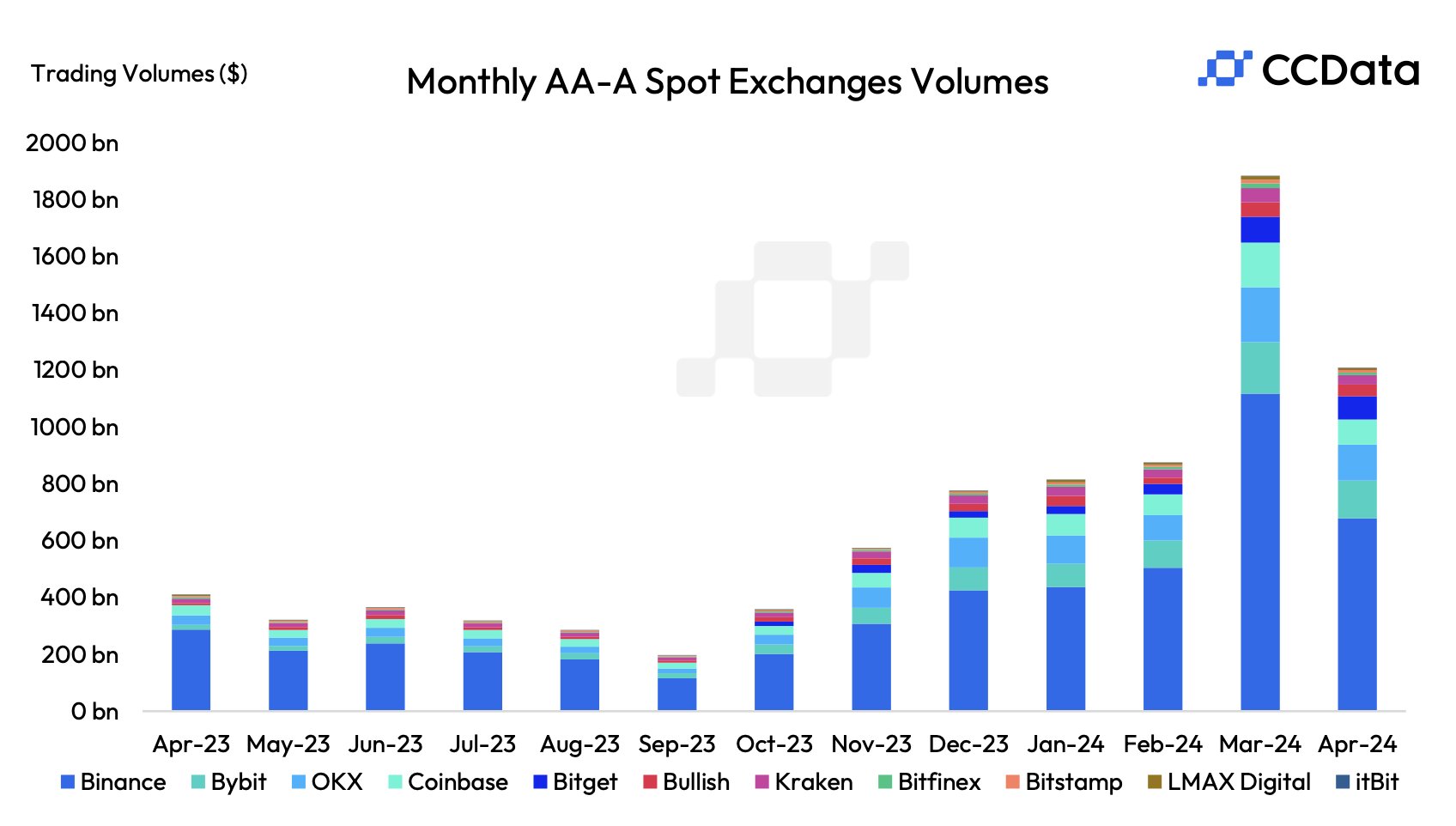
Among AA-A graded centralized exchanges, Binance maintained its uncontested dominance as the world’s largest crypto platform by volume, despite taking a massive hit in absolute numbers. In April, Binance handled $679 billion in spot trading volume, representing a 39.2% decrease compared to the previous month.
Bybit, holding a Grade AA rating, secured the second position among top-tier spot exchanges, registering $133 billion in volume. This marked a 26.9% decline—one of the more resilient performances among major platforms. Meanwhile, OKX (Grade A) rounded out the top tier, processing $126 billion in spot trades, which translated to a 34.8% drop from its March figures.
Asset and Sector Basket Returns (As of May 10)
While exchange order books saw diminished activity, CCData’s basket performance metrics tracked through mid-May highlighted a fascinating divergence in investor interest across various crypto sub-sectors:
- Metaverse/Gaming: +32.4%
- Artificial Intelligence (AI): +17.4%
- Meme Tokens: +16.2%
- Layer-1 Networks: +7.1%
- Decentralized Finance (DeFi): +6.7%
- Staking Assets: +4.0%
- Exchange Tokens: +3.5%
- Infrastructure: +1.6%
- Layer-2 Scaling Solutions: -4.2%
This data illustrates that while core spot and derivatives trading on centralized exchanges slowed down, speculative capital aggressively targeted high-growth thematic narratives. The metaverse and gaming sector spearheaded the recovery with a remarkable 32.4% month-to-date return, followed closely by AI-related crypto projects (17.4%) and meme tokens (16.2%). Conversely, layer-2 scaling solutions lagged behind, registering a negative return of 4.2% as liquidity temporarily bypassed scaling infrastructure in favor of high-beta plays.
Official Responses and Industry Observations
Market analysts and exchange representatives have largely viewed the April volume contraction as a natural and healthy cooling-off period rather than a harbinger of a structural bear market.
Industry commentators note that parabolic price movements and record-shattering trading volumes are inherently unsustainable over long horizons. Following months of intense, leveraged speculation leading up to the Bitcoin halving, a period of deleveraging and market consolidation is standard market mechanics.
Furthermore, compliance and regulatory pressures continue to shape the centralized exchange landscape. Top-tier platforms like Binance, OKX, and Bybit have been engaged in continuous overhauls of their Know-Your-Customer (KYC) and Anti-Money Laundering (AML) frameworks globally. While these enhanced compliance measures fortify the industry against illicit activity, they can also introduce friction for casual retail traders, temporarily dampening high-frequency volume during periods of market uncertainty.
Independent market researchers point out that the resilience of April 2024 volumes relative to the entirety of 2023 demonstrates that the institutionalization of crypto—spurred by spot ETF inflows and broader corporate adoption—has permanently elevated the floor of baseline market liquidity.
Implications: What the Slowdown Means for the Future of Crypto Trading
The steep drop in centralized exchange volumes carries several profound implications for traders, investors, and exchange operators alike.
1. Shift Toward Decentralized Alternatives and Niche Narratives
When centralized spot and derivatives volumes contract sharply, it often signals that retail traders are either sitting on cash or moving capital into decentralized finance (DeFi) protocols and high-risk speculative niches. The outperformance of meme tokens, AI protocols, and gaming tokens by mid-May suggests that retail appetite has not vanished; rather, it has fragmented. Traders are hunting for alpha in smaller-cap assets that offer asymmetric upside potential, bypassing traditional exchange order books in favor of on-chain decentralized exchanges (DEXs) and specialized pools.
2. Exchange Revenue Pressures
For centralized exchange operators, a 43.8% month-over-month drop in transactional throughput translates directly to a significant reduction in fee revenues. While top-tier giants like Binance, Bybit, and OKX possess robust balance sheets capable of weathering multi-month volume slumps, smaller exchanges operating on thin margins may face consolidation pressures. To counteract declining trading fees, platforms are increasingly diversifying their product offerings—expanding into wealth management, staking services, institutional custody, and Web3 wallet integrations.
3. Macroeconomic Sensitivity
April’s data underscores just how tightly coupled the cryptocurrency market has become with global macroeconomic indicators. As central banks navigate the delicate balance of controlling inflation without stifling economic growth, crypto trading volumes have proven highly sensitive to shifting monetary policy expectations. Until macroeconomic clarity emerges—particularly regarding interest rate trajectories—CEX volumes may remain range-bound as institutional players adopt a risk-off posture.
Conclusion
The 43.8% plunge in centralized exchange volumes in April marks the end of a historic six-month expansion phase, but it should be interpreted as a cyclical breathing spell rather than an existential threat to the digital asset economy. As the market digests the aftermath of the Bitcoin halving and capital rotates into high-performing sectors like gaming and artificial intelligence, the crypto industry continues to demonstrate its dynamic, adaptable nature. Whether May and the subsequent quarters will spark a renewed surge in CEX activity remains dependent on both broader macroeconomic tailwinds and the evolution of retail and institutional narratives.