
Crypto Investment Surge: Institutional Capital Floods Market as YTD Inflows Near Record Highs
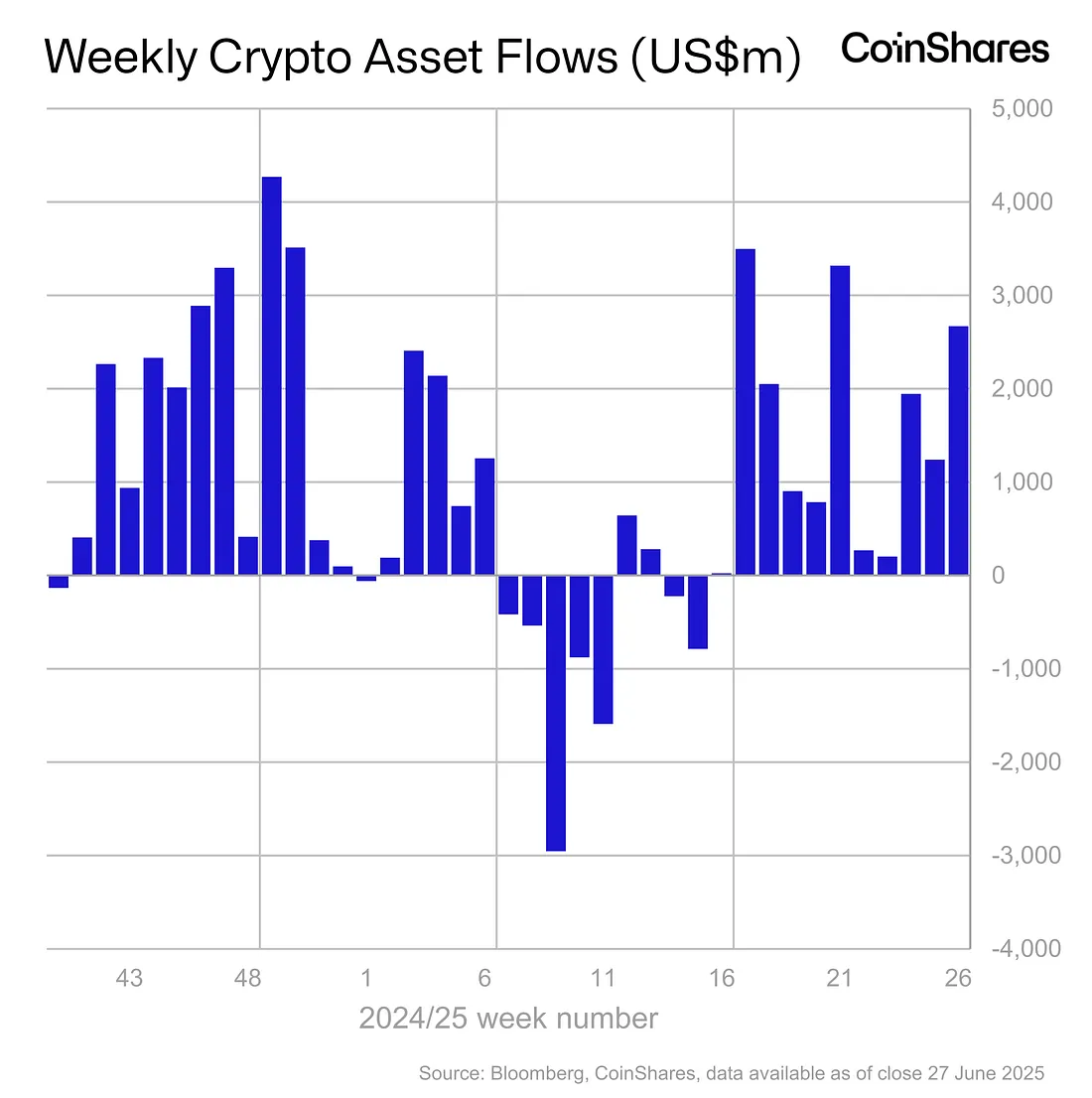
The institutional embrace of digital assets has reached a new, feverish pitch. According to the latest Digital Asset Fund Flows Weekly Report from CoinShares, the leading European crypto asset management firm, investment products have experienced a fourth consecutive week of massive capital injections. With nearly $1 billion entering the market in a single week, the industry is signaling a robust return to risk-on sentiment, driven by shifting macroeconomic tides and a growing appetite for Bitcoin as a strategic financial asset.
Main Facts: A Billion-Dollar Wave of Institutional Capital
The data released by CoinShares confirms that global digital asset investment products recorded total inflows of $882 million last week. This momentum has pushed the year-to-date (YTD) inflows to a staggering $6.7 billion, a figure that is rapidly approaching the all-time peak of $7.3 billion observed in early February of this year.
The market dominance remains firmly in the hands of the United States. While regional dynamics varied—with Canada and Hong Kong reporting minor outflows of $8 million and $4.3 million respectively—the U.S. market acted as the primary engine of growth, absorbing $840 million in new capital. Germany and Australia followed, albeit at a distance, recording $44.5 million and $10.2 million in inflows, respectively.
Bitcoin continues to act as the primary catalyst for this activity. Of the total $882 million influx, Bitcoin-specific investment products captured $867 million. This surge has propelled US-listed Bitcoin ETFs to a historic milestone: cumulative net inflows have reached $62.9 billion since their inception in January 2024, eclipsing the previous record of $61.6 billion set during the bullish window of early February.
Chronology of the Recent Institutional Pivot
To understand the current surge, one must look at the recent timeline of institutional engagement with crypto:
- January 2024: The launch of spot Bitcoin ETFs in the United States fundamentally altered the market landscape, providing a regulated conduit for traditional finance (TradFi) capital to enter the digital asset space.
- February 2024: The market experienced its first major "peak" of the year, with cumulative inflows hitting $61.6 billion. This period was characterized by initial excitement surrounding the ETFs and the subsequent price appreciation of BTC.
- March–August 2024: The market saw periods of volatility, with various macroeconomic pressures—including interest rate uncertainty and shifting inflation data—causing temporary cooling in institutional inflows.
- October 2024: The trend shifted decisively toward accumulation. A sustained four-week streak of consistent inflows began, culminating in the most recent data reflecting an $882 million weekly spike, signaling that the "winter" of institutional hesitation has effectively thawed.
Supporting Data: Dissecting the Flow Dynamics
While Bitcoin remains the undisputed leader, the broader market is witnessing a nuanced distribution of capital. The following breakdown illustrates the current investment landscape:
Asset-Specific Performance
- Bitcoin (BTC): $867 million in inflows. It remains the primary vehicle for institutional exposure, acting as the "digital gold" proxy for major funds.
- Sui (SUI): An outlier in the altcoin space, attracting $11.7 million. This reflects growing investor interest in high-performance Layer-1 networks that promise scalability and enterprise-grade utility.
- Ethereum (ETH): Despite being the second-largest asset by market cap, Ethereum saw a muted performance, recording only $1.5 million in inflows. This discrepancy highlights a growing "Bitcoin-only" preference among institutional allocators who view BTC as a distinct asset class compared to the utility-heavy nature of Ethereum.
Geographic Distribution
The geographic data provides a clear picture of where institutional trust is currently concentrated:
- United States: $840 million (The clear leader, supported by the ETF infrastructure).
- Germany: $44.5 million (Maintains its position as a primary European hub for crypto-asset management).
- Australia: $10.2 million (Showing emerging growth as local regulatory frameworks become more transparent).
Official Analysis: The Macroeconomic Drivers
CoinShares’ research team identifies a triad of macroeconomic factors currently fueling this institutional trend. These catalysts provide a lens through which to view the current price action and the sustained inflow of capital.
1. Global M2 Money Supply Expansion
The M2 money supply—a measure of the total amount of currency in circulation plus various types of deposits—is seeing an expansionary phase globally. As central banks potentially move toward more accommodative monetary policies to stimulate growth, investors are increasingly turning to hard assets. Bitcoin, with its capped supply, is being positioned by institutional managers as a hedge against the debasement of fiat currency.
2. Stagflationary Risks in the United States
The U.S. economy faces a complex environment where growth is slowing, yet inflationary pressures persist. In such "stagflationary" scenarios, traditional assets like bonds may struggle to provide real returns. Institutional investors are seeking assets that demonstrate a lack of correlation with the broader equity markets, with Bitcoin increasingly viewed as an insurance policy against domestic economic stagnation.
3. State-Level Adoption of Bitcoin
The most significant shift in the institutional narrative is the movement toward Bitcoin as a "strategic reserve asset." Several U.S. states have begun discussing or implementing frameworks to hold Bitcoin on their balance sheets. This move legitimizes the asset for institutional entities that were previously wary of the regulatory "gray zone" surrounding cryptocurrencies.
Implications: The Road Ahead for Digital Assets
The implications of this influx are profound for both the cryptocurrency market and the broader financial system.
A Maturing Financial Infrastructure
The fact that US-listed ETFs have surpassed their previous record for cumulative inflows suggests that the product market fit for Bitcoin is permanent. It is no longer a speculative play for retail day traders; it is now a foundational component of modern asset allocation strategies. We are witnessing the "institutionalization" of crypto, where the volatility of the past is being dampened by the long-term horizons of pension funds, hedge funds, and family offices.
The "Flight to Quality" Within Crypto
The data also highlights a "flight to quality." Institutional capital is demonstrating a clear preference for Bitcoin, with other assets failing to draw significant attention. This suggests that the next market cycle will be defined by Bitcoin’s role as a sovereign-grade asset, potentially leaving smaller, less-established altcoins to compete in a separate, more retail-driven ecosystem.
Regulatory and Political Sentiment
The ongoing inflows into regulated vehicles suggest that investors are increasingly confident in the regulatory environment. As the U.S. moves closer to potentially clearer legislative frameworks, the risk-premium associated with digital assets is shrinking. This makes the asset class more attractive to institutional fiduciaries who are bound by strict mandates regarding the types of assets they can hold.
Final Thoughts: A Paradigm Shift
The report from CoinShares is more than just a summary of weekly numbers; it is a barometer for the shift in the global financial order. When nearly a billion dollars enters the crypto ecosystem in a single week, it confirms that digital assets have graduated from the fringes of the financial system to its very center.
For the average investor, the message is clear: the institutional narrative has changed. While the market remains prone to short-term volatility, the long-term trajectory is being dictated by massive, persistent flows from the world’s most sophisticated capital allocators. As Bitcoin inches closer to its all-time highs in terms of institutional engagement, the question for market participants is no longer if they should have exposure to digital assets, but how much they can afford to be without it.
Disclaimer: The information provided in this article is for educational and informational purposes only and does not constitute financial, investment, or legal advice. Cryptocurrency investments are inherently high-risk and volatile. Investors should conduct their own due diligence and consult with a certified financial advisor before making any investment decisions. The Daily Hodl does not endorse the purchase or sale of any specific cryptocurrency or digital asset.