
Institutional Crypto Inflows Surge: A $16.9 Billion Mid-Year Assessment
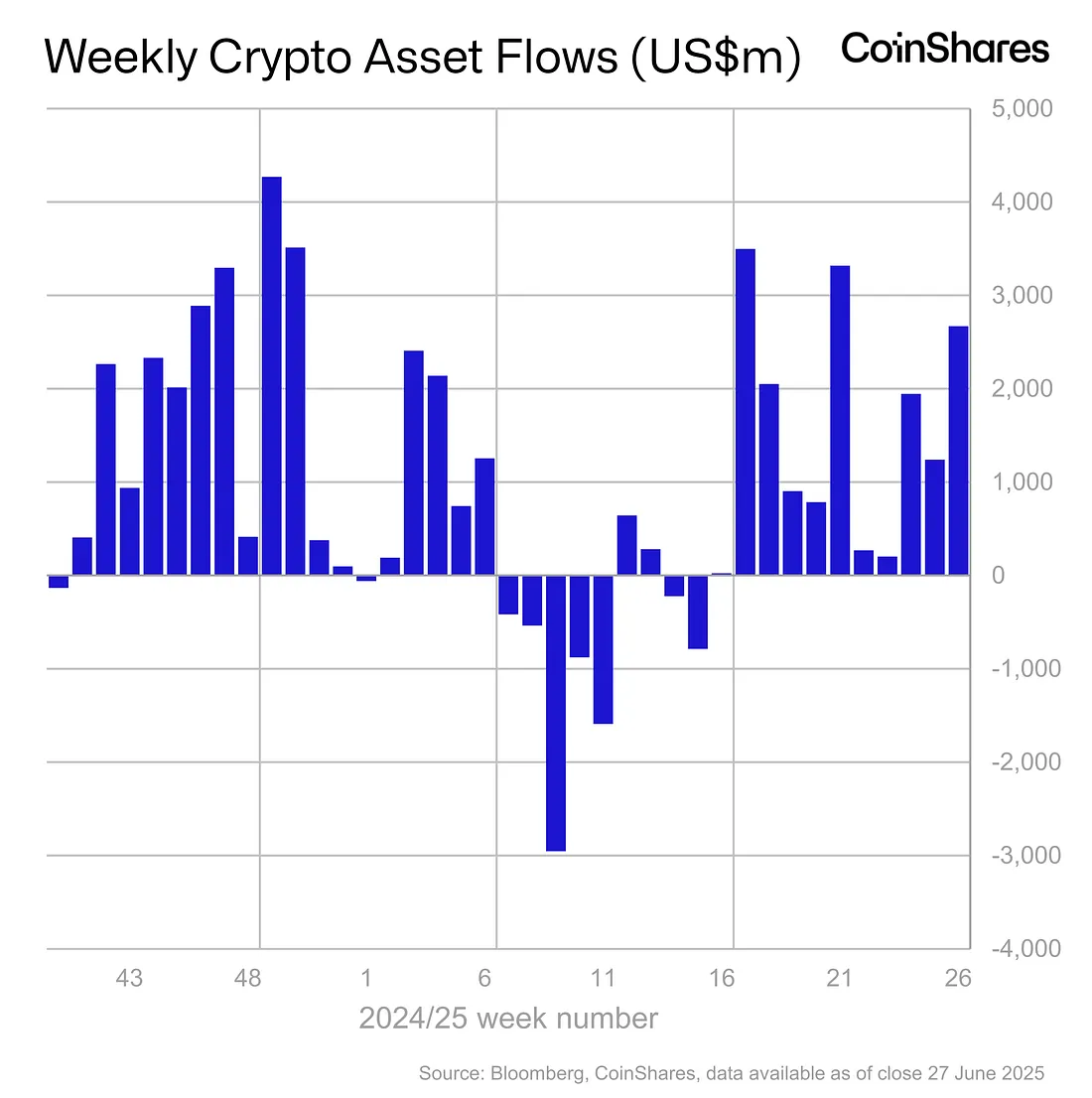
The global landscape for digital asset investment is experiencing a robust resurgence as we cross the midpoint of 2025. According to the latest Digital Asset Fund Flows Weekly report from CoinShares, institutional investors have poured a staggering $16.9 billion into crypto-focused investment products over the last eleven weeks. This sustained wave of capital underscores a fundamental shift in institutional sentiment, cementing digital assets as a cornerstone of modern portfolio diversification despite broader macroeconomic headwinds.
As the financial world navigates a complex period of shifting monetary policy and geopolitical instability, the data suggests that sophisticated investors are increasingly turning to Bitcoin and Ethereum as "digital gold" and technological hedge instruments.
The Core Data: An Unprecedented 11-Week Rally
The mid-year data provides a compelling narrative of resilience. In the first six months of 2025, total inflows into institutional digital asset funds have reached approximately $16.9 billion, placing the year on a trajectory remarkably similar to the $18.3 billion recorded during the same period in 2024.
Last week alone, the market witnessed a substantial $2.7 billion inflow, marking the 11th consecutive week of positive sentiment. This streak is not merely a quantitative trend; it represents a psychological shift among asset managers who are moving away from the "wait-and-see" approach that characterized the late 2024 cycle.
Key Performance Metrics
- 11-Week Cumulative Inflow: $16.9 Billion.
- Single-Week Inflow (Latest): $2.7 Billion.
- Bitcoin Dominance: 83% of total weekly inflows.
- Year-to-Date (YTD) Performance: Trailing 2024 levels by only a narrow margin, suggesting a stable, long-term accumulation phase.
Chronology: The Evolution of 2025 Market Sentiment
To understand the current momentum, one must look at the progression of the year. The first quarter of 2025 began with cautious optimism as global central banks signaled a pivot in interest rate policies. As the uncertainty regarding inflation and the strength of the U.S. Dollar persisted, institutional capital began to rotate out of traditional treasury bonds and into spot-based crypto investment vehicles.
Q1: The Foundation
Early 2025 was defined by the maturation of the spot ETF market. As regulatory frameworks solidified across various jurisdictions, institutional barriers to entry lowered significantly. This period saw a consistent, albeit modest, accumulation of assets as fund managers began testing the waters with digital asset allocations.
Q2: The Institutional Acceleration
The second quarter witnessed a departure from the tentative nature of Q1. Heightened geopolitical tensions in the Middle East and Eastern Europe, combined with volatile fiscal policy discussions in Washington, served as a catalyst for flight-to-safety capital. Investors began to view Bitcoin specifically as a hedge against currency debasement. By the time the market reached the mid-year point, the 11-week rally had transformed from a sporadic trend into a structural reallocation of capital.
Regional Disparities: A Global Map of Capital Flows
The distribution of these inflows reveals a stark contrast between regions, highlighting where crypto-friendliness and regulatory clarity are currently concentrated.
The United States: The Engine of Growth
The United States remains the undisputed leader in institutional adoption. Last week, the U.S. market accounted for $2.65 billion of the total $2.7 billion global inflow. This dominance is largely attributed to the widespread availability and institutional-grade infrastructure of U.S.-listed spot Bitcoin ETFs, which have become the primary vehicle for pension funds, family offices, and hedge funds to gain exposure.
Europe: Mixed Results
Europe offers a nuanced picture. While Switzerland and Germany saw modest inflows of $23 million and $19.8 million, respectively, they have not mirrored the aggressive growth seen in the American market. This suggests that while European institutional appetite is present, the localized product offerings may be facing stiffer competition from broader global assets.

Asia and Emerging Markets: Outflow Pressures
Conversely, Canada, Hong Kong, and Brazil recorded net outflows. Hong Kong, which was previously a focal point for institutional growth in the region, saw $132 million in outflows during June alone. Analysts suggest this is less of a rejection of digital assets and more a reflection of regional profit-taking and a reallocation toward assets that offer higher liquidity during localized periods of economic volatility.
Asset-Specific Performance: Bitcoin vs. Ethereum
Bitcoin’s Hegemony
Bitcoin remains the primary beneficiary of institutional confidence, capturing 83% of all new capital inflows. The appetite for "short-Bitcoin" products has plummeted, with $2.9 million in outflows last week and $12 million YTD. This serves as a definitive indicator that the "short-selling" institutional crowd has largely capitulated, conceding that the bullish long-term thesis for Bitcoin has gained the upper hand.
Ethereum’s Growing Utility
Ethereum, the second-largest digital asset, continues to see steady demand, securing $429 million in inflows last week. This reflects a broader institutional recognition of Ethereum not just as a currency, but as the foundational layer for decentralized finance (DeFi) and tokenized real-world assets. As institutional interest in smart-contract platforms grows, Ethereum continues to capture the "innovation premium" that many investors are seeking.
Implications: What This Means for the Future of Finance
The data provided by CoinShares carries significant implications for the future of the global financial system.
1. The Normalization of Digital Assets
The consistency of the 11-week inflow streak signals that digital assets are being "normalized" in the eyes of institutional allocators. They are no longer viewed as speculative "side bets" but are increasingly being treated as a legitimate asset class within a diversified portfolio.
2. Geopolitics as a Catalyst
The CoinShares report explicitly cites "heightened geopolitical volatility" as a primary driver. As nations move toward fragmented trade blocs and potential de-dollarization strategies, institutional investors are looking for assets that operate independently of central bank mandates. Bitcoin’s algorithmic supply cap and decentralized nature make it an increasingly attractive alternative to fiat-denominated assets.
3. The Monetary Policy Pivot
With the direction of global interest rates remaining uncertain, investors are hedging against both inflation and deflationary shocks. If interest rates remain "higher for longer," Bitcoin’s role as a store of value is tested; if rates are cut, liquidity floods the market, typically pushing crypto assets higher. In either scenario, institutional players are positioning themselves to capitalize on the shift.
Conclusion: A Resilient Path Forward
The $16.9 billion influx recorded over the last three months is a testament to the durability of the crypto market. While retail investors often react to price volatility with emotional trading, the institutional capital tracked by CoinShares demonstrates a methodical, long-term investment strategy.
As we move into the second half of 2025, the market will likely focus on whether this momentum can be sustained. If the regulatory environment continues to stabilize—particularly in the U.S.—we may see a widening of institutional interest beyond Bitcoin and Ethereum into a broader basket of digital assets. For now, the signal is clear: the institutions have arrived, they are staying, and they are increasingly confident in the future of the digital asset economy.
Disclaimer: The information provided in this article is for informational purposes only and does not constitute financial, investment, or legal advice. Investing in digital assets involves significant risk, including the total loss of principal. Investors are encouraged to conduct their own due diligence and consult with a qualified financial advisor before making any investment decisions.