Ethereum Faces Crucial Juncture as Derivatives Market Resets Amidst Price Slump
Bitcoinist | [Date of Publication]
Ethereum, the second-largest cryptocurrency by market capitalization, is currently navigating a critical period, trading below the significant $1,700 psychological level. The recent price decline, representing a substantial 28% drop from its recent peaks, has prompted analysts to scrutinize the underlying market structure. A detailed examination of derivatives data, particularly Open Interest (OI) across major exchanges, reveals a profound reset that extends beyond short-term price fluctuations, painting a complex picture of market sentiment and future potential.
The current weakness in Ethereum’s price is not an isolated event but rather a symptom of a larger structural adjustment within its derivatives market. A key indicator, Open Interest, which represents the total number of outstanding derivative contracts, has seen a dramatic unwinding. This reduction signifies that leveraged positions built up over an extended period, spanning from 2025 into 2026, are being systematically closed out. This deleveraging process has brought multiple major exchanges back to Open Interest levels not seen since April 2025, effectively nullifying over a year’s worth of accumulated leveraged exposure in a compressed timeframe.
The Unwinding of Leverage: A Tale of Two Exchanges
The extent of this Open Interest reset is starkly illustrated by data from prominent exchanges. On Gate.io, ETH Open Interest plummeted from $4.84 billion on May 7th to $2.68 billion on June 9th. This represents a significant reduction of approximately $2.16 billion, or roughly 45%, in just over a month. Remarkably, the current reading closely mirrors the $2.67 billion recorded on April 11th, 2025.
Bybit exhibits an almost identical pattern. Its ETH Open Interest has contracted to approximately $805 million, a figure that virtually matches the $795 million level observed on April 9th, 2025. The simultaneous return of two major exchanges to April 2025 market structure signifies a comprehensive clearing of leverage that had been accumulated throughout the subsequent period. This deleveraging event is a critical development, as it can significantly alter the dynamics of price discovery and market stability.
Binance’s Divergent Path and the Signal from Funding Rates
While Gate.io and Bybit have largely purged their leveraged positions, Binance, another leading exchange, presents a contrasting scenario. ETH Open Interest on Binance remains elevated, hovering around $2.76 billion, a figure close to its higher range. This divergence raises questions about the underlying sentiment and potential future price action.

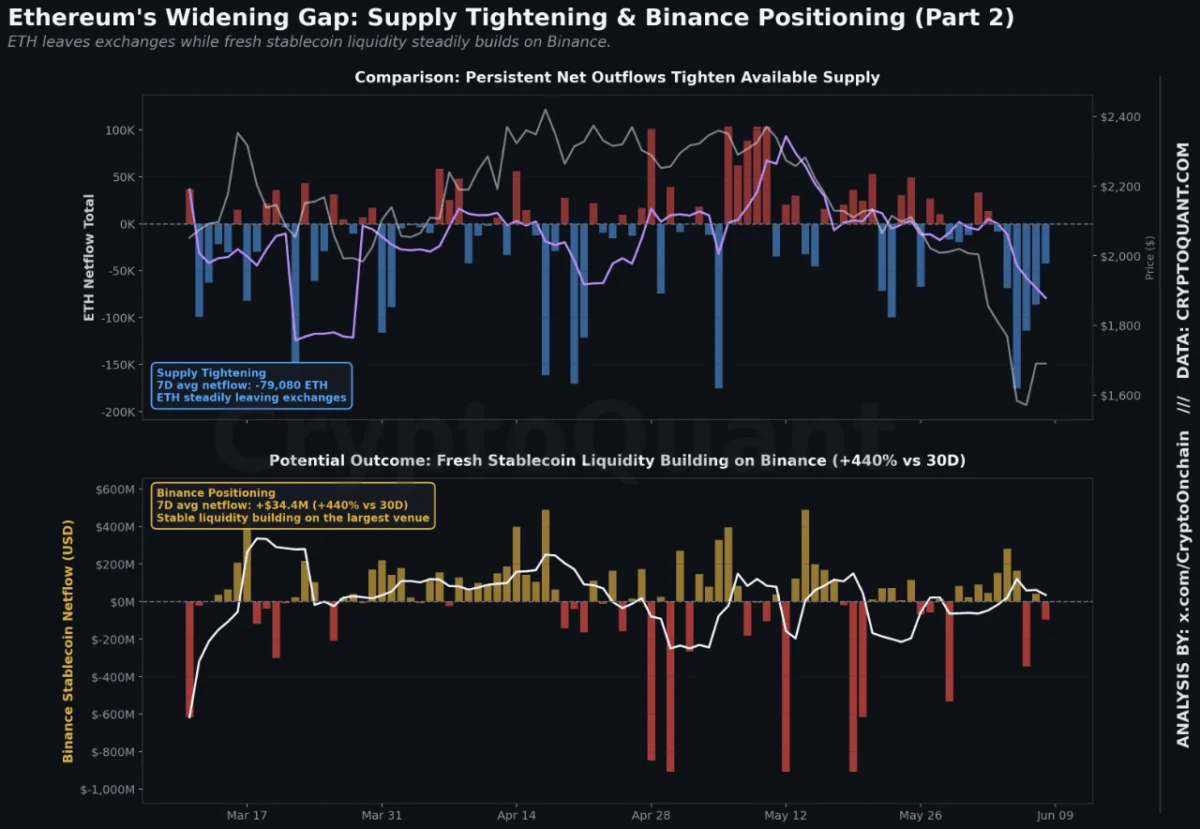
The confirmation of this nuanced market sentiment comes from Binance’s funding rates, which have turned negative. Funding rates in perpetual futures contracts are used to incentivize traders to keep their positions open and to balance the market. When funding rates are negative, it means that traders holding short positions are paying traders holding long positions. This typically indicates that short-sellers are in the majority or that there is a lack of strong bullish conviction among long-term holders.
The negative funding rates on Binance, currently at approximately -0.0038, suggest that existing futures activity is not driven by bullish conviction. Instead, it points to uncertainty at best and a mild bearish bias at worst. Traders are not willing to pay a premium to hold long exposure, indicating a cautious or even bearish outlook on the immediate future of Ethereum’s price.
The Nuances of Derivatives Reset: A Structural Anomaly
A deeper dive into the CryptoQuant analysis reveals a critical asymmetry in the Open Interest reset. While Gate.io and Bybit have effectively cleared the leverage accumulated over more than a year within weeks, Binance has not followed suit. This uneven deleveraging is a significant detail that prevents the current Open Interest reset from being interpreted as a straightforward and clean structural clearing.
The retained Binance positioning does not automatically signal a bullish intent to remain in the market. The funding rate provides a more accurate narrative. Negative funding rates during a price decline can be attributed to three primary conditions:
- Defensive Positioning: Existing market participants may be hedging their long exposure by taking short positions to protect against further losses.
- Short Pressure: Traders actively betting against a recovery might be initiating short positions, expecting further price depreciation.
- Absence of Aggressive Long Conviction: The lack of strong buying pressure from participants who would typically be willing to pay a premium to hold bullish exposure.
None of these conditions are indicative of a market poised for a robust rally. Collectively, they describe a derivatives structure that has partially reset, with the most influential exchange retaining residual positioning. Crucially, this residual positioning lacks the directional commitment that would typically be considered constructive for a sustained upward move.
Ethereum’s Price Action: Breaking Key Support Levels
Beyond the derivatives market, Ethereum’s spot price action paints a grim picture. The cryptocurrency is currently trading near $1,670, having experienced one of its most significant weekly breakdowns of the current cycle. This decline has pushed ETH below its February lows, reaching levels not witnessed since early 2023.

This price movement is particularly significant as it invalidates the broad trading range that had contained Ethereum for the majority of 2026. It further solidifies the bearish structure that has been developing since the rejection from the $4,800 cycle peak.
From a market structure perspective, the chart of Ethereum is characterized by a clear sequence of lower highs and lower lows. Following its failure to hold above the $2,250-$2,350 resistance zone, Ethereum lost the critical $1,800 support area. This level had previously served as the floor for the consolidation observed between February and March. The subsequent breakdown triggered a rapid descent towards the $1,500 region, where buyers finally intervened to prevent a more severe collapse.
Technical Indicators Signal Downward Trend
The technical landscape for Ethereum further reinforces the prevailing bearish sentiment. The cryptocurrency is now trading below all major weekly moving averages. The 50-week, 100-week, and 200-week moving averages are all clustered significantly above the current price. This configuration not only highlights the strength of the prevailing downtrend but also establishes substantial overhead resistance, making any upward price recovery a challenging endeavor.
The recent low established near $1,500 has emerged as the most critical support level on the chart. Should buyers manage to defend this area, Ethereum might find the foundation to build a base and attempt a recovery towards the $1,800 mark. However, a weekly close below these recent lows would expose the market to a deeper retracement, potentially pushing prices towards the $1,300-$1,400 region. Such a move would further extend the current correction and confirm a deterioration in the long-term market structure.
Expert Analysis and Market Implications
The confluence of a significant price decline, a substantial reset in derivatives markets, and bearish technical indicators suggests that Ethereum is facing a critical juncture. While the unwinding of leverage on exchanges like Gate.io and Bybit can be seen as a cleansing event, the persistent leverage on Binance, coupled with negative funding rates, introduces an element of uncertainty.
The structural reset, while incomplete, indicates that the era of excessive leverage has likely come to an end. This can be viewed as a positive development in the long run, as it reduces the risk of cascading liquidations that can exacerbate price drops. However, in the short to medium term, the lack of clear bullish conviction and the presence of defensive positioning suggest that a swift and decisive recovery may be unlikely.

Market participants will be closely watching the $1,500 support level. A failure to hold this crucial support could trigger further downside, potentially retesting lower levels not seen in over a year. Conversely, a successful defense of this area, combined with a shift in sentiment reflected in positive funding rates and a reduction in bearish positioning, could signal the beginnings of a stabilization and eventual recovery.
The current environment underscores the importance of cautious trading and a deep understanding of market structure. The data suggests that while some of the froth has been removed from the derivatives market, the underlying sentiment remains cautious, and the path ahead for Ethereum is likely to be challenging. The coming weeks will be crucial in determining whether the current price levels can hold as support or if further deterioration awaits.
Disclaimer: This article is for informational purposes only and does not constitute financial advice. Cryptocurrency investments are subject to high market risk. Please conduct your own research and consult with a qualified financial advisor before making any investment decisions.