Ethereum’s Derivative Market Reset: A Structural Shift Underpinning Price Action
[City, Date] – The cryptocurrency market is witnessing a significant structural shift within Ethereum’s (ETH) derivatives landscape, a development that analysts believe is more indicative of future price action than the immediate price decline. Ethereum is currently trading below the critical $1,700 mark, having experienced a substantial 28% correction from recent highs. This downturn, coupled with a notable unwinding of leveraged positions across major exchanges, points towards a fundamental recalibration of market sentiment and positioning.
A detailed analysis by CryptoQuant, a leading blockchain analytics firm, highlights that the current price weakness is not an isolated event but rather a consequence of a broader deleveraging process. The data reveals that Open Interest (OI) – a metric representing the total number of outstanding derivative contracts – has significantly decreased across prominent exchanges, erasing over a year’s worth of accumulated leverage in a remarkably compressed timeframe. This reset in derivatives positioning is seen as a key determinant of whether the current $1,700 level will hold as support or give way to further price erosion.
The Unwinding of Leverage: A Tale of Two Exchanges
The most compelling evidence of this structural shift comes from the dramatic reduction in Open Interest on exchanges like Gate.io and Bybit. On Gate.io, ETH’s Open Interest plummeted from $4.84 billion on May 7 to $2.68 billion on June 9, a stark decline of approximately $2.16 billion, or about 45%, in just over a month. This current figure remarkably mirrors the $2.67 billion recorded on April 11, 2025, effectively rolling back the exchange’s leveraged exposure to levels seen over a year prior.
Bybit exhibits an almost identical pattern. Its ETH Open Interest has fallen to near $805 million, a level that closely aligns with the $795 million recorded on April 9, 2025. The simultaneous return of two major exchanges to their April 2025 market structures signifies a substantial clearing of leverage that had been built up throughout the intervening period. This synchronized deleveraging suggests a widespread reassessment of risk and a reduction in speculative fervor that had characterized the market.
Binance’s Divergent Path and the Signal of Funding Rates
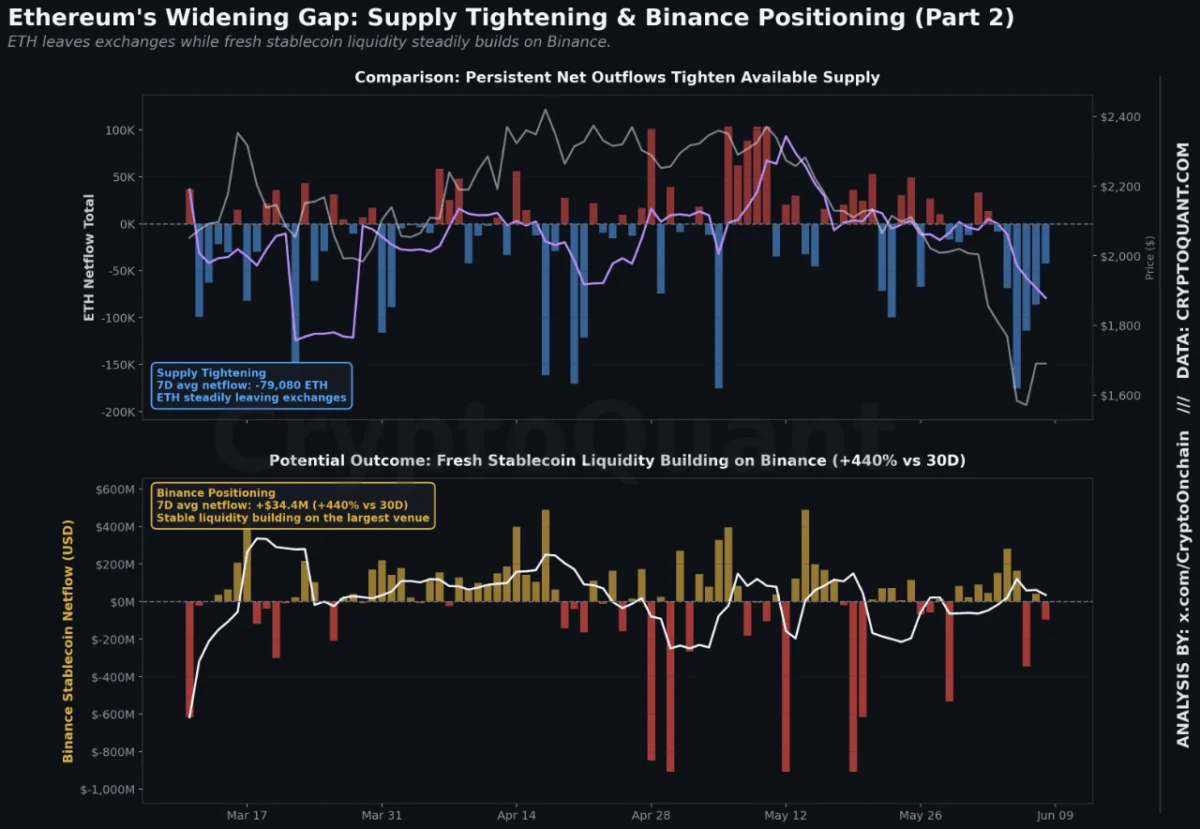
While Gate.io and Bybit have shown a significant reset, Binance, the world’s largest cryptocurrency exchange, presents a different picture. ETH’s Open Interest on Binance remains elevated, hovering around $2.76 billion, close to its previous higher range. This divergence from the deleveraging trend observed on other major platforms is a key point of analysis for CryptoQuant.

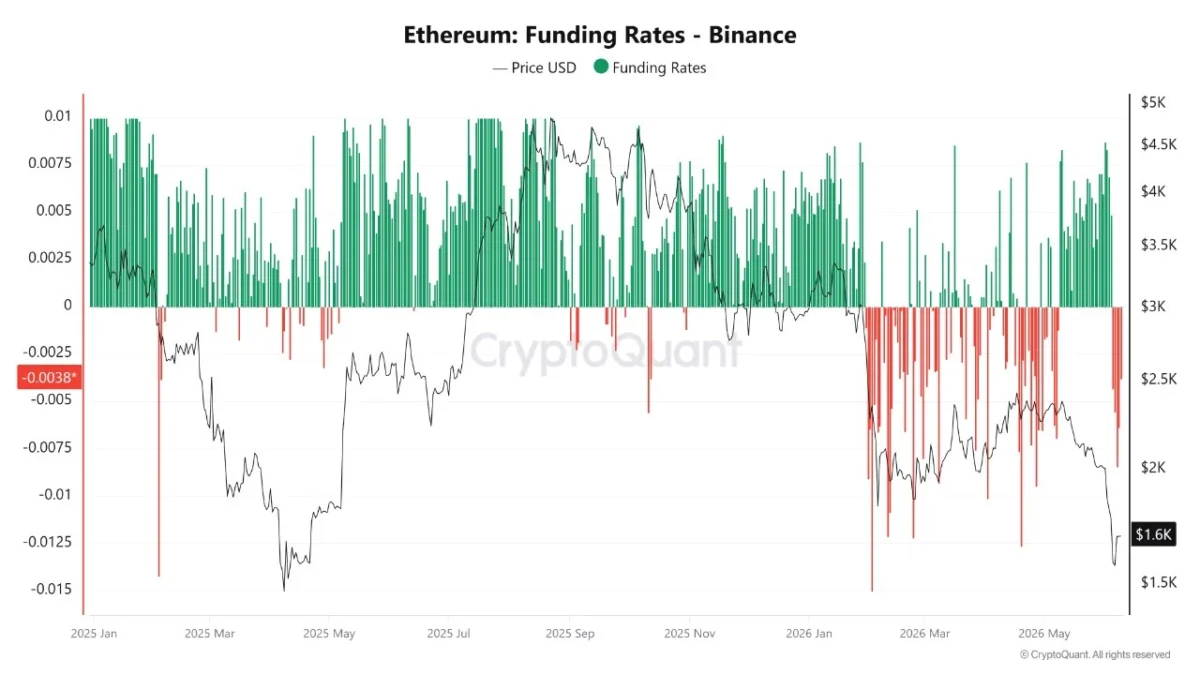
However, the presence of retained Open Interest on Binance does not necessarily signal bullish conviction. The exchange’s funding rates offer a more nuanced perspective. Binance’s funding rates have turned negative, currently standing at approximately -0.0038. Negative funding rates indicate that traders holding short positions are paying a premium to holders of long positions. In a declining market, this typically signifies a lack of bullish conviction among market participants. Instead of paying to hold long exposure, traders are either hedging existing positions, betting on further price declines (shorting), or simply lacking the aggressive bullish sentiment that would drive them to pay a premium.
This combination of retained Open Interest on Binance coupled with negative funding rates paints a complex picture. It suggests that while a significant portion of leverage has been cleared across the market, the remaining positions on the dominant exchange are not underpinned by strong directional conviction. This suggests a market that is more defensive and uncertain than one poised for an immediate rally.
Implications of the Uneven Derivatives Reset
The asymmetry in the Open Interest reset between exchanges is a critical detail that prevents the current deleveraging from being interpreted as a clean slate for a bullish resurgence. CryptoQuant’s analysis emphasizes that while Gate.io and Bybit have effectively wiped the slate clean of leveraged positions accumulated over more than a year, Binance’s continued high Open Interest, combined with negative funding, points to a different dynamic.
The report posits that this situation describes one of three scenarios:
- Defensive Positioning: Traders holding existing long positions may be hedging their exposure by taking short positions in the futures market to mitigate potential losses.
- Short Pressure: Traders are actively betting against a recovery, initiating short positions in anticipation of further price declines.
- Absence of Bullish Conviction: The lack of aggressive long-term interest means that participants are not willing to pay a premium to hold bullish exposure, indicating a general lack of confidence in an upward trajectory.
Collectively, these scenarios suggest a derivatives structure that has partially reset but with the most influential venue, Binance, holding residual positioning without the robust directional commitment that would typically signal constructive market sentiment. This creates a market environment where a recovery, if it occurs, may face significant headwinds from these lingering, unconvicted positions.

Ethereum’s Technical Breakdown: Below February Lows and Key Support
Beyond the derivatives data, Ethereum’s price action itself paints a bearish picture. The cryptocurrency has breached its February lows, trading near $1,670. This marks a significant technical breakdown, invalidating the broad trading range that had contained ETH for much of 2026 and confirming the continuation of a bearish structure that has been in place since its rejection from the $4,800 cycle peak.
From a market structure perspective, ETH has established a clear sequence of lower highs and lower lows. After failing to break above the critical $2,250-$2,350 resistance zone, the cryptocurrency lost the crucial $1,800 support area, which had previously served as the floor for its February-March consolidation. This breakdown triggered a swift decline towards the $1,500 region, where initial buying interest emerged to prevent a more severe collapse.
The Technical Landscape: Moving Averages and Support Levels
A key observation from the technical charts is that ETH is now trading below all major weekly moving averages. The 50-week, 100-week, and 200-week moving averages are situated significantly above the current price, reinforcing the strength of the prevailing downtrend and acting as formidable overhead resistance. This confluence of technical indicators suggests that any short-term rallies may face strong selling pressure.
The recent low established near the $1,500 mark has now become the most critical support level on the chart. For bulls to regain control and initiate a potential recovery, they must successfully defend this area. A sustained hold above $1,500 could pave the way for a bounce back towards the $1,800 level, potentially forming a base for future price appreciation.

However, the outlook remains precarious. A weekly close below these recent lows would signal a further deterioration of the long-term market structure. Such a development would expose Ethereum to a deeper retracement, potentially pushing its price towards the $1,300-$1,400 region. This would extend the current correction and solidify the bearish sentiment that has gripped the market.
Expert Analysis and Future Outlook
Sebastian, a seasoned crypto analyst with a UC Berkeley Fintech certification, emphasizes the importance of understanding the interplay between derivatives data and price action. "The unwinding of leverage is a crucial event in any market cycle," Sebastian notes. "When we see such a significant reset, it often precedes a period of price discovery. However, the unevenness of this reset, particularly the retained open interest on Binance coupled with negative funding, suggests a cautious, rather than aggressively bullish, sentiment. This implies that the current price weakness might be more than just a short-term correction."
He further elaborates, "The technical breakdown below key support levels, combined with the clear bearish structure of lower highs and lower lows, validates the concerns raised by the derivatives data. The market is currently at a crossroads. The $1,500 level is a critical battleground. If buyers can decisively defend it, we might see a short-term reprieve. But a failure to do so would open the door to further downside, potentially retesting levels not seen since early 2023."
The implications for Ethereum are significant. The current market conditions suggest a period of consolidation and potential further downside before any meaningful recovery can take hold. Investors and traders are closely watching the $1,500 support level, understanding that its defense will be crucial in determining the short-to-medium term trajectory of ETH. The broader market sentiment, heavily influenced by macroeconomic factors and regulatory developments, will also play a pivotal role in shaping Ethereum’s path forward.
The ongoing deleveraging in the derivatives market, while a sign of a healthier, less leveraged ecosystem in the long run, is currently contributing to the downward pressure on Ethereum’s price. The market is seeking clarity, and the current data points towards a cautious approach, with the potential for further downside before a sustainable recovery can be established. The coming weeks will be critical in determining whether the current support holds or if Ethereum succumbs to further bearish momentum.