Institutional Appetite for Crypto Surges: $16.9 Billion Inflow Streak Signals Robust Mid-Year Momentum
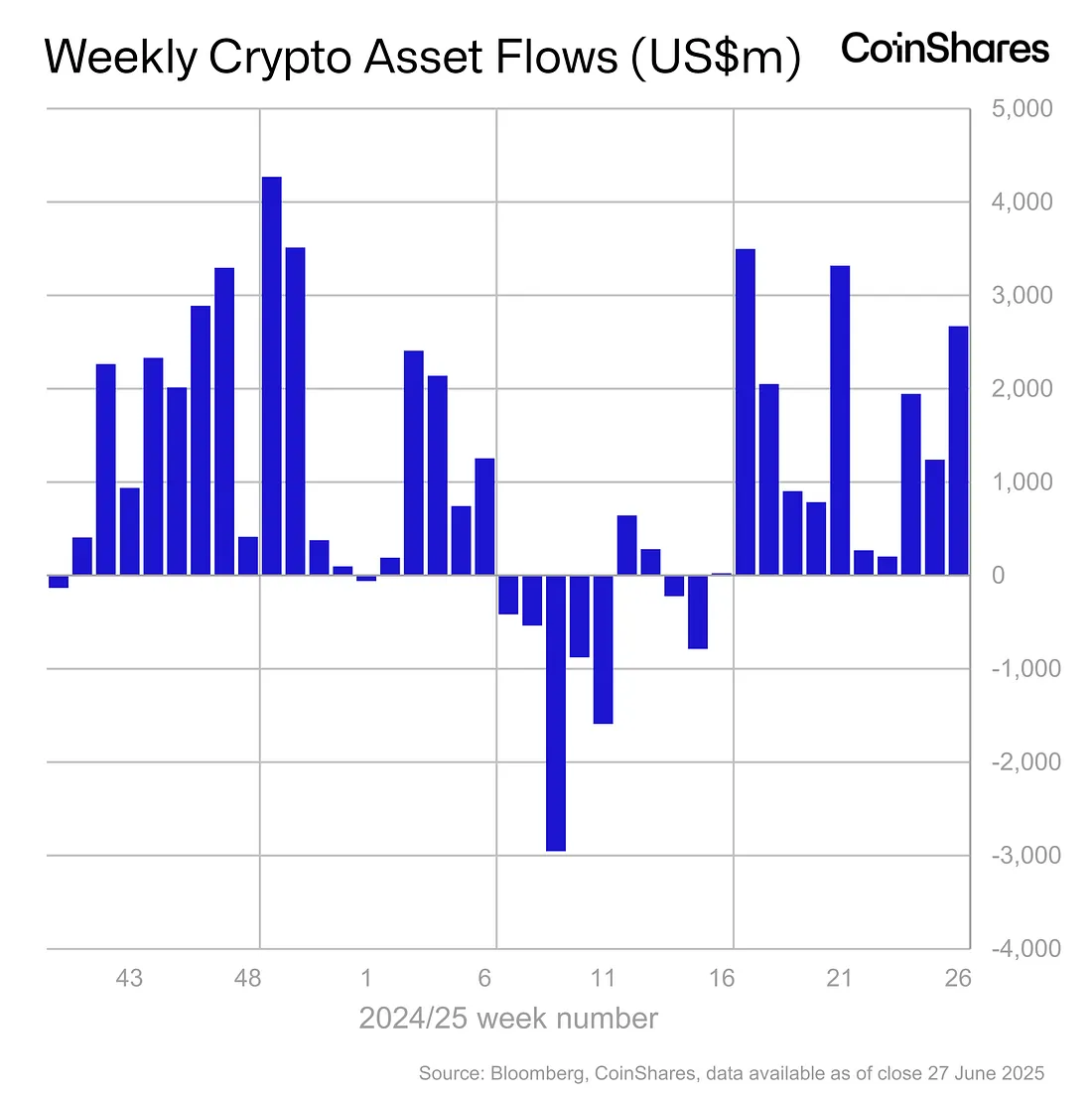
The institutional landscape for digital assets has undergone a profound transformation throughout the first half of 2025. According to the latest "Digital Asset Fund Flows Weekly" report published by industry-leading asset management firm CoinShares, institutional investors have funneled over $16.9 billion into crypto-linked investment vehicles over the past eleven weeks alone. This sustained surge underscores a resilient confidence in digital assets, even as macroeconomic conditions remain characterized by geopolitical tension and shifting monetary policy frameworks.
Main Facts: The State of Institutional Inflows
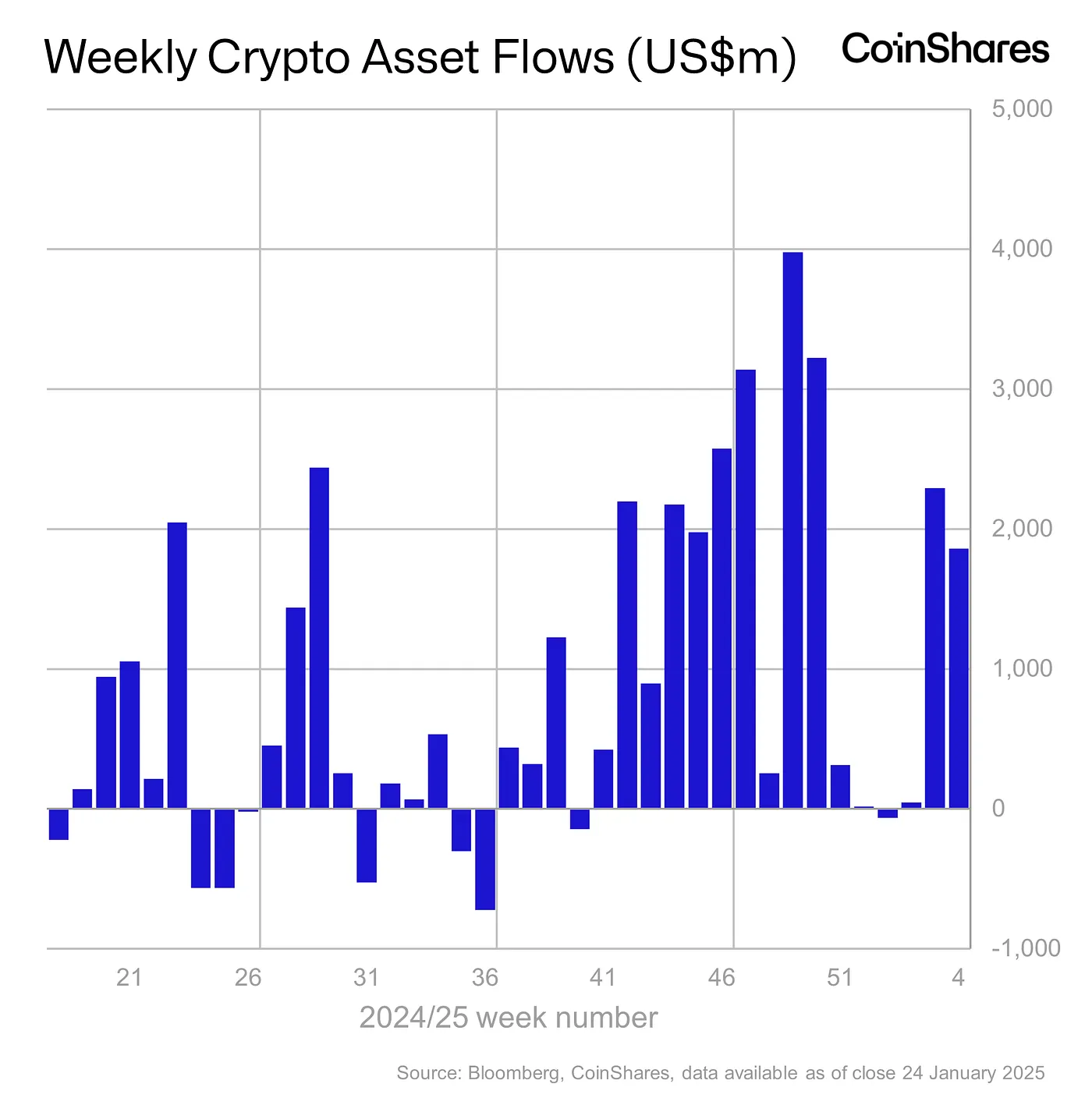
The data provided by CoinShares reveals that the first six months of 2025 (H1) have been remarkably productive for the digital asset sector. With $16.9 billion in inflows recorded in just the last quarter, the momentum is rivaling the figures seen during the same period in 2024, when inflows reached $18.3 billion by the end of June.
The primary driver of this capital accumulation is a convergence of traditional financial anxieties. Investors, increasingly wary of currency debasement and regional conflicts, appear to be viewing Bitcoin and Ethereum as essential hedges against systemic volatility. This "flight to quality" within the crypto space has been dominated by the United States, which continues to act as the global epicenter for institutional digital asset investment.
Chronology: A Quarter of Unrelenting Growth
To understand the current trajectory, one must look at the progression of the last eleven weeks.
- April 2025: The period began with tentative institutional accumulation following the initial market adjustments of Q1. Institutional vehicles started to see consistent weekly growth as participants weighed the impact of fluctuating interest rates.
- May 2025: As geopolitical tensions in several key regions intensified, capital flight into digital assets accelerated. This period marked the beginning of a sustained multi-week streak where inflows consistently exceeded the $1 billion threshold per week.
- June 2025: The momentum culminated in a massive surge throughout the month, bringing the eleven-week total to $16.9 billion. Notably, the final week of the half-year period saw a singular inflow of $2.7 billion, confirming that investor appetite remains largely unsatiated.
Supporting Data: Regional Shifts and Asset Performance
The geographic distribution of these inflows highlights a stark divide in global market sentiment.
The Dominance of the US Market
The United States remains the undisputed leader in institutional adoption, accounting for a massive $2.65 billion of the most recent $2.7 billion weekly inflow. This concentration reflects the continued maturation of spot-based investment vehicles and the increasing integration of crypto into traditional portfolio strategies by US-based asset managers and institutional funds.
European and Global Trends
While the US surged, the European landscape presented a more nuanced picture. Switzerland and Germany recorded moderate inflows of $23 million and $19.8 million, respectively, signaling that European institutional investors remain active, albeit at a lower volume than their American counterparts.
Conversely, certain regions saw outflows, suggesting a strategic rotation of capital. Canada, Hong Kong, and Brazil recorded outflows of $13.6 million, $2.3 million, and $2.4 million, respectively. The situation in Hong Kong is particularly notable, with $132 million in outflows during the month of June, a development likely linked to local market rebalancing and shifting regulatory sentiment in Asian markets.
Bitcoin and Ethereum: The Institutional Favorites
Bitcoin (BTC) continues to command the lion’s share of institutional attention, accounting for 83% of the total inflows recorded in the most recent reporting period. The $2.2 billion allocated to Bitcoin products underscores a fundamental bullish outlook among institutional players. Furthermore, the persistent outflows from "short-Bitcoin" investment products—which saw another $2.9 million in withdrawals—bring year-to-date (YTD) outflows for these instruments to $12 million. This trend serves as a powerful indicator that the "smart money" is positioning for long-term appreciation rather than short-term price discovery.
Ethereum (ETH) has also solidified its position as a pillar of institutional portfolios. Following a successful period of network maturation, Ethereum attracted $429 million in a single week, proving that the institutional narrative has moved beyond Bitcoin to encompass the broader smart-contract utility offered by the Ethereum ecosystem.
Official Perspectives and Expert Analysis
In its report, CoinShares analysts highlighted that the current market dynamics are not merely a product of speculative fervor, but a direct response to macroeconomic uncertainty.

"We believe this resilient investor demand has been driven by a combination of factors, primarily heightened geopolitical volatility and uncertainty surrounding the direction of monetary policy," the report stated.
The sentiment among analysts is that as central banks navigate the "higher-for-longer" interest rate environment, traditional bond markets have become less attractive as safe-haven assets. Digital assets, by contrast, offer a non-correlated alternative that appeals to institutional treasurers and hedge funds tasked with preserving capital against the erosive effects of global economic instability.
Implications: The New Financial Paradigm
The sustained inflow of $16.9 billion into digital assets carries significant implications for the broader financial system.
1. The Validation of Digital Asset Infrastructure
The massive influx of capital validates the infrastructure built by financial institutions over the last three years. The existence of secure, regulated, and liquid investment vehicles—such as ETFs and institutional-grade trusts—has bridged the gap between traditional finance and the decentralized ecosystem. This maturation reduces the barrier to entry for pension funds, insurance companies, and family offices.
2. Market Resilience and Reduced Volatility
Counter-intuitively, the entrance of large-scale institutional investors may act as a stabilizing force. As long-term capital replaces short-term speculative retail trading, the volatility profile of assets like Bitcoin may begin to moderate, potentially leading to a more stable growth curve that aligns with traditional asset classes.
3. Monetary Policy and Geopolitical Hedging
As governments grapple with record levels of debt and the potential for currency debasement, the institutional embrace of "digital gold" (Bitcoin) suggests that the financial sector is preparing for a future where traditional fiat-based hedges are insufficient. This represents a structural shift in how institutional portfolios are constructed, moving toward a "digital-first" allocation strategy.
4. Regulatory Pressures and Global Arbitrage
The divergence in regional flows—specifically the outflows seen in Hong Kong and Canada—suggests that institutional investors are sensitive to regulatory environments. As countries compete to attract digital asset capital, the market is likely to see an increase in "regulatory arbitrage," where funds migrate to jurisdictions that provide the greatest legal clarity and investor protection.
Conclusion: Looking Toward the Second Half of 2025
As we cross the mid-year threshold, the data suggests that the institutional "Crypto Spring" is far from over. With $16.9 billion in fresh capital deployed in just under three months, the market is signaling that it has moved past the era of digital assets as a niche experiment.
The coming months will be critical. Should geopolitical tensions persist and monetary policy remain in a state of flux, the institutional momentum is likely to continue. Investors are currently looking past short-term price swings, focusing instead on the long-term potential of blockchain technology to serve as the foundational ledger for a digital global economy. While risks remain—including the potential for sudden regulatory shifts or further macro-shocks—the current trajectory indicates that institutional entities are increasingly viewing digital assets as a permanent, non-negotiable component of a diversified, future-proof portfolio.
Disclaimer: The information provided in this article is for educational and informational purposes only and does not constitute financial, investment, or legal advice. The Daily Hodl is not an investment advisor, and the opinions expressed here are not recommendations to buy or sell any assets. Cryptocurrency investments are high-risk and speculative in nature. Investors should conduct their own thorough due diligence and consult with a certified financial advisor before making any investment decisions. The Daily Hodl participates in affiliate marketing and may receive commissions for certain links.