Institutional Appetite Surges: Crypto Markets Defy ‘Hawkish’ Rate Cut Fears with $1.9 Billion Inflow
The landscape of digital asset investment has experienced a significant shift in sentiment, according to the latest data from CoinShares. Following a period of heightened anticipation and market volatility, institutional investors have signaled a robust endorsement of the cryptocurrency sector in the wake of the U.S. Federal Reserve’s long-awaited decision to lower interest rates. Despite initial trepidation, the market has demonstrated a decisive move toward accumulation, recording two consecutive weeks of massive capital inflows.
Main Facts: A Resilient Market Response
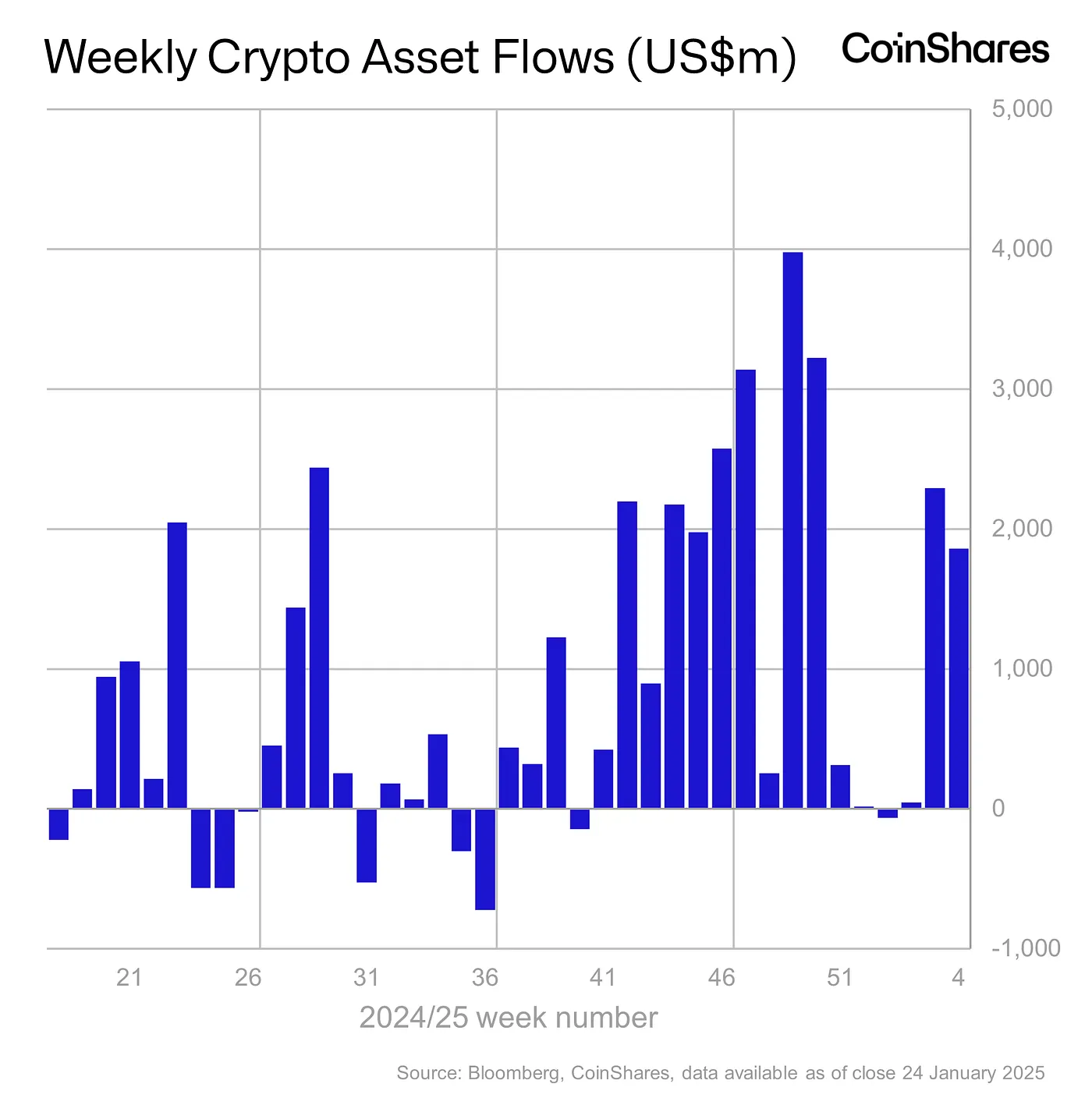
The latest Digital Asset Fund Flows Weekly Report from CoinShares reveals that digital asset investment products garnered a total of $1.9 billion in inflows over the past week. This development is particularly noteworthy because it reflects a recovery from an initial period of uncertainty. When the Federal Reserve announced its interest rate cut—a move characterized by many analysts as a "hawkish cut"—institutional investors initially adopted a defensive posture.
The "hawkish" nature of the cut refers to the Fed’s communication strategy, which tempered expectations for aggressive future easing, thereby creating a temporary cooling effect on risk-on assets. However, as investors processed the macroeconomic implications, the trend reversed sharply. By the latter half of the week, specifically on Thursday and Friday, a massive wave of capital totaling $746 million surged into the market, confirming that institutional confidence remains largely intact.
Chronology of Market Sentiment
To understand the recent surge, one must look at the timeline of events leading up to the Fed’s announcement.
The Anticipation Phase
For months, global financial markets were gripped by speculation regarding the timing and magnitude of the Federal Reserve’s pivot. Crypto assets, which are historically sensitive to liquidity conditions, saw significant volatility as traders priced in various scenarios. Institutional portfolios were largely positioned on the sidelines, waiting for a definitive signal from the central bank.
The Immediate Reaction: Initial Caution
When the interest rate cut was finalized, the immediate market response was not the unbridled rally some had anticipated. Instead, there was a brief moment of hesitation. Institutional ETP investors paused to evaluate the "hawkish" undertones of the Fed’s messaging. During the first 48 hours following the announcement, the market showed signs of a "wait-and-see" approach, with capital movement remaining relatively subdued.
The Pivot: A Strong Finish
The narrative changed by the midweek mark. As market participants began to digest the long-term implications of lower rates—which generally favor non-sovereign assets like Bitcoin—the "dip-buying" phenomenon took hold. Thursday and Friday served as a crescendo, with nearly $750 million flooding into crypto ETPs, cementing a positive weekly total that erased any doubt about the market’s current appetite for risk.
Supporting Data: Regional and Asset-Specific Trends
The geographical distribution of these inflows highlights a clear leader in the global push for digital asset adoption.
Regional Breakdown
- The United States: The U.S. remains the undisputed epicenter of this institutional wave, accounting for a staggering $1.8 billion of the $1.9 billion total. This suggests that the proximity to U.S.-based spot ETFs and the maturity of American financial markets continue to drive global demand.
- European and Emerging Markets: Germany and Switzerland followed with $51.6 million and $47.3 million in inflows, respectively. Brazil also showcased growing interest with $9.3 million.
- Regional Outliers: While global sentiment was overwhelmingly positive, Hong Kong bucked the trend, recording minor outflows of $3.1 million. This divergence underscores that while the institutional appetite is global, specific regulatory or regional liquidity conditions can still create localized variances in fund flows.
Asset-Specific Performance
Bitcoin (BTC) maintained its dominance, attracting $977 million in inflows. Interestingly, the data also points to a decline in bearish sentiment; short-Bitcoin investment products, which profit from a decline in price, saw $3.5 million in outflows. The total Assets under Management (AuM) for short-Bitcoin products have now dwindled to a multi-year low of $83 million, suggesting that institutional "bears" are retreating.
Ethereum (ETH) emerged as a major winner, capturing $772 million in inflows. This is a crucial data point, as it indicates a renewed institutional interest in the second-largest cryptocurrency, potentially signaling a broadening of the crypto-portfolio beyond just Bitcoin. Furthermore, Solana (SOL) and XRP continued to perform well, drawing $127.3 million and $69.4 million, respectively, showing that altcoin interest remains robust despite the focus on primary assets.
Official Responses and Expert Analysis
While official institutional statements regarding these flows are often opaque, market analysts have been vocal about the implications of these figures. The consensus among researchers at firms like CoinShares is that the market is finally "digesting" the reality of a lower-rate environment.

The prevailing theory among analysts is that the Federal Reserve’s pivot marks the beginning of a new liquidity cycle. "Low interest rates generally lower the opportunity cost of holding non-yielding assets," noted one market analyst. "When the Fed cuts, the cost of capital decreases, and the attractiveness of ‘hard’ assets like Bitcoin—which operate outside the traditional banking credit system—increases significantly."
The Rekt Capital charts and other industry indicators have mirrored this sentiment, suggesting that the recent price action is consistent with historical patterns seen during the early stages of liquidity expansion cycles.
Implications for the Future
The implications of these inflows are multi-faceted, affecting everything from market volatility to long-term regulatory sentiment.
1. Liquidity and Macroeconomic Sensitivity
The fact that inflows accelerated after the initial reaction suggests that institutional investors are looking past the "hawkish" rhetoric and focusing on the underlying trend of monetary easing. If this trend continues, we may see a period of sustained accumulation where crypto assets act as a hedge against fiat currency debasement.
2. Diversification of Institutional Portfolios
The high inflow figures for Ethereum, Solana, and XRP suggest that the "institutional crypto trade" is maturing. Investors are no longer merely buying Bitcoin as a "digital gold" proxy; they are actively allocating capital into utility-driven networks and smart contract platforms. This diversification is a healthy sign of market maturation.
3. The Decline of the ‘Short’ Trade
The consistent outflows from short-Bitcoin products are perhaps the most telling indicator of market confidence. As institutional investors move to long-only positions, the "short-squeeze" risk decreases, potentially leading to more stable, organic price appreciation.
4. Regulatory and Policy Outlook
As billions of dollars continue to flow into U.S.-regulated ETPs, the political weight of the crypto industry grows. The sheer volume of institutional capital flowing through these vehicles makes it increasingly difficult for policymakers to ignore the asset class, likely fostering an environment where future regulatory discussions are focused on integration rather than prohibition.
Conclusion
The data from CoinShares paints a picture of a market that has weathered the "hawkish" uncertainty of the Federal Reserve and emerged stronger. With nearly $2 billion in new capital entering the space in just one week, the trend suggests that institutional investors view the current macroeconomic environment as an opportune moment to increase their exposure to digital assets.
As we move forward, the interplay between Federal Reserve policy and crypto inflows will remain the most critical variable in the market. For now, however, the message from the institutional sector is clear: the pivot has arrived, and capital is moving to digital assets with renewed conviction.
Disclaimer: This report is for informational purposes only and does not constitute financial, investment, or legal advice. Cryptocurrency investments are subject to high market volatility and risks. Investors should conduct their own due diligence and consult with a qualified financial advisor before making any investment decisions. The Daily Hodl does not endorse or recommend the purchase or sale of any specific assets.