Institutional Appetite Surges: Digital Asset Funds Kick Off 2026 with $582 Million Influx
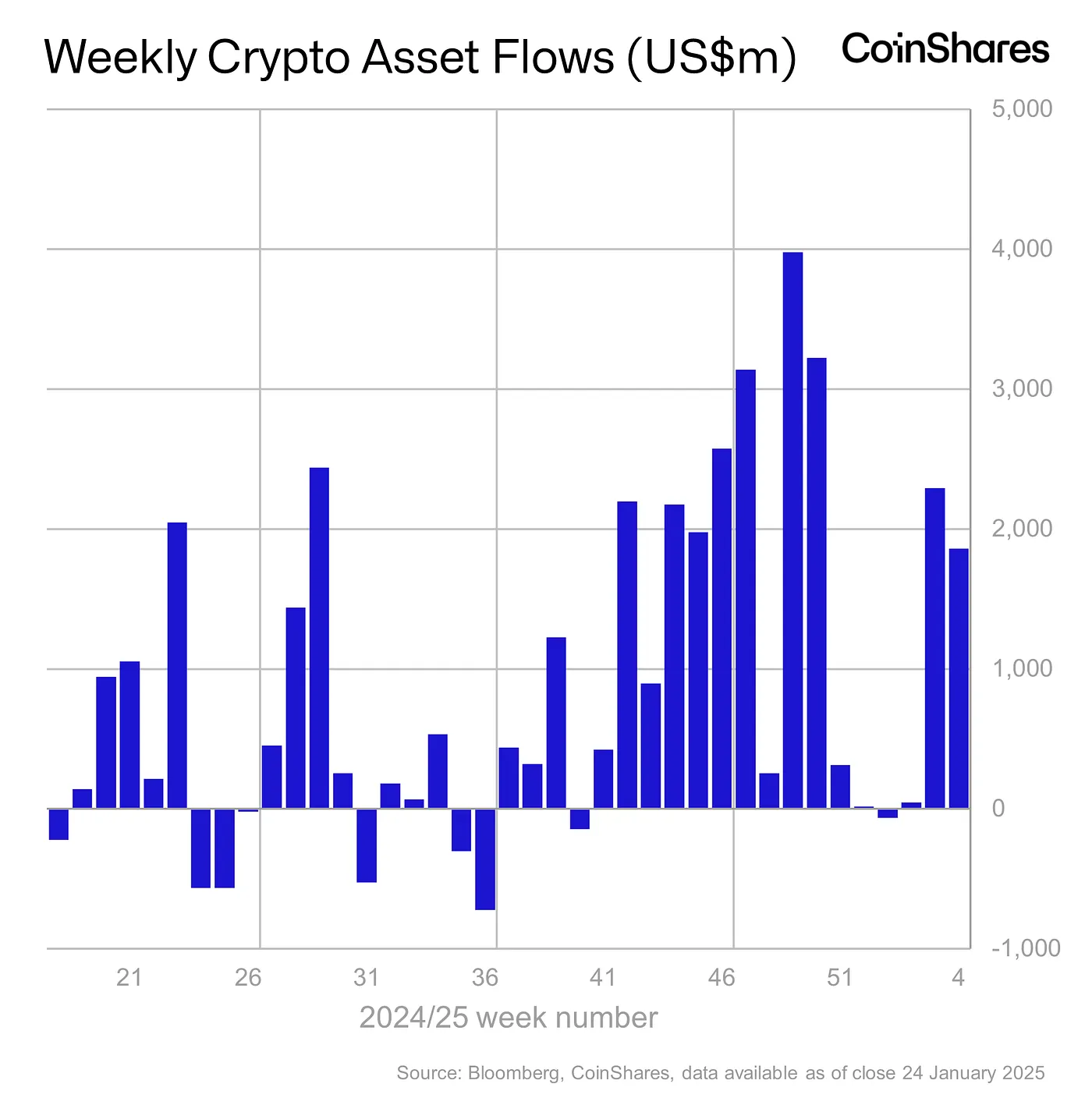
As the global financial markets pivot toward the new year, institutional interest in the digital asset space has demonstrated remarkable resilience. According to the latest data from CoinShares, institutional investment vehicles dedicated to cryptocurrencies have recorded a robust $582 million in net inflows over the past week, signaling a strong start to 2026 and reinforcing the institutionalization of the crypto asset class.
Main Facts: A Strong Opening for Digital Asset Products
The recent CoinShares report highlights a dynamic start to the year. While the week began with a period of volatility and minor outflows, the market sentiment shifted drastically by Friday. The report notes that last Friday alone saw a massive surge of $671 million in inflows, effectively cushioning the earlier losses and bringing the net weekly total to $582 million.
The breakdown of these inflows reveals a clear preference among institutional players:
- Bitcoin (BTC): Remains the primary beneficiary, attracting $512 million in new capital.
- Ethereum (ETH): Continues to capture significant interest, with $119 million flowing into investment products.
- XRP: Emerged as a notable performer with $10.7 million in fresh inflows.
- Solana (SOL): Experienced a brief cooling-off period, recording $30 million in outflows, bucking the general trend of the week.
This data point underscores the ongoing commitment from institutional entities—such as hedge funds, asset managers, and family offices—to maintain exposure to digital assets despite macroeconomic uncertainties.
Chronology: From a Record-Breaking 2025 to a Fresh Start
To understand the significance of this week’s numbers, it is essential to contextualize them against the backdrop of 2025. The previous year was nothing short of historic for the crypto-investment industry.
The 2025 Performance Summary
Throughout 2025, global digital asset products accumulated a staggering $47.2 billion in total inflows. This figure sits just shy of the all-time record of $48.7 billion established in 2024. The consistent growth throughout the year suggests that institutional investors have moved past the "experimental" phase of crypto investment and are now treating digital assets as a foundational component of a diversified portfolio.
Regional Shifts and Market Maturity
The geographic distribution of these inflows provides a map of global sentiment:
- The United States: Remained the dominant force, accounting for $44.5 billion of the annual inflows. While this represented a 12% decline from 2024, the volume remains unparalleled globally.
- Germany’s Resurgence: Perhaps the most significant development in 2025 was Germany’s turnaround. After posting outflows in the previous cycle, the region rebounded with $2.5 billion in net inflows, signaling renewed confidence from European institutional stakeholders.
- Canada and Switzerland: Continued their steady performance, adding $1.1 billion and $775 million, respectively.
Supporting Data: The Year of the Altcoin Giants
While Bitcoin remains the king of inflows—accounting for $26.9 billion in 2025—the narrative of the past year was defined by the aggressive growth of Ethereum, XRP, and Solana.
Asset-Specific Gains
The growth in Ethereum and altcoin products has been nothing short of exponential:
- Ethereum: Led the charge among altcoins with $12.7 billion in annual inflows, a 138% increase year-over-year. This surge reflects growing institutional interest in the smart contract ecosystem and the broader utility of the Ethereum network.
- XRP: Recorded an impressive $3.7 billion in inflows, representing a 500% increase year-over-year.
- Solana: The standout in terms of relative growth, Solana saw $3.6 billion in inflows—a massive 1,000% gain compared to the previous year.
Conversely, "other" altcoins saw their popularity wane, with inflows falling by 30% year-over-year, suggesting that institutional capital is becoming increasingly selective, focusing on assets with established track records, high liquidity, and clear utility.
Official Perspectives and Market Analysis
The sustained inflow of capital into these products is not merely a product of market hype but is deeply rooted in the structural changes occurring within the financial sector.
Industry analysts suggest that the "institutionalization" of crypto is being driven by the availability of regulated, transparent investment vehicles. As CoinShares noted in its research blog, the ability for institutional investors to gain exposure to Bitcoin or Ethereum without the complexities of self-custody or direct wallet management remains the primary catalyst for these flows.
Furthermore, the presence of "short-bitcoin" products—which attracted $105 million in 2025—indicates that while the broader market sentiment is bullish, there is a sophisticated subset of investors utilizing these tools to hedge against volatility. This inclusion of hedging mechanisms is a hallmark of a maturing market, moving away from a speculative retail-driven environment toward a more nuanced, professionalized trading ecosystem.
Implications: What This Means for the Future
The implications of this institutional trend are far-reaching for both the crypto ecosystem and the traditional financial world.
1. Market Stability and Liquidity
As institutional capital becomes a larger percentage of total market volume, the volatility traditionally associated with crypto assets may begin to moderate. Institutional players generally have longer time horizons and more disciplined risk management strategies than retail traders, which can serve to stabilize price action over the long term.
2. Regulatory Normalization
The massive inflows from the US, Germany, and Canada are heavily reliant on clear regulatory frameworks. The fact that billions of dollars are moving into these products suggests that legal and compliance teams at major financial institutions are satisfied with the current regulatory landscape, particularly regarding custody and reporting standards.
3. The "Flight to Quality"
The shift away from miscellaneous altcoins toward the "Big Three" (Bitcoin, Ethereum, and to an extent, XRP/Solana) suggests a "flight to quality." As the market matures, investors are increasingly differentiating between high-utility networks and speculative tokens. This consolidation is likely to continue, with capital gravitating toward assets that offer the strongest network effects and the most robust developer ecosystems.
4. Macroeconomic Hedge
With global economic conditions characterized by fluctuating inflation rates and geopolitical instability, the role of Bitcoin and Ethereum as "digital gold" or "digital oil" is being tested in real-time. The continued investment during periods of economic uncertainty proves that these assets are increasingly viewed by institutional allocators as legitimate diversifiers within a global portfolio.
Conclusion
As we look further into 2026, the trajectory established in the first week of January is telling. Despite the occasional day of outflows, the overarching trend is one of institutional accumulation. With nearly $600 million flowing into digital asset products in the first week of the year alone, the appetite for crypto-exposure shows no sign of diminishing.
Investors and market observers should continue to monitor these weekly flow reports from CoinShares, as they serve as the "canary in the coal mine" for institutional sentiment. As these products become more accessible and the infrastructure around them becomes more sophisticated, the line between traditional finance and decentralized digital assets will continue to blur, likely leading to a new chapter of integration and growth in the global financial system.
Disclaimer: The information provided in this article is for informational purposes only and does not constitute financial, investment, or legal advice. Investing in digital assets, including Bitcoin, Ethereum, XRP, and Solana, carries a high level of risk. The Daily Hodl is not an investment advisor and does not recommend the buying or selling of any specific asset. Always conduct your own thorough due diligence and consult with a certified financial planner before making any investment decisions. The Daily Hodl participates in affiliate marketing and may receive compensation for certain links.