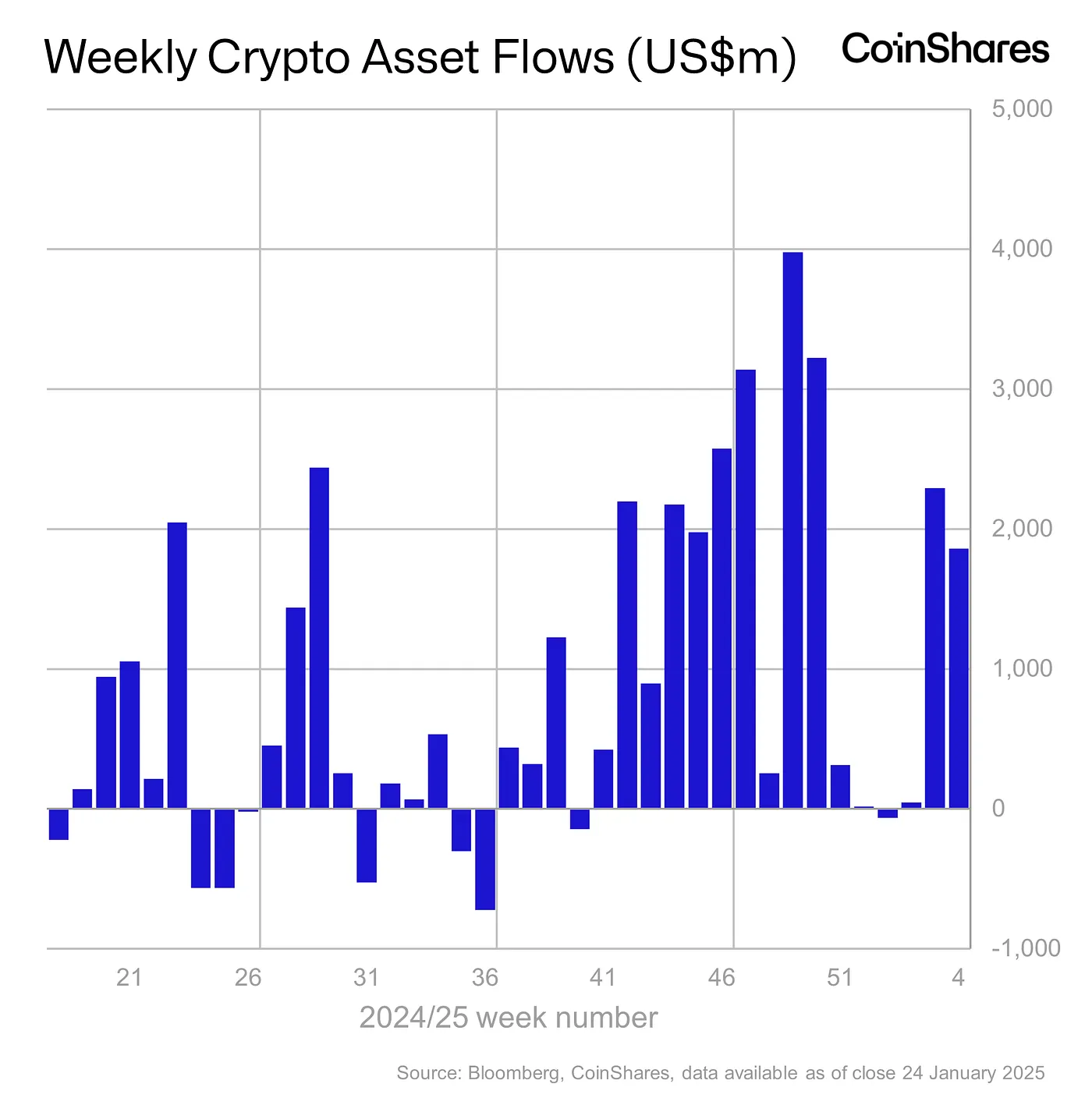
Institutional Capital Floods Crypto Markets: CoinShares Reports Near-Record Yearly Inflows
The digital asset landscape is witnessing a seismic shift in institutional sentiment, with crypto-focused investment vehicles recording one of the most robust periods of capital accumulation in recent history. According to the latest Digital Asset Fund Flows Weekly Report published by the European digital asset management giant CoinShares, the sector has entered a state of rapid expansion, drawing nearly $1 billion in fresh capital within a single week.
This surge, characterized by a fourth consecutive week of consistent inflows, has pushed year-to-date (YTD) investment totals to $6.7 billion, placing the market within striking distance of the all-time high of $7.3 billion recorded in early February. As macroeconomic headwinds shift and regulatory attitudes in the United States undergo a transformation, investors are increasingly utilizing exchange-traded products (ETPs) as a primary conduit for crypto exposure.
The Core Data: A Multi-Billion Dollar Surge
The figures released by CoinShares paint a picture of aggressive institutional repositioning. Last week alone, global digital asset investment products absorbed $882 million. This liquidity influx is not merely a localized phenomenon but a global trend, though the distribution of this capital reveals a clear geographic hierarchy.
Geographic Distribution of Capital
The United States remains the undisputed engine of this growth. Commanding $840 million in inflows, American markets have dwarfed their international counterparts. This dominance is largely attributed to the maturity of the U.S. ETF ecosystem and the increasing comfort level of institutional allocators with regulated crypto-financial instruments.
In contrast, other major markets showed mixed results. While Germany and Australia recorded healthy inflows of $44.5 million and $10.2 million respectively, regions like Canada and Hong Kong saw minor outflows of $8 million and $4.3 million. This divergence suggests that capital is actively rotating toward jurisdictions that offer the most liquid and regulatory-certain environments for digital asset management.
Chronology of the Recent Bull Run
To understand the current momentum, one must look at the progression of the market over the last two months.
- Mid-Q3 Stabilization: Following a period of volatility during the summer, late-quarter data began showing a consistent "buy-the-dip" mentality among institutional investors.
- The October Inflow Streak: October marked the beginning of a sustained four-week inflow streak, signaling that institutional investors were no longer merely "dipping a toe" into the market but were committed to long-term positions.
- November Momentum: The most recent report highlights an acceleration of this trend. The $882 million weekly inflow represents a significant spike compared to earlier weeks, indicating that the market is currently experiencing a "fear of missing out" (FOMO) phase among institutional participants.
- The Milestone Achievement: A landmark event occurred last week when U.S.-listed spot Bitcoin ETFs reached a cumulative net inflow milestone of $62.9 billion since their inception in January 2024. This figure officially eclipsed the previous high-water mark of $61.6 billion set in early February, confirming that the current institutional cycle has officially surpassed the post-launch euphoria phase.
The Catalyst Drivers: Why Institutions Are Buying
CoinShares’ research team suggests that the current price appreciation and the corresponding surge in inflows are not driven by a single factor, but by a "confluence of macro-economic pressures."
1. The Global M2 Money Supply Expansion
The M2 money supply—a measure of cash, checking deposits, and easily convertible near-money—is expanding globally. As central banks potentially move toward more accommodative monetary policies, investors are increasingly looking toward "hard assets" to hedge against the debasement of fiat currency. Bitcoin, often categorized as "digital gold," is the primary beneficiary of this liquidity injection.
2. Stagflationary Risks in the United States
The persistent threat of stagflation—a period of stagnant economic growth combined with high inflation—has traditional investors rattled. When traditional equities and fixed-income assets show signs of fragility, uncorrelated assets become highly attractive. Institutional managers are increasingly viewing Bitcoin as a necessary component of a diversified portfolio designed to weather a stagflationary environment.
3. The Shift in Political and Regulatory Stance
Perhaps the most significant driver is the emerging political consensus in the U.S. regarding digital assets. Several U.S. states have begun exploring or approving legislation that recognizes Bitcoin as a "strategic reserve asset." This legitimization at the sub-federal level creates a "halo effect," providing institutional investors with the regulatory cover they need to increase their crypto allocations without fearing future litigation or restrictive policies.
Asset-Specific Performance: Bitcoin vs. Altcoins
While the crypto market is diverse, the current inflow cycle is heavily concentrated on the market leader.
Bitcoin’s Hegemony
Bitcoin (BTC) continues to dominate the narrative, attracting $867 million of the $882 million total weekly inflow. This concentration highlights that for institutional investors, Bitcoin remains the primary vehicle for gaining crypto exposure. The efficiency of spot Bitcoin ETFs has reduced the friction for entry, allowing capital that was previously sidelined to enter the market with ease.
The Altcoin Landscape
While Bitcoin dominates, there is evidence of targeted interest in specific altcoin ecosystems.
- SUI: The SUI network has emerged as a surprising standout, recording $11.7 million in inflows. This suggests that investors are looking beyond legacy assets to projects with high-throughput capabilities and robust development ecosystems.
- Ethereum: Interestingly, Ethereum (ETH) saw a relatively muted response, with only $1.5 million in inflows. This divergence between BTC and ETH reflects a broader trend where investors are currently prioritizing the "store-of-value" narrative of Bitcoin over the "smart-contract utility" narrative of Ethereum, at least for the time being.
Implications for the Future of Finance
The data provided by CoinShares suggests that we are witnessing the institutionalization of crypto as an asset class. The transition from speculative retail participation to sustained institutional flows marks a "coming of age" for the sector.
Implications for Asset Managers
Investment firms that have not yet integrated digital assets into their portfolio offerings are likely to find themselves at a competitive disadvantage. The demand for ETPs is no longer speculative; it is a clear mandate from high-net-worth individuals and institutional clients who view crypto as a hedge against systemic risk.
The Impact on Market Liquidity
With billions of dollars flowing into ETFs, the underlying market structure for Bitcoin is becoming more stable. As more BTC is locked up in these regulated vehicles, the circulating supply on exchanges effectively tightens. This supply-demand imbalance, when combined with the upcoming economic realities of 2025, could set the stage for sustained price appreciation.
Regulatory and Policy Outlook
The trend of states adopting Bitcoin as a strategic reserve asset is likely to put pressure on federal regulators to provide a more comprehensive framework. If the U.S. continues to lead in inflows, it forces other jurisdictions—particularly in Europe and Asia—to either modernize their own financial products or risk losing their position as hubs for financial innovation.
Conclusion: A New Era of Institutional Adoption
The latest report from CoinShares serves as a bellwether for the digital asset market. We are no longer in the "early adopter" phase; we are in the era of institutional integration. The combination of macro-economic uncertainty, a loosening monetary environment, and a more favorable regulatory landscape has created a "perfect storm" for crypto inflows.
As we look toward the remainder of the year, all eyes will be on whether this momentum can be sustained. With Bitcoin consistently breaking records and institutional infrastructure expanding, the narrative surrounding digital assets has shifted from "high-risk speculation" to "strategic portfolio necessity." For the savvy investor, the message from the markets is clear: institutional capital has arrived, and it is here to stay.
Disclaimer: The information provided in this article is for educational and informational purposes only and does not constitute financial, investment, or legal advice. Digital asset investments carry a high level of risk and may not be suitable for all investors. Please consult with a qualified financial advisor before making any investment decisions. The Daily Hodl is not responsible for any financial losses incurred based on the content of this article.