Institutional Capital Returns: Crypto Markets Surge Following Federal Reserve’s Pivotal Rate Decision
The global digital asset landscape is currently experiencing a robust resurgence of institutional confidence. Following months of macroeconomic uncertainty and anticipation, the United States Federal Reserve finally initiated a shift in monetary policy, triggering a significant reaction across crypto-focused exchange-traded products (ETPs). According to the latest data from leading digital asset management firm CoinShares, the sector has recorded its second consecutive week of substantial inflows, signaling a shift in investor sentiment as the markets begin to digest the long-term implications of a changing interest rate environment.
Main Facts: A Resurgence of Institutional Appetite
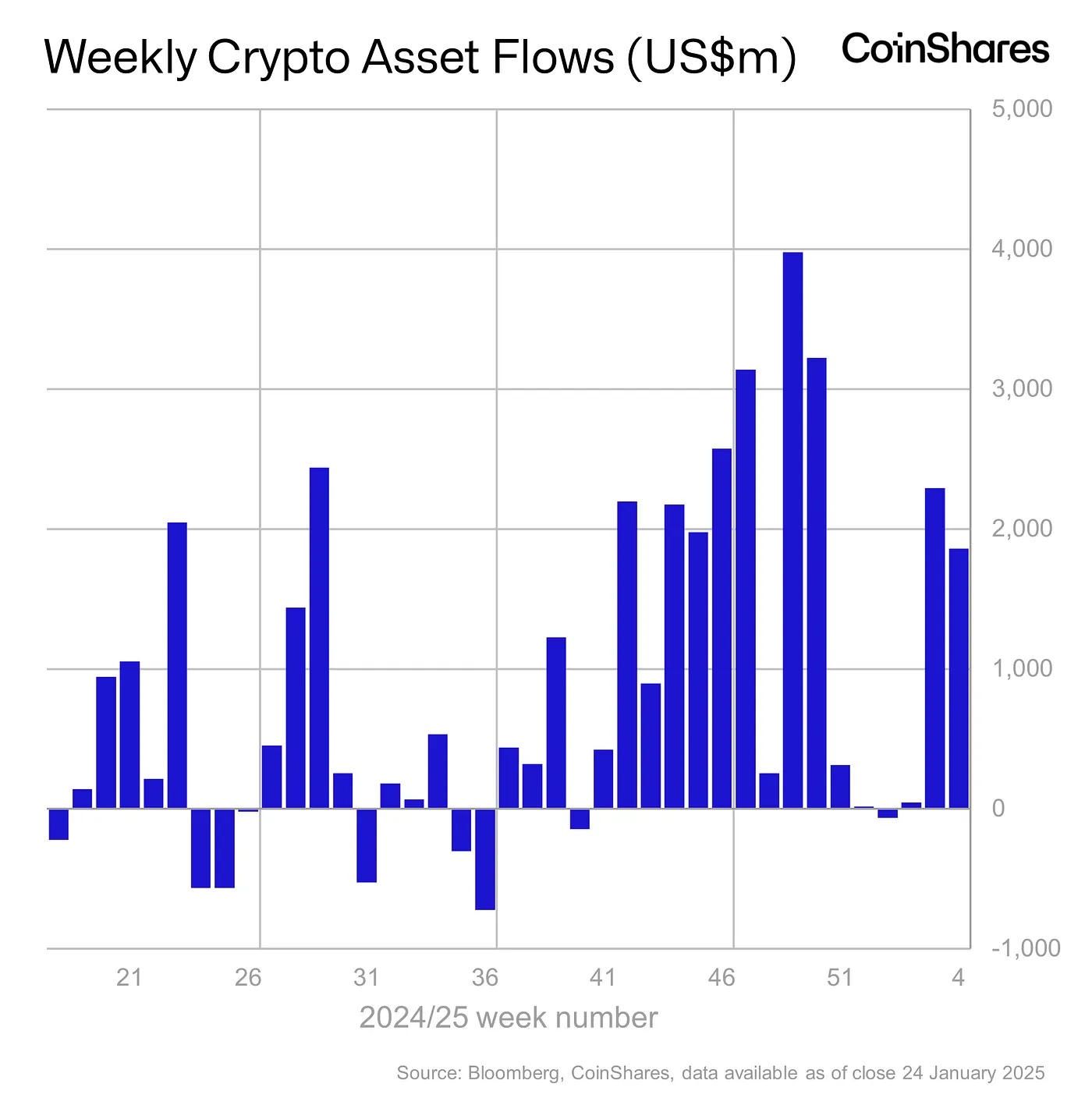
The most recent Digital Asset Fund Flows Weekly Report published by CoinShares reveals a total of US$1.9 billion in new capital flowing into digital asset investment vehicles. This influx marks a decisive turnaround from the period of stagnation that characterized the summer months.
The data underscores a critical narrative: despite initial skepticism regarding the nature of the Federal Reserve’s recent interest rate cut—often described by analysts as a “hawkish cut”—institutional investors ultimately viewed the move as a green light for risk-on assets. While the initial reaction to the Fed’s announcement was marked by a palpable sense of caution, the latter half of the week saw a dramatic acceleration in capital allocation. Specifically, $746 million in institutional capital entered the market on Thursday and Friday alone, suggesting that once the initial volatility settled, sophisticated investors recognized the potential for digital assets to hedge against—or benefit from—the shifting macroeconomic tides.
Chronology of Market Sentiment
To understand the current market momentum, one must look at the timeline of the past week.
Early Week: The "Hawkish Cut" Confusion
When the Federal Reserve announced its rate decision, the language surrounding the move was not as dovish as some market participants had hoped. The resulting “hawkish cut” caused a brief period of confusion. Institutional investors, typically risk-averse in the face of policy ambiguity, took a wait-and-see approach. This period was defined by muted trading volumes and a lack of clear directional conviction.
Mid-Week: Reassessment and Analysis
As market analysts and economic strategists began dissecting the Federal Reserve’s policy statements and the accompanying Summary of Economic Projections, the narrative shifted. Investors began to weigh the benefits of increased liquidity against the potential for a slowing economy. By mid-week, it became clear that the institutional consensus was coalescing around the idea that lower interest rates, regardless of the Fed’s messaging, provide a more favorable environment for non-yielding assets like Bitcoin.
Late Week: The Surge
The influx of nearly $750 million in the final 48 hours of the trading week confirms that the institutional "smart money" had reached a bullish conclusion. This late-week buying pressure was the primary driver behind the $1.9 billion weekly total, turning what started as a hesitant week into one of the most successful periods for crypto ETPs in recent months.
Supporting Data: Regional and Asset-Specific Trends
The geographical distribution of these inflows provides a clear map of where global sentiment is strongest. The United States remains the undisputed leader in institutional crypto adoption, accounting for a staggering $1.8 billion of the total inflows. This dominance is largely attributed to the maturity of the U.S. spot Bitcoin and Ethereum ETF markets, which provide a regulated gateway for institutional capital.
Following the United States, other key financial hubs showed continued interest:
- Germany: Recorded $51.6 million in inflows.
- Switzerland: Added $47.3 million.
- Brazil: Saw $9.3 million in capital entry.
Conversely, Hong Kong experienced a minor divergence, seeing outflows totaling $3.1 million. This suggests that while global sentiment is broadly positive, regional regulatory and market-specific factors continue to influence investor behavior in Asian markets.
Asset Performance Breakdown
The composition of these inflows reveals a clear hierarchy in institutional preference:

- Bitcoin (BTC): As the primary bellwether for the industry, Bitcoin attracted $977 million in inflows. This confirms that Bitcoin remains the foundational asset for institutional portfolios. Interestingly, short-bitcoin products continued to face headwinds, posting $3.5 million in outflows. This has driven the total Assets under Management (AuM) for short-bitcoin products to a multi-year low of just $83 million, indicating a significant decline in bearish institutional sentiment.
- Ethereum (ETH): Ethereum followed closely with an impressive $772 million in inflows. This is a vital metric, as it indicates that institutions are looking beyond Bitcoin to diversify their digital asset exposure, particularly following the successful integration of Ethereum into US-based spot ETFs.
- Solana (SOL): Solana solidified its position as the premier "alternative" to the two market leaders, capturing $127.3 million in new capital.
- XRP: Rounding out the top performers, XRP saw $69.4 million in inflows, suggesting that investors are regaining confidence in the utility and legal standing of the asset.
Official Responses and Expert Analysis
Market observers and analysts have been quick to link these flows to the broader macro environment. CoinShares’ report explicitly notes that the “hawkish cut” was initially misinterpreted as a negative signal before the market realized that the Fed’s priority has shifted toward supporting economic growth.
Industry experts suggest that the "hawkish" element of the cut—the Fed’s desire to maintain a level of restraint despite lower rates—is being viewed as a prudent move to avoid an inflationary spike, rather than a sign of a looming recession. This perception is fueling institutional appetite, as it implies a “Goldilocks” scenario: rates are trending downward, but the underlying economy remains resilient enough to support investment.
Furthermore, the significant contraction in short-bitcoin product AuM serves as a strong signal from institutional desks. Market makers and institutional traders are effectively signaling that they no longer view the downside risk as compelling enough to justify the costs of hedging, reflecting a broader expectation of price appreciation.
Implications for the Future of Crypto Markets
The return of institutional capital carries profound implications for the digital asset market as we move into the final quarter of the year.
1. The Normalization of Digital Assets
The massive $1.9 billion inflow is evidence that digital assets have moved firmly into the mainstream of institutional asset allocation. This is no longer speculative "retail-driven" volatility; it is a systematic allocation of capital by pension funds, hedge funds, and family offices utilizing regulated ETPs.
2. The Impact of Fed Policy on BTC
As the Federal Reserve continues its rate-cutting cycle, the opportunity cost of holding non-yielding assets like Bitcoin decreases. Historically, this environment is highly correlated with crypto bull markets. The fact that Bitcoin captured nearly $1 billion in a single week suggests that investors are front-running a period of prolonged monetary easing.
3. Diversification Beyond Bitcoin
The substantial inflows into Ethereum, Solana, and XRP highlight a maturing market. Institutional investors are moving down the risk curve, seeking assets that offer smart contract functionality, decentralized finance (DeFi) utility, and cross-border payment efficiency. This trend likely signals that the next phase of the crypto market cycle will be driven by the adoption of blockchain-based infrastructure, rather than just the "digital gold" narrative.
4. Regulatory and Macro Risks
Despite the optimism, the market remains sensitive. The "hawkish" nature of the recent rate cut serves as a reminder that the Federal Reserve remains cautious. Any future data showing an unexpected spike in inflation could force the Fed to pause, which would likely result in an immediate correction across crypto markets. Investors are advised to remain vigilant, as institutional sentiment can shift rapidly if the macro-narrative changes.
Conclusion
The latest CoinShares report paints a picture of a resilient and growing institutional crypto market. While the initial reaction to the Federal Reserve’s interest rate cut was characterized by caution, the subsequent flood of capital proves that institutional investors are positioning themselves for a future where digital assets play a central role in a diversified portfolio.
With Bitcoin leading the charge, and significant capital flowing into Ethereum and other altcoins, the stage is set for a dynamic period of growth. As the global financial system continues to adjust to the reality of lower interest rates, digital assets are increasingly being recognized as a vital component of the modern financial architecture. Investors, however, should continue to conduct their own due diligence, keeping in mind that while institutional momentum is a strong indicator of value, the crypto market remains inherently volatile and subject to global macroeconomic pressures.