The Illusion of Liquidity: Why Wash Trading Continues to Plague the Cryptocurrency Landscape
The integrity of global financial markets relies heavily on the transparency and accuracy of trading data. In the nascent and volatile world of cryptocurrency, however, these pillars are frequently undermined by a pervasive practice known as "wash trading." Recently, Bobby Ong, co-founder of the prominent crypto data aggregator CoinGecko, sounded a stark alarm, suggesting that the industry’s struggle with artificial volume inflation is not only persisting but, in many corners of the market, worsening.
The Mechanics of Market Deception
Wash trading is a sophisticated form of market manipulation where an entity simultaneously acts as both the buyer and the seller of a financial instrument. By trading with themselves—or through coordinated accounts—bad actors create the illusion of high trading volume and liquidity. This deceptive practice is designed to lure unsuspecting investors, who often interpret high volume as a signal of popularity, healthy liquidity, and genuine market interest.
In the context of decentralized digital assets, wash trading serves a specific, predatory purpose: it creates a "pump" effect. For a fledgling cryptocurrency project or an unscrupulous exchange, generating fake volume can artificially boost a token’s ranking on market aggregators, potentially triggering algorithmic trading bots and retail FOMO (Fear Of Missing Out).
A Concerning Trend: The Industry’s "Worsening" State
In a candid interview with BlockTV, Bobby Ong articulated the gravity of the situation, noting that the spot market, in particular, has become increasingly unreliable as a source of truth.
"I would say that the situation is actually getting worse," Ong stated. "The trading volume for the spot market is almost close to not being used as a trusted source anymore. There are so many exchanges that are just wash trading that it’s ridiculous."
Ong’s assessment highlights a systemic failure within the non-regulated sector of the crypto exchange landscape. While established, multi-billion-dollar platforms have moved toward compliance, a vast "long tail" of smaller, offshore, or unregulated exchanges continues to operate in a gray area, where reporting metrics are often inflated to attract volume-hungry traders and listing fees from token issuers.
The Search for Truth: The Primacy of Regulated Exchanges
Given the prevalence of data manipulation, Ong suggests that investors must fundamentally change how they perceive market metrics. He argues that the only reliable data points in the current environment are those originating from strictly regulated, licensed entities.

"If you really want to get real 24-hour trading volume, I think the only real way is to look at volume from regulated exchanges—such as those in the US, in Japan—those licensed exchanges," Ong explained. "Coinbase, Gemini, and Japanese regulated exchanges; those regulated exchanges will likely have legit volumes."
For the average retail investor, the implication is clear: the reported volume on many global exchanges should be treated with extreme skepticism. When a platform lacks a regulatory framework, it lacks the oversight required to prevent internal price manipulation. Without audit trails or stringent anti-money laundering (AML) controls, these exchanges remain a "black box" where volume is often a fabricated marketing tool rather than a reflection of organic market demand.
Chronology of Market Distrust
The issue of fake volume is not a new development, but its visibility has evolved alongside the industry.
- 2017-2018 (The Bull Run Expansion): As Bitcoin’s price surged, hundreds of new exchanges emerged globally. This period saw the "volume arms race," where exchanges competed for higher rankings on tracking websites to capture the attention of a massive influx of new retail participants.
- 2019 (The Wake-Up Call): Research reports from firms like Bitwise Asset Management brought the issue to the mainstream, revealing that up to 95% of reported Bitcoin trading volume on unregulated exchanges was likely non-existent. This period marked a pivotal shift in how data aggregators like CoinGecko approached their methodology.
- Late 2019 to Present: The industry began witnessing a divergence. While regulated platforms moved toward institutional-grade reporting, the "long tail" of offshore exchanges turned to more sophisticated, bot-driven wash trading, making detection significantly harder for automated systems that rely solely on public API feeds.
Data-Driven Solutions: The "Trust Score" Evolution
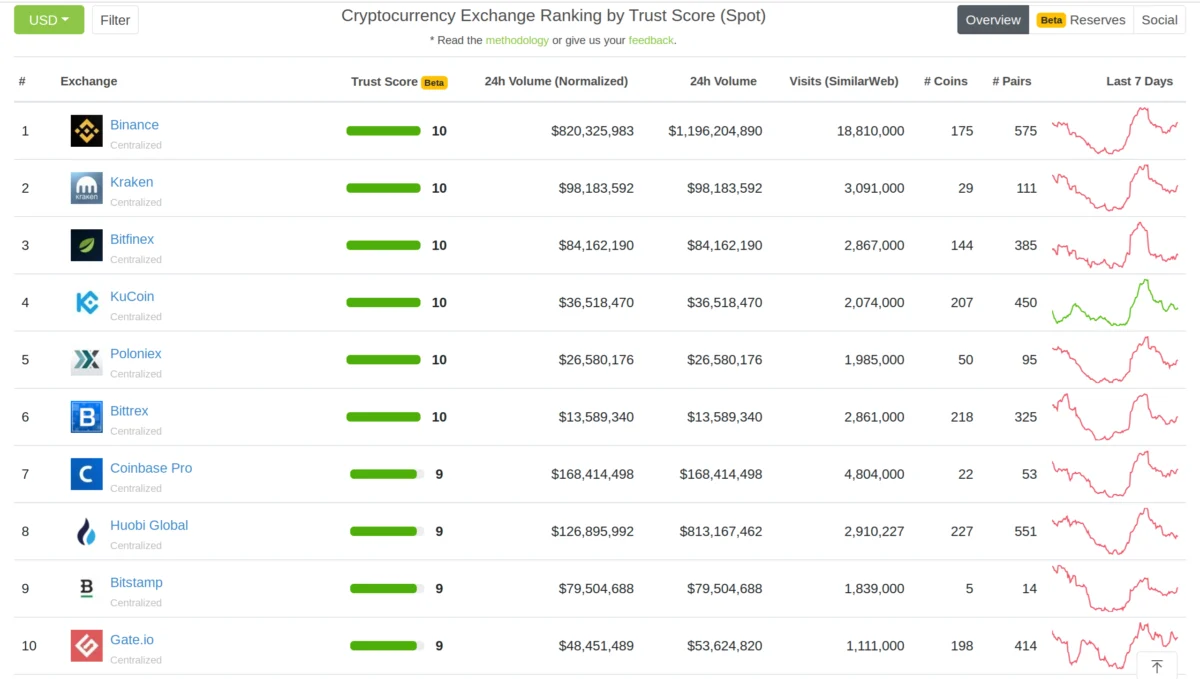
In response to the endemic nature of fake volume, CoinGecko introduced a "Trust Score" metric. This initiative represents a departure from traditional volume-based rankings, which previously served as the industry standard.
The Trust Score algorithm is a multi-dimensional approach designed to penalize exchanges that rely on inflated data. By incorporating three key pillars, CoinGecko aims to provide a more holistic view of an exchange’s health:
- Reported Trading Volume: While still a factor, it is no longer the sole determinant.
- Web Traffic Analysis: Using data to correlate volume with actual human activity on an exchange’s website.
- Order Book Depth: A technical metric that measures how much a large order would move the price. Legitimate, high-volume exchanges typically have deep order books that can absorb significant trade sizes without drastic price slippage.
By weighting these metrics, CoinGecko has managed to provide a more accurate hierarchy of market participants. Currently, top-tier exchanges like Binance and Kraken consistently rank at the top, reflecting that their volume is supported by real user activity and robust order books.
Implications for the Future of Crypto
The persistence of wash trading creates a ripple effect that extends far beyond the losses of individual investors.
1. The Regulatory Burden
The prevalence of market manipulation provides fuel for regulators worldwide to justify tighter restrictions. When wash trading is rampant, it complicates the narrative for those advocating for the legitimacy of digital assets. Regulators in the US, EU, and Asia point to these manipulative practices as evidence that the crypto sector requires the same, if not more, oversight than traditional equity markets.
2. The Institutional Barrier
Institutional investors—pension funds, hedge funds, and family offices—require verifiable data to deploy capital. Wash trading creates an "information asymmetry" that makes it impossible for risk-averse institutions to enter the market. As long as a significant portion of volume is perceived as fake, the industry will struggle to attract the level of institutional liquidity necessary for widespread adoption.
3. The Erosion of Price Discovery
True price discovery occurs when supply and demand meet in a fair and transparent environment. When volume is spoofed, the "market price" becomes a distorted reflection of reality. This can lead to flash crashes, where liquidity suddenly evaporates because the perceived depth of the market was never actually there.
Moving Toward a Transparent Future
The warning from Bobby Ong is a necessary reminder that the cryptocurrency industry is still in its adolescence. While technological advancements in blockchain have provided the tools for transparency, the human element—the desire to manipulate markets for short-term gain—remains a persistent challenge.
For the industry to mature, the focus must shift from "volume at any cost" to "transparency as a competitive advantage." As data aggregators refine their algorithms and regulatory frameworks continue to solidify, the gap between legitimate, regulated exchanges and those operating in the shadows will likely widen.
Investors, for their part, must exercise heightened due diligence. The era of blindly trusting exchange-reported volume is over. By prioritizing platforms with transparent, auditable, and regulated operations, the community can collectively work to marginalize the influence of bad actors, fostering a healthier, more resilient market ecosystem.
Disclaimer: The information provided in this article is for educational and informational purposes only and does not constitute financial, investment, or legal advice. Cryptocurrency investments involve significant risk, including the loss of principal. Readers are encouraged to conduct their own thorough research and consult with a qualified financial advisor before making any investment decisions.