Institutional Capital Surge: Bitcoin and Digital Assets Witness Record Inflows Following U.S. Policy Shifts
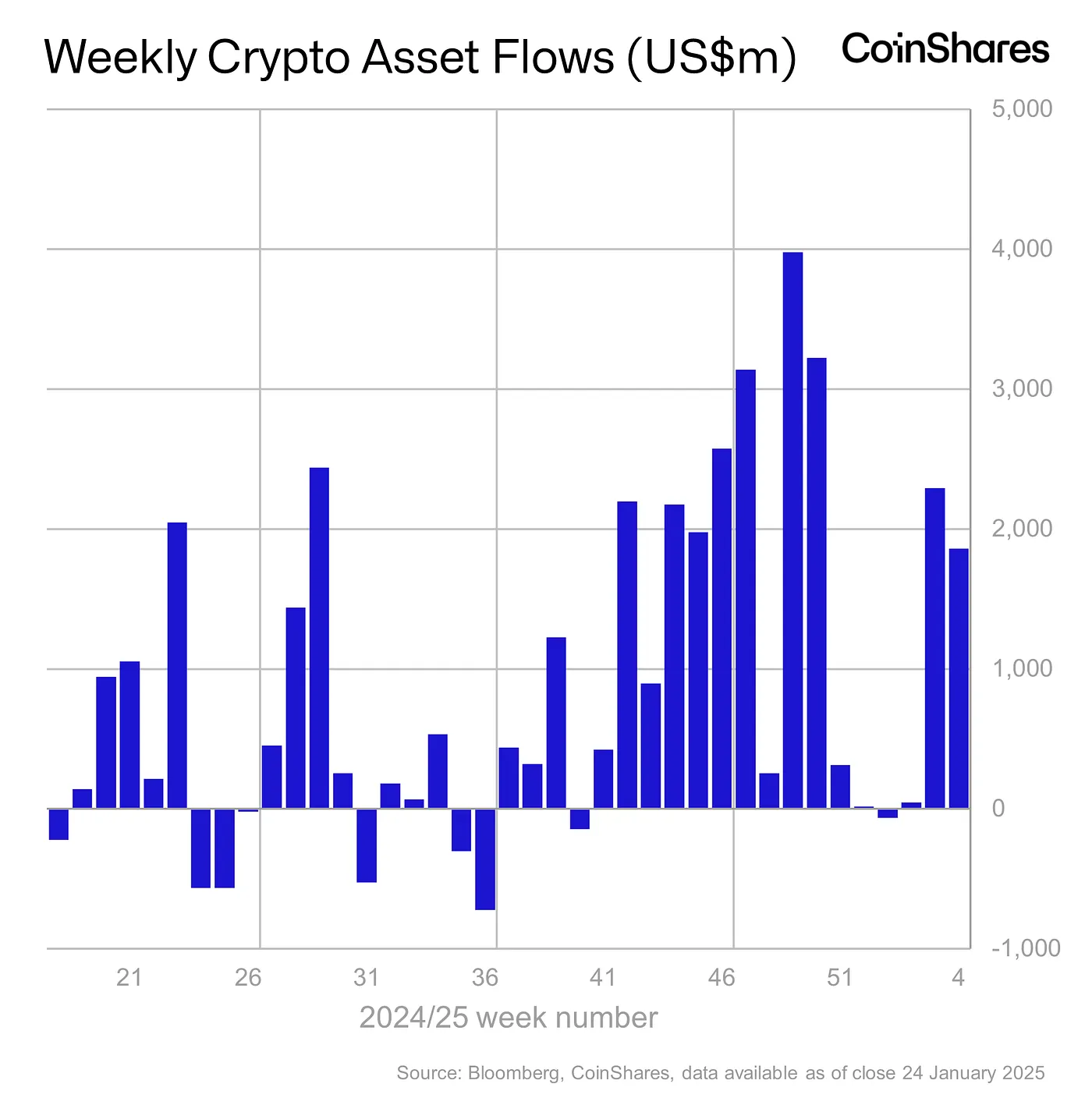
In a dramatic display of market confidence, institutional investors have accelerated their commitment to the digital asset sector, pouring nearly $2 billion into investment vehicles over the past week. According to the latest "Digital Asset Fund Flows" report from prominent crypto asset manager CoinShares, this massive influx of capital appears to be a direct reaction to recent executive orders originating from the Trump administration, signaling a potential paradigm shift in the U.S. government’s stance toward cryptocurrency.
The Main Facts: A $2 Billion Vote of Confidence
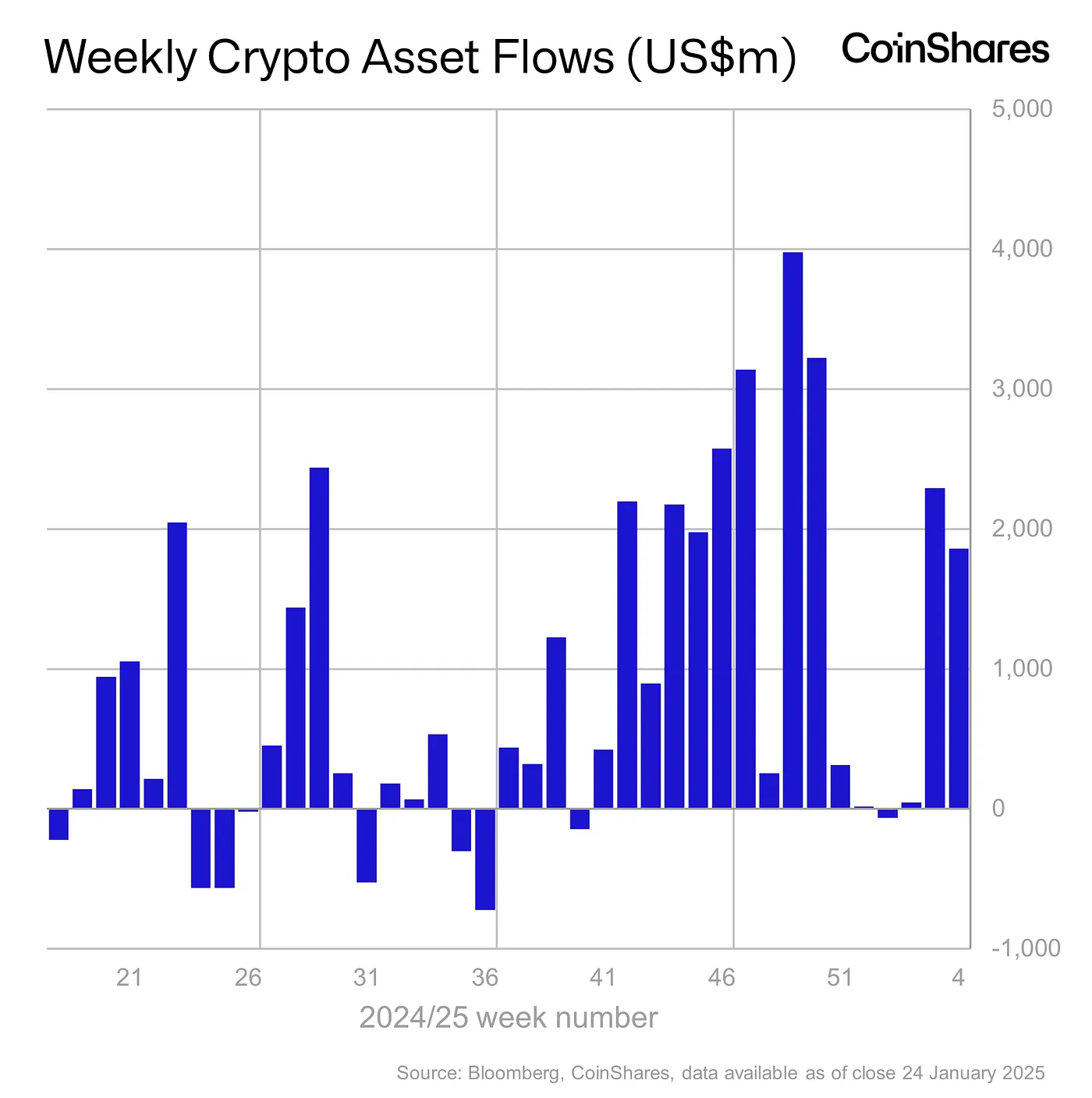
The data confirms that institutional appetite for crypto remains insatiable, even as market prices experienced a period of relative consolidation. CoinShares reports that digital asset investment products saw a staggering $1.9 billion in inflows last week. This brings the year-to-date (YTD) total inflows to $4.8 billion—a figure that underscores the rapid institutionalization of the asset class.
Perhaps most telling is the resilience of trading volumes. Despite relatively flat price action during the reporting period, trading activity remained elevated at $25 billion for the week. This volume represents approximately 37% of all activity on trusted crypto exchanges, indicating that the institutional buying pressure is not just a trend, but a significant component of current market liquidity.
Chronology: The Catalyst of Executive Action
To understand the current surge, one must look at the recent timeline of events within the U.S. regulatory environment. The crypto market, often volatile and reactive to political sentiment, found a new catalyst in the form of presidential executive orders aimed at integrating digital assets into the national financial framework.
The Policy Pivot
The spark for this historic inflow was the emergence of directives proposing the initiation of a strategic reserve asset in Bitcoin. This proposal represents a departure from previous years of regulatory ambiguity. By positioning Bitcoin as a potential national strategic asset, the administration has effectively signaled that digital currencies are moving from the periphery of finance to the center of sovereign balance sheets.
The Market Response
Following the announcement of these orders, institutional capital began to flow in earnest. While the market had already been anticipating regulatory clarity, the specific nature of the executive orders provided the "institutional green light" that many hedge funds, family offices, and asset managers had been waiting for. The influx began in earnest mid-week, culminating in a total of $1.7 billion entering U.S.-based funds alone, effectively cementing the United States as the global leader in institutional crypto adoption.
Supporting Data: A Deep Dive into Asset Flows
The data provided by CoinShares offers a granular view of where capital is being deployed. The trend is clear: Bitcoin remains the undisputed "digital gold" for institutional players, while Ethereum and other altcoins are seeing varying degrees of interest.
Bitcoin’s Dominance
Bitcoin (BTC) continues to command the lion’s share of institutional interest. Last week, BTC-specific investment vehicles recorded $1.6 billion in inflows. To put this in perspective, Bitcoin accounted for 92% of all inflows into the digital asset sector over the period. The YTD total for Bitcoin now stands at $4.4 billion.
Interestingly, the report highlights that even as Bitcoin hit new all-time highs pre-inauguration, there was a resurgence of interest in short-Bitcoin ETFs, which saw inflows of $5.1 million. This suggests that while the prevailing sentiment is overwhelmingly bullish, sophisticated traders are hedging their bets against potential volatility following the rapid price appreciation.
Ethereum and the Altcoin Landscape
Ethereum (ETH), the second-largest cryptocurrency by market capitalization, continues to attract significant capital. ETH-focused funds recorded $205 million in inflows, bringing its YTD inflows to $177 million—a positive turnaround for the asset.
While most of the crypto ecosystem enjoyed inflows, there were exceptions. Cardano (ADA) was the notable outlier, suffering minor outflows during the week. However, this is largely viewed as a rebalancing act rather than a loss of faith in the underlying technology. The broader trend remains overwhelmingly positive, with virtually every other digital asset product tracked by CoinShares maintaining or growing its assets under management.

Geographic Breakdown: Who is Investing?
The concentration of capital is distinctly skewed toward Western markets, with the United States leading the charge.
- United States: $1.7 billion in inflows. The sheer volume here reflects the U.S. market’s reaction to the domestic policy environment.
- Switzerland: $35 million. Continuing its role as a stable, crypto-friendly European hub.
- Canada: $31 million. A long-standing leader in regulated crypto ETFs.
- Germany: $23 million. Demonstrating consistent institutional interest despite broader European regulatory hurdles.
Implications for the Future of Finance
The implications of this massive capital injection are profound, suggesting that the "institutionalization" of crypto is no longer a forecast, but a reality.
1. The Normalization of Bitcoin as a Reserve Asset
If the U.S. government moves forward with a strategic Bitcoin reserve, it effectively legitimizes the asset for institutional portfolios that were previously restricted by mandate or risk policy. Pension funds, sovereign wealth funds, and insurance companies—entities that manage trillions of dollars—now have a roadmap for entry.
2. Market Maturity and Liquidity
The high trading volume relative to price movement suggests that the market is becoming deeper and more liquid. Institutional players are not just "buying and holding"; they are actively trading, hedging, and managing positions. This reduces the likelihood of "flash crashes" and increases the overall stability of the ecosystem.
3. The Regulatory "Arms Race"
The fact that the U.S. is capturing the vast majority of inflows will likely trigger a competitive response from other jurisdictions. Countries that have been hesitant to embrace crypto may soon feel the economic pressure to provide clearer regulatory frameworks to prevent capital flight to the United States.
Official Responses and Expert Sentiment
While the report focuses on quantitative data, the qualitative sentiment in the industry is one of cautious optimism. Industry leaders have long argued that the absence of clear regulation was the single greatest barrier to entry for Wall Street. The current executive actions are being interpreted as the first significant steps toward removing those barriers.
However, analysts remain divided on the long-term impact of a strategic reserve. Proponents argue it will stabilize the price of Bitcoin and provide a hedge against inflation. Critics, conversely, point to the potential for increased government oversight and the irony of centralizing an asset specifically designed to be decentralized.
Conclusion: A New Era for Digital Assets
The $1.9 billion in weekly inflows serves as a definitive statement from the institutional investment community. By aligning their capital with the shift in U.S. policy, these institutions are signaling that the era of digital assets being treated as "fringe" or "speculative" is coming to a close.
As we look toward the remainder of the year, the key metrics to watch will be the follow-through on the proposed strategic reserve and whether the current inflow trend can be sustained as the market digests these political developments. One thing is certain: the institutional gates have been opened, and the flow of capital is rapidly accelerating the integration of digital assets into the bedrock of the global financial system.
Disclaimer: The information provided in this article is for educational and informational purposes only and does not constitute financial, investment, or legal advice. Cryptocurrency investments involve a high degree of risk, including the potential loss of principal. Readers should conduct their own due diligence and consult with a professional financial advisor before making any investment decisions. The author and publisher are not responsible for any financial losses incurred based on the information provided herein.