Institutional Capital Surge: Crypto Investment Products Kick Off 2025 with $582 Million Influx
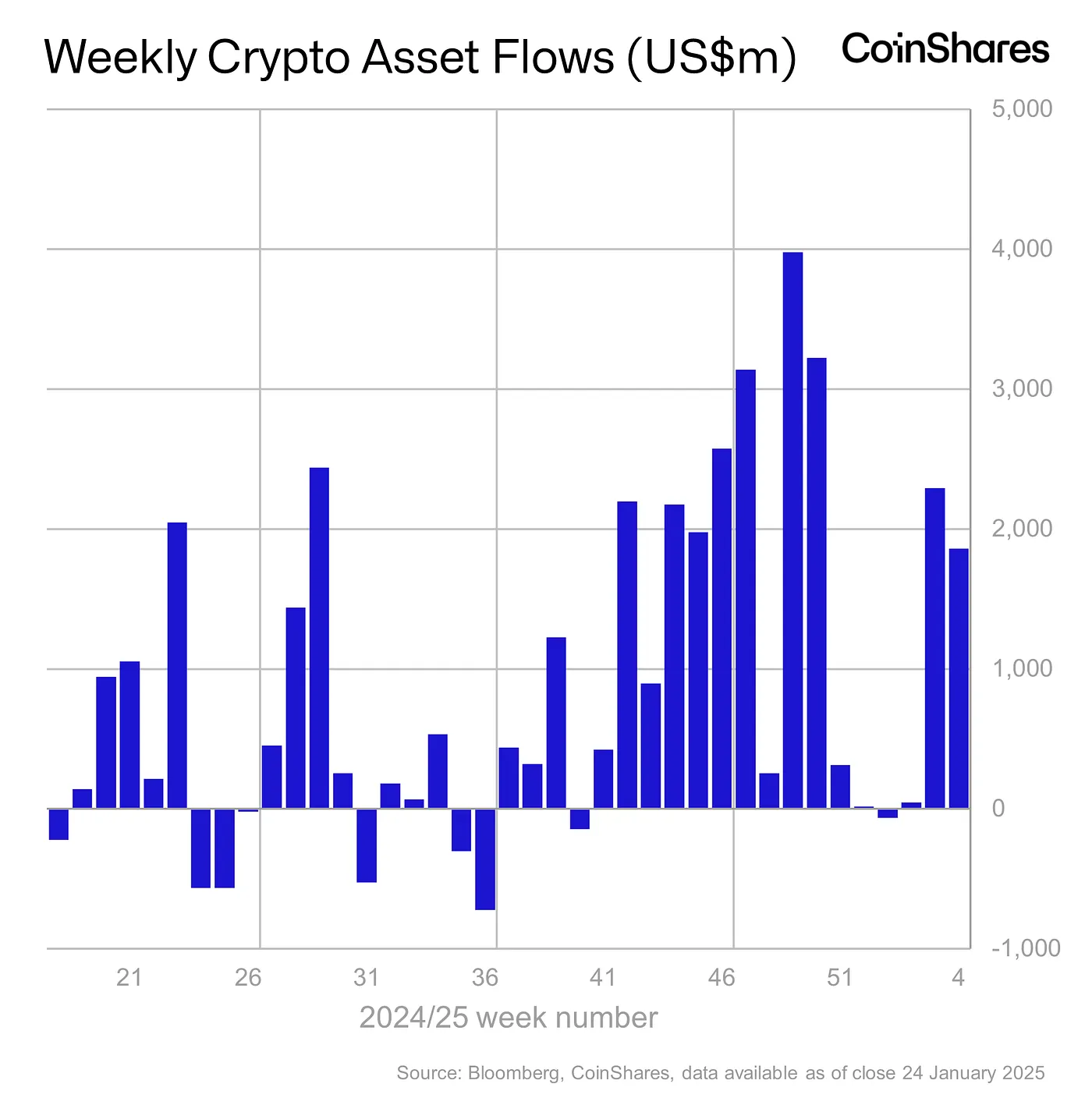
As the global financial markets navigate the opening weeks of 2025, the institutional appetite for digital assets remains remarkably robust. According to the latest data from CoinShares, a leading digital asset investment firm, institutional investors have signaled renewed confidence in the cryptocurrency sector, pouring $582 million into crypto-linked investment products within the first week of the new year.
This latest wave of capital suggests that the momentum witnessed throughout 2024 is continuing into the new calendar year, as traditional finance continues to bridge the gap with the blockchain ecosystem.
The State of the Market: A High-Octane Start to 2025
The start of the year was characterized by a distinct "buy-the-dip" mentality. While the week began with minor volatility and initial outflows, the market sentiment shifted sharply by Friday. CoinShares reported that Friday alone saw a massive influx of $671 million, which effectively neutralized earlier selling pressure and brought the net weekly total to $582 million.
This performance is being viewed by analysts as a litmus test for the institutional market. Having finished 2024 with a historic $48.7 billion in total annual inflows, the $47.2 billion recorded in 2025—while slightly lower—indicates that the institutional adoption of digital assets is far from a passing trend. It is becoming a structural component of diversified portfolios.
Breakdown of Weekly Inflows
The capital allocation across specific assets reveals a clear hierarchy of investor preference:
- Bitcoin (BTC): Remains the undisputed king of institutional interest, drawing $512 million in fresh capital over the past week.
- Ethereum (ETH): Solidified its position as the preferred altcoin, attracting $119 million.
- XRP: Continues to gain institutional favor, recording $10.7 million in net inflows.
- Solana (SOL): Experienced a temporary setback, recording $30 million in outflows, likely as investors took profits following the asset’s significant run-up in late 2024.
Chronology of Institutional Adoption: From 2024 to 2025
To understand the current surge, one must look at the trajectory of the past 24 months. The year 2024 served as a watershed moment for the industry, characterized by the approval of Spot ETFs in major jurisdictions and a subsequent flood of liquidity into the space.
2024: The Year of the Record-Breaker
In 2024, the digital asset market saw an unprecedented $48.7 billion in inflows. The United States led this charge, accounting for $44.5 billion of the total. This was largely driven by the institutional infrastructure built around regulated investment vehicles, which allowed pension funds, family offices, and wealth management firms to gain exposure to Bitcoin and Ethereum without the complexities of self-custody.
The Regional Turnaround
While the U.S. remains the dominant force, the geographic distribution of capital has become increasingly interesting. In 2025, Germany has emerged as a significant player, recording a staggering $2.5 billion in inflows. This represents a complete reversal from 2023, where the German market suffered from outflows. Canada and Switzerland have also maintained strong growth, adding $1.1 billion and $775 million, respectively. This global diversification suggests that the institutional interest in blockchain is no longer a purely North American phenomenon.
Supporting Data: The Institutional Pivot to Altcoins
While Bitcoin continues to command the lion’s share of investment, the data indicates a maturation in investor strategy. Ethereum, in particular, has seen a massive surge in institutional attention. Over the course of 2025, Ethereum-linked products have attracted $12.7 billion in inflows—an increase of 138% compared to the previous year.
The interest in other Layer-1 protocols and enterprise-focused assets has been equally compelling:
- XRP: With $3.7 billion in annual inflows, XRP has seen a 500% year-over-year increase. This is widely attributed to the clarification of its regulatory status in the U.S. and its continued adoption in cross-border payment networks.
- Solana: Despite recent outflows, Solana remains a powerhouse with $3.6 billion in inflows for 2025, marking a 1,000% increase year-over-year.
Conversely, "basket" or diversified altcoin products have seen a decline in sentiment, with inflows falling by 30%. This suggests that institutional investors are moving away from speculative, broad-based altcoin funds in favor of high-conviction, specific assets with established use cases and clear market positions.
Official Perspectives and Market Analysis
Industry experts at CoinShares and other major research firms suggest that the inflows are indicative of a broader macroeconomic environment. With global central banks signaling potential shifts in interest rate policies, investors are increasingly looking for "digital gold" and technological hedges.
"The consistency of these flows is what stands out," says one market strategist. "We aren’t just seeing sporadic buying based on hype. We are seeing sustained, programmatic capital allocation from institutions that have spent months doing their due diligence."
However, the industry remains cautious. The $105 million invested in "Short-Bitcoin" products serves as a reminder that a segment of the market remains skeptical of the current price action. These products allow investors to profit from a decline in Bitcoin’s price, indicating that for every institutional buyer, there is still a contingency hedging against a potential correction.
Implications: What This Means for the Future
The current trend of institutional accumulation has several profound implications for the digital asset landscape:
1. Market Stability and Reduced Volatility
Large-scale institutional players generally employ long-term investment horizons. Unlike retail traders who may react impulsively to short-term news, institutional funds are governed by strict risk-management protocols. As these entities come to hold a larger percentage of the circulating supply, it is expected that the volatility historically associated with crypto assets may begin to compress, leading to a more mature and predictable market.
2. Regulatory Compliance as a Standard
The influx of capital into regulated investment products—such as ETFs and ETPs (Exchange Traded Products)—has forced the crypto industry to align with global financial regulations. This "institutionalization" is the primary driver for mainstream acceptance, as it provides the necessary transparency and security that fiduciary entities require before allocating client capital.
3. The Shift from Speculation to Utility
The data clearly shows that capital is flowing toward assets that offer utility—Ethereum’s smart contract ecosystem, XRP’s payment infrastructure, and Solana’s high-throughput network. This trend suggests that the market is beginning to value digital assets based on their functional economic output rather than purely speculative price movements.
Conclusion
The first week of 2025 has provided a clear signal: the institutional "winter" is well and truly over. With nearly $600 million in net inflows to start the year, the market is exhibiting the kind of resilience that only deep-pocketed, long-term investors can provide. While Bitcoin remains the anchor of the crypto-economy, the surging interest in Ethereum, XRP, and Solana indicates that institutional portfolios are becoming increasingly sophisticated.
As the year progresses, the focus will likely shift to whether this pace of accumulation can be sustained. If the trends seen in 2024 and the start of 2025 are any indication, the digital asset class is no longer an outlier in the world of finance—it is becoming a cornerstone of the modern institutional portfolio.
Disclaimer: The information provided in this article is for educational and informational purposes only and does not constitute financial, investment, or legal advice. The Daily Hodl is not an investment advisor. Cryptocurrency investments carry high risks, and market volatility can lead to the loss of principal. Investors are encouraged to conduct their own due diligence and consult with a professional financial advisor before making any investment decisions.