Institutional Momentum: Crypto Investment Products Kick Off 2026 with $582 Million Influx
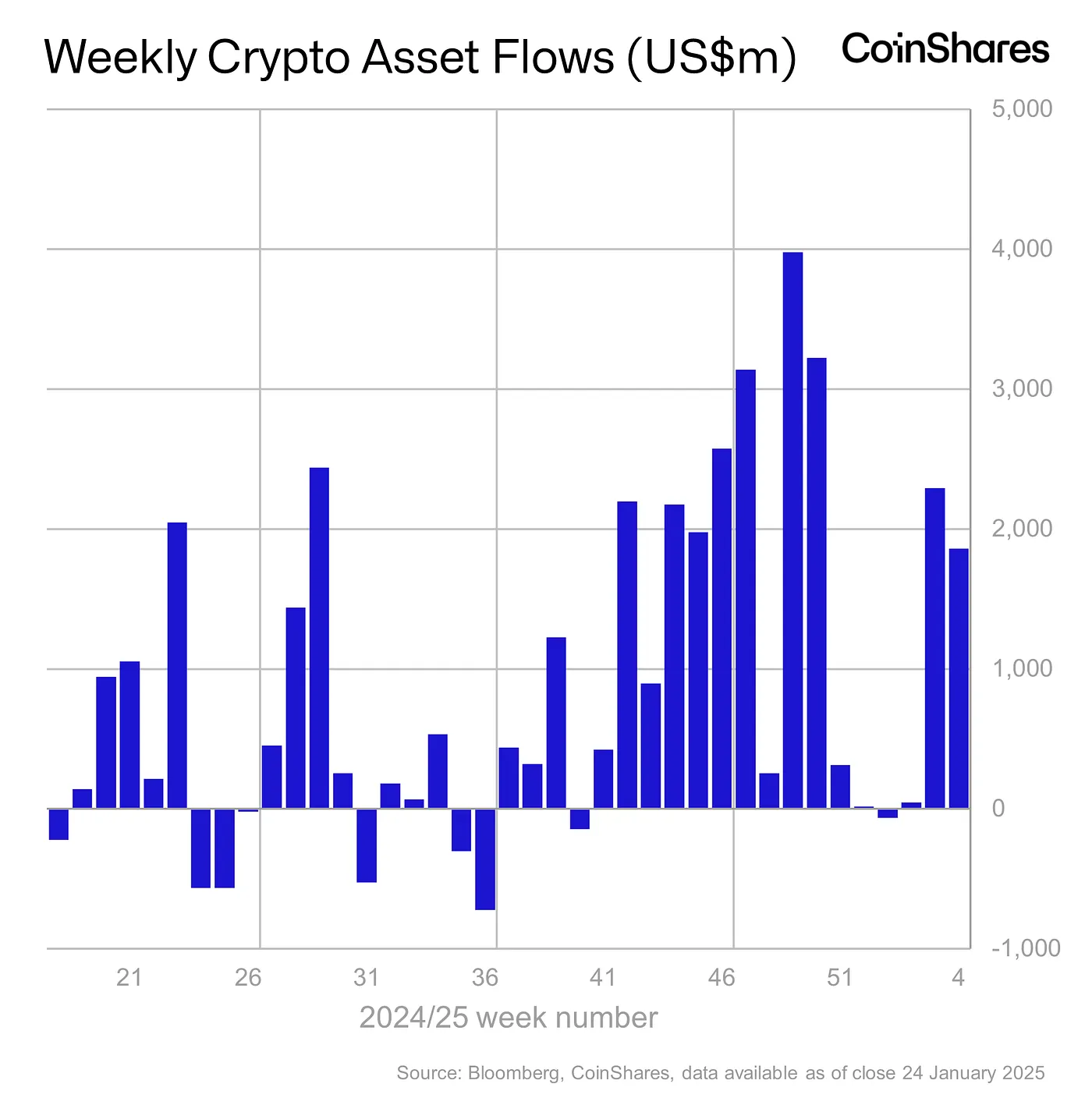
The global digital asset landscape has entered 2026 with a decisive show of institutional confidence, signaling that the momentum generated throughout a historic 2025 is carrying over into the new year. According to the latest data from CoinShares, institutional investors have signaled a bullish start, pouring $582 million into digital asset investment products during the opening week of the year.
This resurgence, characterized by a sharp pivot toward major assets like Bitcoin and Ethereum, underscores a maturing market where traditional financial players are increasingly integrating cryptocurrencies into their long-term portfolio strategies.
Main Facts: A Strong Start to the New Year
The first week of 2026 has provided a vital barometer for market sentiment. Despite experiencing early volatility and localized outflows mid-week, the market experienced a significant surge, particularly on the final Friday, which saw inflows of $671 million. This late-week buying pressure effectively eclipsed the earlier negative sentiment, resulting in a net positive balance of $582 million for the week.
The breakdown of these inflows highlights a clear preference among institutional desks:
- Bitcoin (BTC): Remains the undisputed king of institutional portfolios, attracting $512 million in new capital.
- Ethereum (ETH): Solidified its position as the primary altcoin interest, drawing in $119 million.
- XRP: Continues to capture significant interest, securing $10.7 million in fresh inflows.
- Solana (SOL): Experienced a temporary setback, recording $30 million in outflows, though analysts view this as a short-term rebalancing rather than a shift in long-term sentiment.
Chronology of Institutional Flows
To understand the current state of the market, one must look at the trajectory established over the last twelve months. The year 2025 served as a landmark period for digital asset adoption, with global products recording a staggering $47.2 billion in total inflows. This figure sits just behind the all-time record set in 2024, which saw $48.7 billion in capital allocations.
The 2025 Performance Review:
- Q1–Q2 2025: Initial institutional caution gave way to aggressive accumulation as macroeconomic headwinds stabilized.
- Q3 2025: The market witnessed a massive surge in altcoin interest, with Ethereum leading the charge, supported by increased utility in decentralized finance (DeFi).
- Q4 2025: Global markets closed on a high note, with heavy capital inflows suggesting that institutional "smart money" was preparing for a sustained bull cycle entering 2026.
The United States remained the dominant force in this financial landscape, accounting for $44.5 billion of the total 2025 inflows. While this represented a 12% decline from the peak activity of 2024, the sheer volume of capital confirms that the U.S. remains the central hub for crypto-financial products.
Supporting Data: Regional Shifts and Asset Dominance
While the U.S. holds the lion’s share of activity, other regions have emerged as critical battlegrounds for capital allocation. The geographic distribution of flows in 2025 paints a picture of a truly global asset class.
Regional Highlights:
- Germany: Recorded a remarkable turnaround, posting $2.5 billion in net inflows throughout 2025 after suffering from outflows in the previous year. This suggests that European regulatory clarity is successfully attracting capital back into the region.
- Canada: Continued its steady growth, contributing $1.1 billion in inflows.
- Switzerland: Remained a stalwart for digital asset investment, recording $775 million, proving that its financial infrastructure is highly conducive to crypto-backed vehicles.
Asset Performance Metrics:
The disparity in performance between assets reveals shifting investor priorities:
- Bitcoin: Totaled $26.9 billion in inflows for 2025. Interestingly, "Short-Bitcoin" products attracted $105 million, though they remain a niche segment, indicating that the vast majority of institutional investors are betting on price appreciation rather than hedging against downside risk.
- Ethereum: The standout performer in terms of growth, posting $12.7 billion in inflows—a massive 138% year-over-year increase.
- XRP & Solana: These assets saw astronomical growth in interest, with XRP recording $3.7 billion (a 500% increase) and Solana capturing $3.6 billion (a 1,000% increase) compared to 2024.
Conversely, "other" altcoins have seen a softening of interest, with inflows for these smaller projects falling 30% year over year, suggesting a flight to quality as investors consolidate their holdings into established, "blue-chip" digital assets.
Official Perspectives and Market Implications
The current influx of capital has profound implications for the broader crypto ecosystem. Financial analysts and researchers at firms like CoinShares suggest that the "institutionalization" of the market is no longer a future trend—it is the current reality.
The Implications of Institutional Adoption:
- Reduced Volatility: As institutional investors hold for the long term rather than engaging in high-frequency retail speculation, market volatility is expected to stabilize over the long term.
- Market Maturation: The shift toward established assets like ETH and BTC indicates that institutional desks are applying the same risk-management frameworks to crypto that they apply to traditional equities or commodities.
- Policy Pressure: The consistent inflow of capital is forcing global regulators to accelerate the development of comprehensive frameworks. Countries that have lagged in providing clear guidelines, such as some members of the European Union and parts of Asia, are now seeing pressure from domestic firms to compete with the favorable environments found in the U.S. and Switzerland.
Professional Sentiment
Financial experts note that the divergence in performance between top-tier assets and lower-cap tokens is a sign of a "flight to quality." Institutional investors are increasingly risk-aware; they prefer assets with high liquidity, robust development ecosystems, and clear regulatory standing.
The $30 million outflow in Solana should not be misinterpreted as a loss of faith in the Solana blockchain itself, but rather as an indicator of portfolio rebalancing. Institutional managers often trim positions in high-performing assets to lock in gains or to reallocate capital toward other opportunities as the fiscal year begins.
Conclusion: Looking Ahead
As we progress through the first quarter of 2026, the data suggests that the institutional appetite for digital assets remains robust. The ability of the market to absorb mid-week outflows and finish the week with a net gain of $582 million is a testament to the resilience of current market participants.
Investors, both institutional and retail, should monitor the upcoming monthly reports for shifts in geographic distribution and sector-specific interest. While the momentum is clearly positive, the market remains susceptible to macroeconomic triggers, such as interest rate decisions by major central banks and ongoing global regulatory developments.
For the average investor, the current data serves as a reminder that while volatility is a hallmark of the crypto industry, the long-term trend of institutional integration is firmly established. As always, market participants are encouraged to conduct their own due diligence, as historical performance—while a useful indicator—never guarantees future results in the fast-paced, high-stakes world of digital finance.
Disclaimer: Opinions expressed in this report are for informational purposes only and do not constitute financial, investment, or legal advice. Investing in Bitcoin, Ethereum, and other digital assets involves significant risk. Investors should perform their own thorough research and consult with a qualified financial advisor before making any investment decisions. The Daily Hodl does not recommend the purchase or sale of any specific asset. Your trades and transfers are at your own risk.