
Macro Strategist Raoul Pal Predicts Crypto Will Reach 4 Billion Users by 2030, Outpacing Early Internet Adoption
By Financial Markets News Desk
Published: April 2024
Main Facts
Cryptocurrency adoption is currently tracking on an aggressive growth trajectory that mirrors—and frequently exceeds—the meteoric rise of the internet during the late 1990s and early 2000s. According to macroeconomic analyst and Real Vision CEO Raoul Pal, empirical data from the past five years suggests that Bitcoin (BTC) and the broader digital asset ecosystem are precisely on schedule to achieve a staggering four billion users by the turn of the decade.
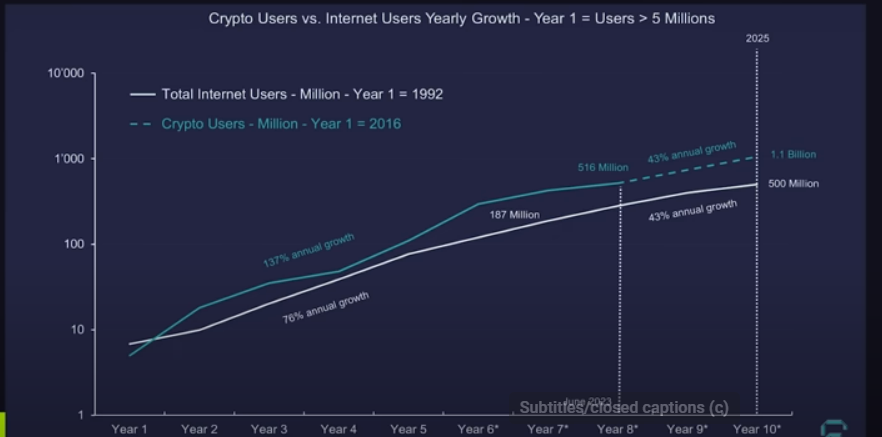
In a comprehensive market update, the former Goldman Sachs executive revealed that digital asset adoption has consistently outperformed historical technological benchmarks. Pal’s forecasting model indicates that the crypto sector will likely surpass the milestone of one billion active global users by the end of 2025.
Key highlights of Pal’s projection include:
- Current Adoption Volume: The crypto market has already amassed approximately 516 million users globally.
- Near-Term Milestones: Projections indicate the ecosystem will cross the 1.1 billion user threshold by late 2025.
- Long-Term Target: By 2030, Pal’s models project that approximately four billion people—roughly half of the global population—will interact with blockchain technology and digital currencies.
- Comparative Velocity: While the internet initially expanded at an annualized rate of 76% during its formative years before slowing down to 43% by year eight, the cryptocurrency sector has maintained a compound annual growth rate (CAGR) of approximately 137%.
Chronology of Digital Asset Growth: From Niche Asset to Global Movement
To understand the weight of Pal’s predictions, it is necessary to examine the historical timeline of how digital assets transitioned from an obscure cryptographic experiment into a macroeconomic asset class.
2008–2015: The Genesis and Infancy
Following the publication of the Bitcoin whitepaper by the pseudonymous Satoshi Nakamoto in late 2008, the nascent industry spent its first several years operating strictly within the confines of cryptography forums, cypherpunk mailing lists, and specialized tech communities. User counts during this period were measured in the thousands, primarily consisting of software developers, hobbyists, and early libertarians.
2016: The Baseline Year for Institutional Tracking
According to macroeconomic frameworks utilized by analysts like Pal, 2016 serves as a foundational baseline for modern crypto adoption. This was the era when the total global user base of cryptocurrencies officially cleared the one-million mark. Infrastructure began to professionalize, retail-facing exchanges gained regulatory footholds, and media attention started expanding past niche tech blogs.
2017–2021: The Retail Explosions and Institutional Awakening
During this five-year window, the cryptocurrency market experienced two monumental bull cycles—first in 2017 driven by the Initial Coin Offering (ICO) boom, and again in 2020–2021 catalyzed by decentralized finance (DeFi), non-fungible tokens (NFTs), and unprecedented macroeconomic monetary stimulus during the COVID-19 pandemic. User growth surged exponentially during these periods, transforming crypto from a localized phenomenon into a truly global asset class.
2022–2024: Bear Market Resilience and Structural Maturity
Despite severe market corrections, regulatory headwinds, and high-profile industry bankruptcies throughout 2022 and 2023, the actual user adoption metrics continued an upward trajectory. By early 2024, the global crypto user base solidified around the half-billion mark, setting the stage for the next wave of institutional integration via spot exchange-traded funds (ETFs) and Layer-2 scaling solutions.

Supporting Data: Comparing Crypto to the Internet Era
Raoul Pal’s predictive model relies heavily on comparative historical analysis, mapping the adoption curve of Web3 against the rollout of the commercial internet between 1994 and 2004.
During the early commercialization phase of the internet, global adoption was recognized as the fastest technological diffusion in human history. However, Pal’s data demonstrates that cryptocurrency is outpacing that historic benchmark by a wide margin.
[Adoption Comparison Metric]
--------------------------------------------------
Technology         Stage Equivalent    Global Users
--------------------------------------------------
Internet           Year 8 (Historical) 187 Million
Cryptocurrency     Current Era         516 Million
--------------------------------------------------
Breaking Down the Numbers
- The Internet Baseline: At an equivalent stage in its developmental lifecycle, the internet had successfully onboarded roughly 187 million users globally.
- The Crypto Phenomenon: At the same relative maturity phase, the cryptocurrency market has already recorded approximately 516 million users—nearly triple the penetration rate of the early internet.
- Growth Rate Discrepancy: The internet expanded at an annualized rate of 76% during its hyper-growth phase before maturing into a slower, steadier 43% annual growth rate after its eighth year. In contrast, cryptocurrencies have sustained an average annual growth rate of 137% since tracking began in earnest.
Conservative Modeling vs. Reality
To maintain analytical rigor, Pal’s forecasting model introduces a deliberate handicap. Rather than projecting that crypto will maintain its current 137% annual growth rate indefinitely, the model assumes that crypto adoption will sharply decelerate to match the mature growth rate of the internet.
Even under this conservative assumption—where the growth curve flattens significantly over the remainder of the decade—the mathematical output yields 1.1 billion users by the end of 2025 and scales to four billion users by 2030.
"If we look out further using the internet adoption growth and we slow down the trend rate of growth of crypto to the same as the internet going forward, we get to four billion users by 2030. That’s half the world’s population," Pal noted in his video update. "Now will this be perfect? It’s been pretty perfect so far, and I’ve been showing this chart for five years now. But let’s assume not. Either way, these numbers are simply staggering."
Official Responses and Industry Perspectives
Pal’s bullish outlook resonates broadly across the digital asset industry, aligning with broader narratives pushed by venture capitalists, fintech leaders, and institutional asset managers.
The Institutional Viewpoint
Major financial institutions, which once dismissed Bitcoin as a speculative fad, have increasingly integrated digital assets into their long-term forecasts. The approval and subsequent multi-billion-dollar inflows into spot Bitcoin and Ethereum ETFs in major global markets signal a structural shift. Executives from firms like BlackRock and Fidelity have frequently cited "demographic shifts" and "digital-native generations" as primary drivers behind the institutionalization of blockchain technology.
Fintech and Consumer Integration
Payment giants such as Visa, Mastercard, PayPal, and Stripe have all rolled out varying degrees of crypto-friendly infrastructure, stablecoin settlement layers, and custody options. Industry executives point out that as consumer-facing applications abstract away the complex mechanics of public-key cryptography and seed phrases, onboarding friction decreases exponentially—paving the way for the mainstream demographic expansion that Pal predicts.
Regulatory Perspectives
While policymakers across various jurisdictions continue to debate the appropriate boundaries for consumer protection, anti-money laundering (AML) compliance, and tax reporting, the overarching trend points toward regulatory clarity rather than outright prohibition. Nations striving to become global financial hubs are actively crafting frameworks to nurture blockchain innovation, thereby providing the legal certainty required for massive corporate and retail adoption.
Implications for Global Finance, Markets, and Society
Should Raoul Pal’s projections materialize, the societal, economic, and technological implications of four billion people utilizing cryptocurrency by 2030 will be profound and far-reaching.
1. Remodelling Global Payments and Remittances
With half of the world’s population integrated into digital asset networks, traditional correspondent banking systems face existential disruption. Cross-border remittances, which currently incur exorbitant fees and multi-day settlement delays through traditional legacy rails, will increasingly migrate to instant, low-cost blockchain settlements and stablecoin networks.
2. Financial Inclusion in Developing Economies
Much of the next wave of internet and crypto adoption is projected to originate from developing economies across Latin America, Southeast Asia, and Africa. In regions plagued by hyperinflation, currency devaluation, and limited access to traditional banking services, cryptocurrencies and decentralized finance protocols serve as vital tools for wealth preservation, commerce, and financial sovereignty.
3. Shift in Macroeconomic Power Dynamics
As sovereign populations increasingly opt out of inflationary fiat systems in favor of decentralized, fixed-supply assets like Bitcoin, central banks will face unprecedented pressure regarding monetary policy execution. The widespread adoption of borderless digital assets limits the efficacy of capital controls and forced currency devaluations by authoritarian regimes.
4. Technological Infrastructure and Scalability Challenges
Onboarding four billion users onto decentralized networks will require monumental advancements in blockchain engineering. Layer-2 networks, sharding, zero-knowledge (ZK) rollups, and enhanced user interface (UI) layers must evolve to handle throughput volumes comparable to traditional payment juggernauts like Visa, all while maintaining the core tenets of decentralization and security.
Conclusion
Raoul Pal’s long-term macro analysis paints an extraordinarily optimistic picture for the future of digital assets. By anchoring crypto user growth against the historical velocity of the internet, his predictive models suggest that skepticism regarding the utility or longevity of blockchain technology is increasingly out of step with empirical reality.
As the industry marches toward the milestone of one billion users by the close of 2025 and looks toward the monumental threshold of four billion users by 2030, the transition from an alternative financial experiment to the foundational layer of global digital infrastructure appears well underway.
Disclaimer: The information provided in this article is for informational and educational purposes only and does not constitute financial, investment, or legal advice. Digital asset markets carry a high degree of risk, and investors should conduct thorough due diligence before committing capital to cryptocurrencies or digital assets.