Shiba Inu Bloodbath: Long Traders Slaughtered as Dormant Whale Dumps 400 Billion SHIB Amid Market-Wide Slump
By Crypto Financial Desk
Published: June 2026
1. Main Facts
The digital asset market can be a ruthless arena, but meme coins often amplify both the ecstasy of parabolic rallies and the agony of precipitous crashes. Shiba Inu (SHIB), once celebrated as the definitive "Dogecoin killer" and a titan of community-driven speculation, has found itself on the receiving end of a brutal market correction.
Over a tumultuous 24-hour trading cycle, long-position traders bore the brunt of a severe market flush, watching helplessly as over $382,000 in SHIB futures positions were forcibly liquidated. The vast majority of these liquidations—an astounding $365,660—were wiped from bullish bets, while short-side traders escaped relatively unscathed, losing a mere $17,320.
This devastating wave of forced closures did not occur in a vacuum. It coincided with the dramatic, sudden awakening of a long-dormant SHIB whale wallet that had remained completely silent for nearly ten months. On-chain intelligence platforms flagged the movement of nearly 400 billion tokens out of the address, sending immediate ripples of anxiety through an already fragile market.
With SHIB plunging 16% over the preceding week, shattering critical psychological support levels, and slipping perilously close to falling out of the top 30 cryptocurrencies by market capitalization, the convergence of massive liquidations and waking whale capital has thrust the token back into the center of a systemic storm.
2. Chronology: The Anatomy of a Whale’s Return
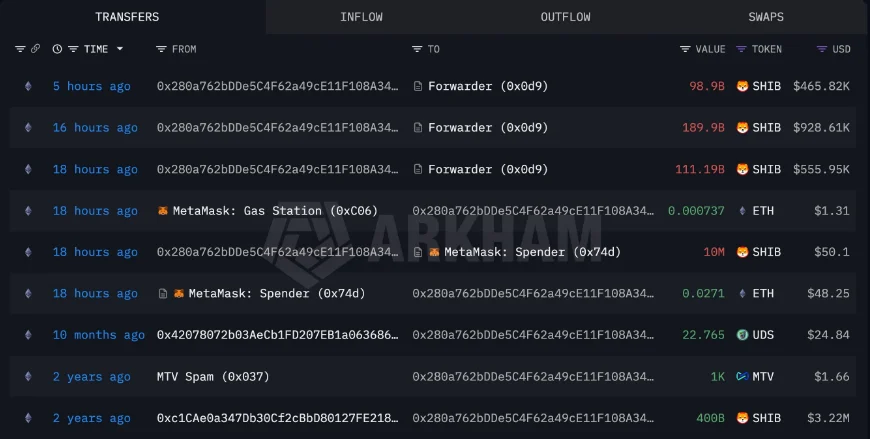
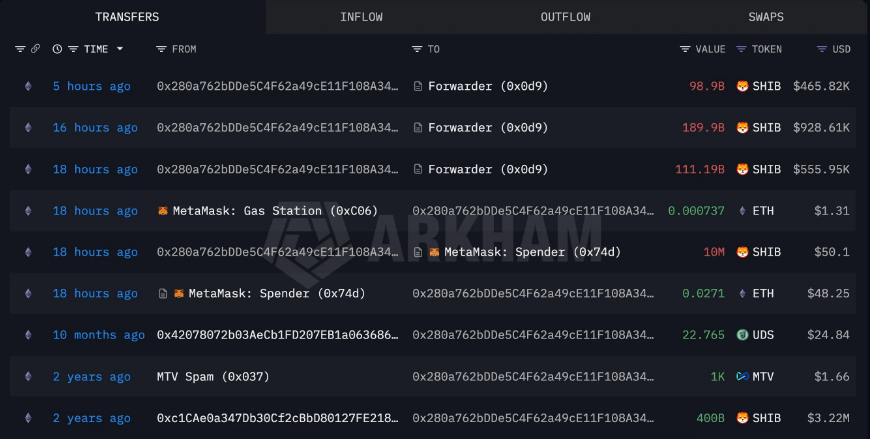
To understand how the panic unfolded, one must trace the step-by-step reactivation of the whale address (0x280a762bDDe5C4F62a49cE11F108A34A7a706f69), as captured by blockchain analytics firm Arkham Intelligence.
The sequence of events unfolded with clinical precision, executed over the course of a few frantic hours:
- Phase 1: The Ten-Month Slumber (August 2025 – June 2026): For nearly a year, the wallet sat as an untouched monument to a prior crypto cycle. Holding a colossal stash of SHIB acquired during earlier, more bullish market regimes, the owner made no transactions, staking moves, or outward transfers.
- Phase 2: The Test Run (Early Session): Before moving life-changing sums of capital, the entity executed a classic security and routing test. A modest transfer of 10 million SHIB was routed through a MetaMask swap mechanism. The transaction went through seamlessly, setting the stage for the primary operation.
- Phase 3: The BitGo Forwarder Outflow: With the testing phase successful, the wallet holder initiated a heavy-volume sequence using BitGo’s Forwarder Smart Contract. Rather than dumping the entire bag at once—which would have created a catastrophic localized flash crash on automated market makers (AMMs)—the whale sliced the holdings into three distinct, highly coordinated tranches:
- Transaction A: Nearly 112 billion SHIB cleared from the wallet.
- Transaction B: Almost 190 billion SHIB followed shortly after.
- Transaction C: A final cleanup transfer of approximately 99 billion SHIB drained the remaining balance.
- Phase 4: The Aftermath: When the dust settled, the address was effectively hollowed out. Totaling an eye-watering 399,989,999,938 SHIB, the entire fortune was cleared out. The wallet now sits with a nominal dust balance of just 110 SHIB—a stark visual representation of capital flight.
3. Supporting Data: Market Metrics and Derivatives Carnage
The timing of the whale’s exit could not have been worse for retail traders clinging to leveraged upside exposure. A deeper dive into the numbers reveals the staggering scale of the financial damage inflicted on the SHIB ecosystem over a single week:
- Derivatives Bloodbath: Out of $382,980 total liquidations across SHIB derivatives markets, 95.5% ($365,660) belonged to long positions. This points to a classic "long squeeze," where over-leveraged traders betting on a bounce were violently shaken out as stop-losses triggered cascading sell orders. Short sellers pocketed the gains, accounting for just $17,320 in liquidations.
- Price and Support Collapse: SHIB suffered a 16% weekly drop, decisively breaking below the critical psychological support level of $0.000005. At the time of reporting, the token was changing hands at $0.000004535, suffering an additional 24-hour decline of 3.50%.
- Market Capitalization Erosion: The sustained downward pressure has battered Shiba Inu’s overall valuation. The token’s market cap has shrunk to approximately $2.65 billion.
- Global Ranking Threat: This capitalization drop has pushed SHIB down to the 29th position on CoinGecko’s global cryptocurrency leaderboard, bringing it dangerously close to falling out of the top 30 tier altogether—a psychological blow to the "SHIB Army" that has long championed the token’s top-tier status.
4. Analyzing the Move: OTC, Cold Storage, or Impending Dump?
In the wake of such a massive capital movement, crypto market participants and analysts have engaged in intense debate regarding the intent behind the BitGo transfers.
The BitGo Infrastructure Factor
To properly interpret the transaction, one must examine the infrastructure utilized. BitGo’s services—including its Forwarder Smart Contracts—are heavily relied upon by institutional-grade investors, high-net-worth funds, and custodians.
When large volumes of tokens are routed through institutional infrastructure like BitGo, two primary scenarios usually present themselves:
- Over-the-Counter (OTC) Deals: Large block trades negotiated directly between private parties off of public order books. OTC transactions are specifically designed to prevent massive price slippage that would occur if the same volume were dumped onto decentralized exchanges (DEXs) or centralized order books (CEXs) like Binance or Coinbase.
- Cold Storage Migration: Institutional custodians often require asset re-allocation for security upgrades, multi-signature wallet migrations, or structural restructuring of client funds.
The Market Impact Paradox
Crucially, neither an OTC transaction nor a cold storage transfer registers immediately as an outright market sell order on public tickers. This introduces a fascinating paradox: while the sheer scale of the 400 billion SHIB transfer is terrifying to retail onlookers, it does not mathematically confirm that the tokens have been sold into spot market liquidity.
Nevertheless, markets are driven by psychology and perception as much as hard math. The realization that a whale holding tens of millions of dollars in unrealized value decided to mobilize their assets during a broader market downturn acted as a psychological catalyst, accelerating bearish sentiment and fueling further liquidations.
5. Implications for the Future of Shiba Inu
The events surrounding Shiba Inu highlight several broader systemic realities regarding meme coin ecosystems, whale dynamics, and leverage risk in the digital asset economy.
The Dangers of High Leverage
The liquidation disparity—where long positions absorbed 95% of the pain—serves as a cautionary tale for retail traders utilizing margin. In speculative assets like meme coins, sentiment can flip on a dime. When macro conditions sour and heavy-hitting whales make unexpected structural moves, leveraged longs provide easy liquidity for market makers to hunt down.
Concentration Risk and Whale Dominance
Despite boasting millions of decentralized wallet addresses, the SHIB ecosystem—like many altcoins and meme tokens—remains vulnerable to whale concentration risk. When a single entity controls a supply of tokens valued in the tens of millions, their individual liquidity decisions carry the weight of systemic shocks. A single dormant wallet waking up can trigger a chain reaction that resets weekly charts and obliterates millions in open interest.
Macro Headwinds and Meme Coin Viability
Shiba Inu’s descent toward the edge of the top 30 cryptocurrencies underscores a shifting crypto landscape. As institutional capital increasingly flows into regulated products, layer-1 utility networks, and real-world asset (RWA) tokenization protocols, legacy meme coins face heightened competition for speculative mindshare. When macro liquidity dries up and risk-off sentiment takes hold, speculative assets are typically the first to experience severe capital flight.
Looking Ahead
As SHIB consolidates below crucial historical support lines, all eyes remain locked on on-chain analytics. Whether the 400 billion tokens moved via BitGo eventually find their way onto spot exchange order books or remain securely locked in institutional vaults will determine whether this week’s flash crash was merely a terrifying shakeout or the prelude to a deeper structural decline. For now, long traders are licking their wounds, and the SHIB Army is forced to defend lines it never expected to breach.