The Ethereum Paradox: Why Network Utility Is Soaring While Price Falters
Despite a turbulent market environment that has left many investors questioning the short-term viability of Ethereum (ETH), a striking divergence has emerged between the asset’s price action and its underlying utility. While price charts depict a bearish struggle, with the asset flirting with the $1,600 support level and analysts forecasting a potential retest of $1,500—or even $700—the Ethereum network is currently experiencing its most productive era in history.
This "Ethereum Paradox"—where record-breaking usage exists alongside depressed market valuation—suggests that while speculators are fleeing, builders and institutional adopters are embedding themselves deeper into the ecosystem than ever before.
Main Facts: The Great Decoupling
The current narrative surrounding Ethereum is defined by a fundamental disconnect. On one hand, ETH is facing significant bearish pressure. Technical analysts, including the renowned Ali Charts, have pointed to the "Delta Price" metric—a reliable indicator that factors in investor cost basis and miner production costs—to suggest that a deeper bottom near $700 could be in the cards before a structural recovery begins.
Conversely, the on-chain reality is entirely different. Data from leading research experts, including Leon Waidmann, Head of Research at Lisk, indicates that Ethereum is operating at peak capacity. By every meaningful metric—from daily active addresses to the systematic migration of ETH off exchanges—the network is exhibiting signs of a massive, long-term accumulation phase by entities that are seemingly indifferent to the current price volatility.
Chronology: From 2018 to the Present
To understand the significance of current network activity, one must look at the historical trajectory of Ethereum’s adoption cycle:
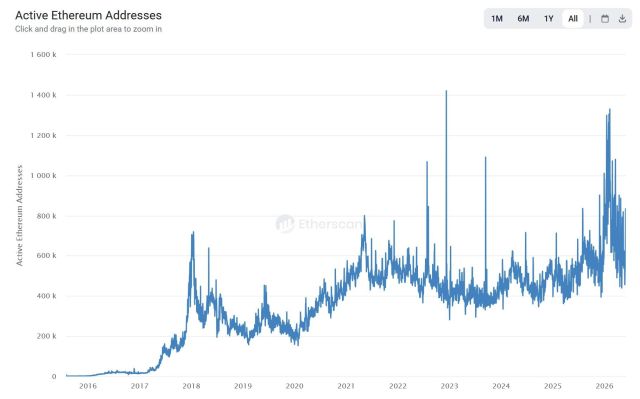
- 2018 (The Pre-Institutional Era): During this period, the Ethereum network was largely experimental. Daily active addresses peaked at approximately 720,000, serving as the high-water mark for the early blockchain era.
- 2021 (The DeFi Summer Peak): The bull market of 2021 pushed the boundaries of the network, with daily active addresses reaching a then-all-time high of 800,000.
- 2025–2026 (The Current Cycle): We are currently witnessing a seismic shift. Throughout the 2025-2026 period, daily active addresses have consistently surged past the 1 million mark, with periodic peaks exceeding 1.3 million.
This chronology reveals a clear trend: the "floor" of Ethereum’s activity has risen significantly. Even in a "dead-looking" market, the number of users interacting with the blockchain is substantially higher than it was at the absolute peak of the 2021 euphoria.

Supporting Data: The Exodus from Exchanges
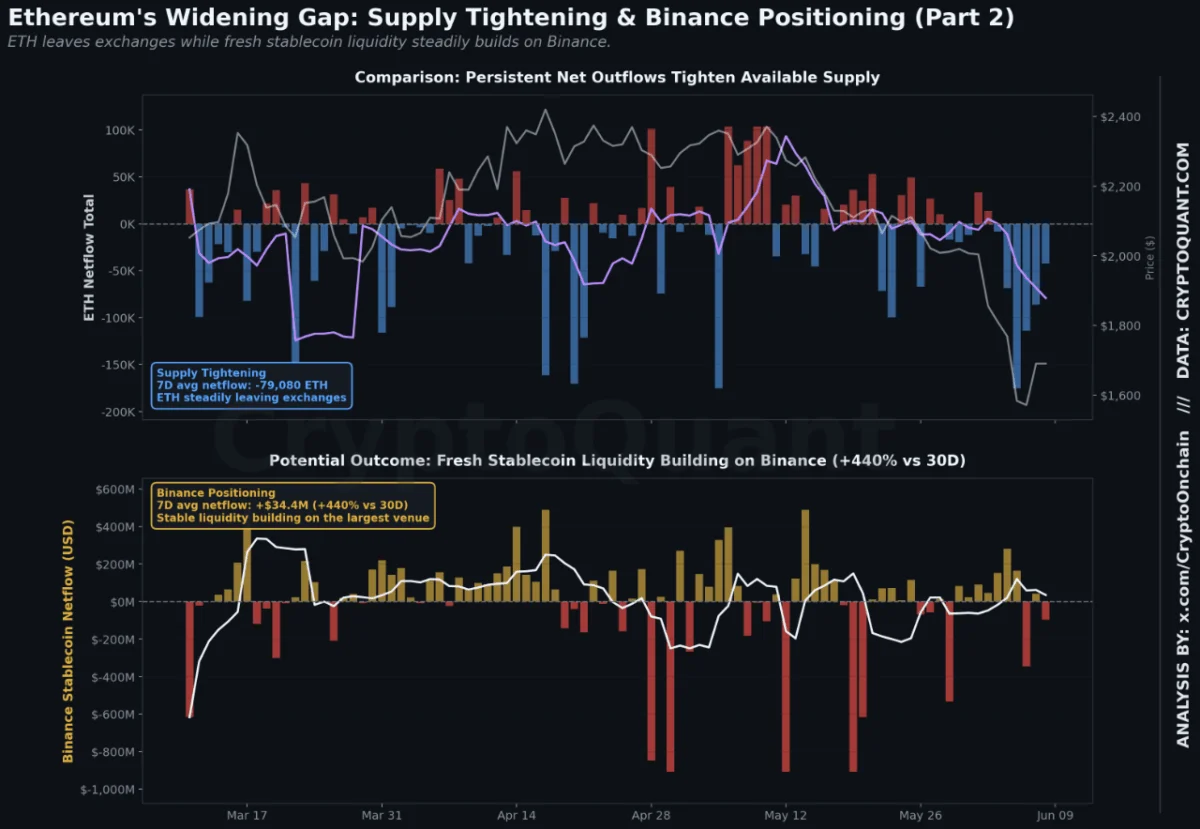
Perhaps the most compelling evidence that long-term sentiment remains bullish is the aggressive withdrawal of ETH from centralized exchanges.
As of late February 2025, the total volume of ETH held on cryptocurrency exchanges dropped to approximately 14.5 million coins—the lowest level in recorded history. This figure is particularly telling when contrasted with October 2023, when exchange balances were closer to 21 million.
In the span of just 2.5 years, over 6 million ETH have been pulled from trading venues into cold storage or smart contract staking protocols. Historically, market crashes are accompanied by "panicked inflows" to exchanges as traders rush to liquidate positions. The current trend is the exact inverse. As Waidmann succinctly noted, "Whoever is buying here isn’t selling back." This suggests that the current price stagnation is not driven by a lack of demand, but rather by a "supply shock" where the liquid circulating supply is being systematically locked away.
The Role of Infrastructure and Tokenization
The surge in network activity is not merely speculative "noise." It is fueled by Ethereum’s evolution into the global settlement layer for decentralized finance (DeFi), institutional asset tokenization, and enterprise-grade blockchain applications.
The Rise of Decentralized Banking
Ethereum has solidified its role as the primary architecture for decentralized banking. Financial institutions are increasingly leveraging the Ethereum Virtual Machine (EVM) to create programmable money and credit markets. Unlike the 2021 cycle, which was largely driven by retail-focused NFT projects and yield farming, the 2025-2026 activity is characterized by institutional-grade liquidity protocols and the integration of real-world assets (RWAs).
Tokenization at Scale
The move toward tokenizing real-world assets—such as treasury bonds, real estate, and carbon credits—has turned Ethereum into a "financial utility." Because these assets require constant on-chain interaction, the network’s activity remains elevated regardless of the price of the native ETH token. For these institutional users, Ethereum’s value lies in its security, decentralization, and uptime, rather than its short-term price performance.

Expert Analysis: Identifying the Floor
The divergence between utility and price has led to a debate among market analysts. While some fear that the $700 level identified by the Delta Price metric is inevitable, others argue that the fundamental strength of the network makes such a drop unlikely.
The Delta Price metric is particularly respected because it tracks the intersection of two critical points:
- The Investor Cost Basis: The average price at which current holders acquired their ETH.
- The Miner/Validator Production Cost: The floor price at which it is economically viable to secure the network.
When price approaches this delta, historical data suggests that selling pressure evaporates, as the risk-to-reward ratio becomes skewed heavily in favor of long-term buyers. If the market continues to mirror previous cycles, a brief dip toward this $700–$800 support zone could serve as the "final shakeout" before the next sustained, utility-driven bull market.
Implications: What This Means for the Future
The current state of Ethereum carries profound implications for the broader cryptocurrency market.
1. The "De-Risking" of the Ecosystem
The consistent movement of ETH off exchanges indicates a "de-risking" of the Ethereum ecosystem. As more tokens move into long-term custody, the volatility of the asset may decrease over time. A smaller float of liquid ETH means that when the next wave of demand hits, the price impact could be significantly more pronounced due to the reduced supply on exchanges.
2. A Shift from Speculation to Utility
The data proves that Ethereum is no longer a speculative plaything; it is a foundational layer of the global digital economy. The fact that the network is handling record levels of traffic while the price is suppressed is a sign of a "maturing market." In traditional finance, this is often referred to as a "divergence of fundamentals," where the underlying value of a business increases even while its stock price is weighed down by macroeconomic headwinds or market-wide liquidation events.
3. The Path to Recovery
For investors, the path forward appears binary. In the short term, the macroeconomic environment and technical resistance levels remain a challenge. However, the long-term thesis for Ethereum has never been stronger. The network is currently processing more real-world economic value than at any point in its history.
When the macro-liquidity environment shifts—when central banks ease monetary policy or institutional capital flows accelerate—Ethereum will be positioned to capture that value with a level of network maturity it has never before possessed.
Final Thoughts: The Quiet Accumulation
As we move through 2025, the narrative of "Ethereum being dead" appears to be a classic case of market misinterpretation. By looking at the charts alone, one might conclude that the network is failing. But by analyzing the flow of assets and the growth of active, daily participants, a different story emerges: one of a system that is building, growing, and solidifying its position as the bedrock of the decentralized internet.
While the price may continue to fluctuate, the underlying network—the developers, the institutional tokenizers, and the long-term holders—is betting on a future where Ethereum is a permanent fixture of global finance. For those who can see past the immediate price action, the current market represents not a tragedy, but a rare opportunity to participate in a cycle of record-breaking utility and quiet, steady accumulation.