The Gaming Frontier: How Web3 Could Become the Catalyst for Mass Crypto Adoption
In the rapidly evolving landscape of digital assets, the question of "mass adoption" has long been the industry’s holy grail. While decentralized finance (DeFi) captured the imagination of early adopters and institutional investors alike, a new report from venture capital titan Andreessen Horowitz (a16z) suggests that the true gateway to mainstream blockchain integration may lie in an unexpected corner: the world of interactive entertainment.
According to the firm’s comprehensive "State of Crypto 2023" report, Web3 gaming is not merely a niche sub-sector, but a strategic engine primed to onboard the next generation of users into the crypto ecosystem. By bridging the gap between traditional gaming mechanics and decentralized ownership, the industry is poised for a transformative shift.
Main Facts: The Intersection of Play and Ownership
At its core, the thesis presented by a16zcrypto is simple yet profound: games provide a natural, engaging environment for users to interact with digital assets without the immediate intimidation factor of complex financial instruments.
Web3 gaming introduces the concept of "true ownership," where players hold verifiable rights to their in-game assets—be it skins, weapons, or virtual real estate—represented as non-fungible tokens (NFTs). Unlike traditional gaming, where assets remain trapped within the walled gardens of centralized developers, Web3 allows for portability and interoperability.
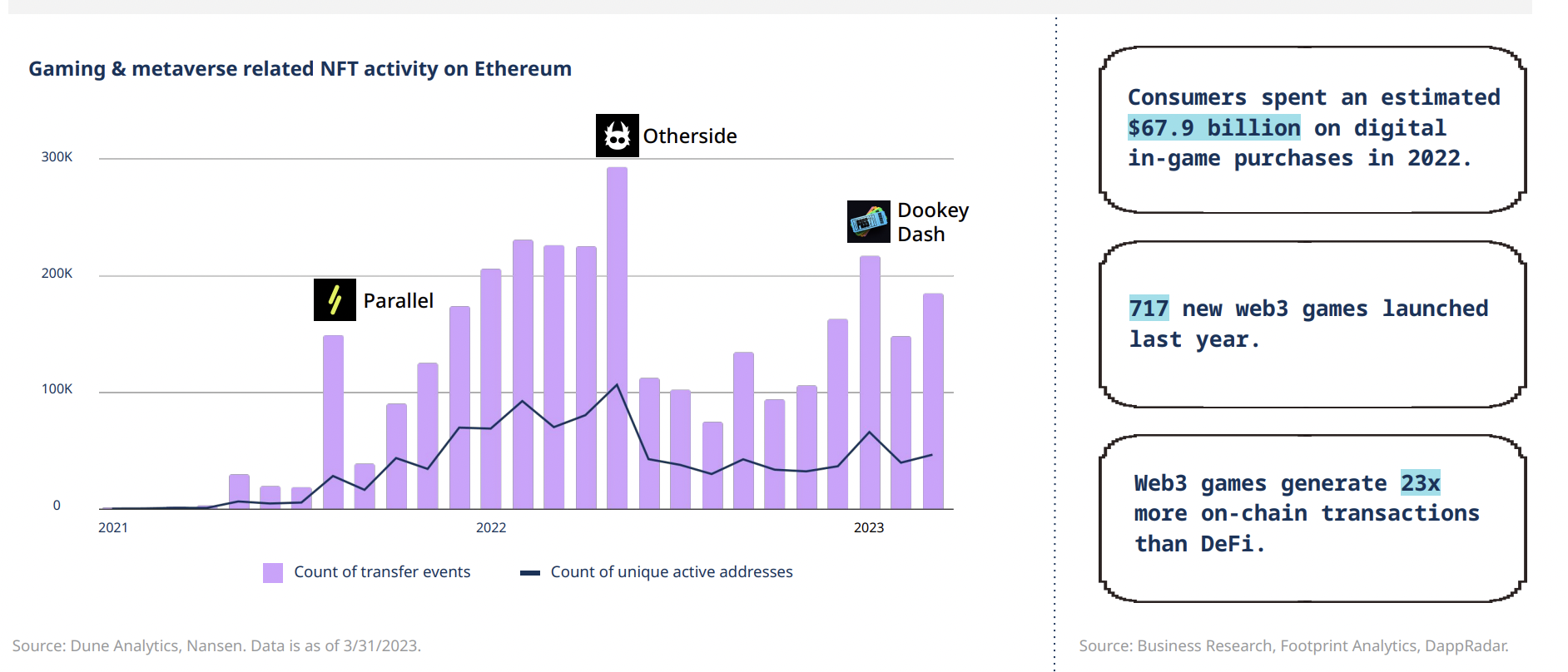
The a16z report underscores that while the crypto market has faced significant headwinds, the infrastructure for Web3 gaming has seen an explosion in development. The firm notes that 717 new Web3 games have entered the market in the last year alone, signaling a robust developer commitment to the space.
Chronology: Mapping the Growth of the Digital Frontier
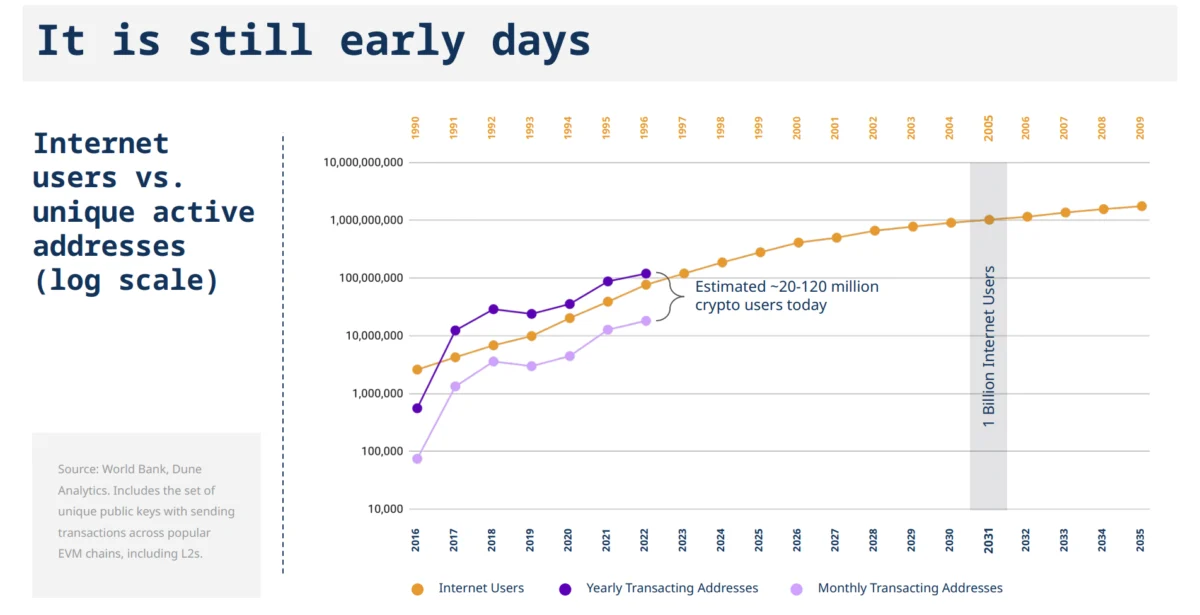
To understand the trajectory of Web3 gaming, one must look at the broader historical context of technological adoption. A16z compares the current state of the crypto industry to the nascent days of the internet in the 1990s.
The 1990s: The Internet’s Infancy
In the early 1990s, the internet was a text-heavy, rudimentary experience restricted to enthusiasts. It wasn’t until graphical user interfaces and consumer-friendly applications (like early browsers) arrived that adoption exploded. Between 1990 and 1996, the world saw a massive surge in users, moving from a few million to nearly 100 million.
2016 to Present: The Crypto Parallel
A16z aligns the growth curve of crypto users, beginning in 2016, with the early internet growth patterns. Despite the volatility of the past few years, the underlying metrics of user engagement continue to climb.

- 2022 Milestones: The report highlights that in 2022, there were an estimated 20 million monthly transacting crypto addresses and 120 million yearly transacting addresses.
- The Gaming Catalyst: As the industry moves into 2023 and beyond, Web3 games are serving as the "graphical user interface" for the blockchain, making the technology accessible to a broader audience that may not care about the underlying ledger technology, but cares deeply about the utility of their digital inventory.
Supporting Data: Why Gaming Outperforms DeFi
One of the most compelling arguments in the a16z report is the sheer volume of activity occurring within gaming ecosystems compared to the more mature DeFi sector.
Transaction Volume
The report reveals that Web3 games are currently generating 23 times more on-chain transactions than decentralized finance protocols. While DeFi remains a critical component of the financial layer of crypto, its utility is largely limited to financial professionals and experienced retail investors. In contrast, games offer high-frequency, low-barrier interaction points.
The Consumer Spend Factor
The economic argument for Web3 gaming is bolstered by the massive scale of the traditional gaming industry. In 2022 alone, consumers spent an estimated $67.9 billion on digital in-game purchases. By migrating even a small fraction of this expenditure to blockchain-based economies, the crypto industry stands to capture a multi-billion dollar market that is already accustomed to the concept of spending money on virtual goods.
Official Responses and Strategic Outlook
Andreessen Horowitz, a firm known for its high-conviction bets on foundational technologies, maintains a bullish stance on the long-term viability of the sector. The a16zcrypto arm has been instrumental in funding infrastructure projects that aim to make blockchain gaming as smooth as traditional web experiences.
In their report, the firm argues that the "early days" rhetoric is backed by data. They suggest that as the "plumbing" of Web3—specifically layer-2 scaling solutions and wallet abstraction—continues to improve, the friction that currently prevents mass adoption will vanish.
Industry analysts suggest that the shift from "Play-to-Earn" (which often suffered from unsustainable tokenomics) to "Play-and-Own" (which focuses on fun and player-owned economies) is the pivotal change that will bring institutional-grade studios into the fray.
Implications: The Future of Digital Economy
The implications of Web3 gaming becoming the primary driver of adoption are far-reaching.
1. Shift in Developer Incentives
As Web3 gaming gains traction, developers will be incentivized to build platforms that reward player loyalty rather than just extracting value. This creates a more sustainable ecosystem where users are not just customers, but stakeholders.
2. Mainstream Normalization
When a user purchases a digital item in a game and realizes they can sell it on a secondary market or take it into a different game, the abstract concept of "crypto" becomes a practical tool. This normalization is exactly what is needed to move crypto from the fringes of finance to the center of consumer culture.
3. Challenges to Overcome
Despite the optimism, the report implicitly acknowledges that the path is not without obstacles. Scalability, regulatory clarity, and user experience (UX) remain the "big three" challenges. The industry must move away from complex seed phrases and high gas fees if it expects to attract the "non-crypto native" gaming population.
4. Long-Term Economic Impact
If Web3 gaming succeeds in its mission, we could see a fundamental restructuring of the digital economy. We are moving toward a world where virtual assets are treated with the same legal and economic weight as physical assets, potentially leading to new forms of employment, taxation, and digital sovereignty.
Conclusion: A Paradigm Shift in Progress
Andreessen Horowitz’s "State of Crypto 2023" report serves as a timely reminder that the crypto industry is far from stagnant. While the headlines often focus on price action and market volatility, the underlying infrastructure is quietly maturing.
Web3 gaming acts as the bridge that connects the abstract capabilities of blockchain technology with the tangible desires of millions of gamers worldwide. By turning digital assets into functional, owned, and tradeable items, the gaming industry is doing the heavy lifting of onboarding users who might otherwise never interact with a crypto wallet.
As the industry looks toward the future, the integration of gaming and finance seems not just likely, but inevitable. The growth metrics provided by a16z suggest that we are currently in a pivotal transition period—one where the foundations of a new digital economy are being laid, block by block, in the virtual worlds of the future.
Disclaimer: The information provided in this article is for informational purposes only and does not constitute financial, investment, or legal advice. Cryptocurrency investments involve a high degree of risk, and you should conduct your own research or consult with a professional advisor before making any financial decisions.