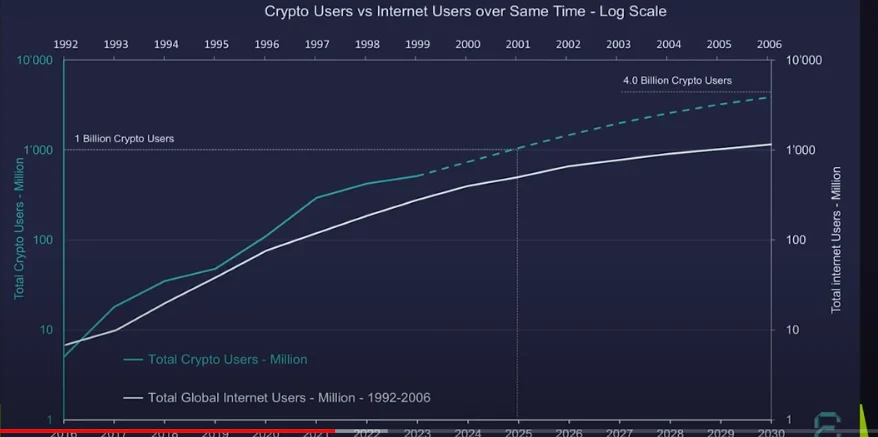
The Great Adoption Curve: Why Raoul Pal Predicts Four Billion Crypto Users by 2030
In the rapidly evolving landscape of digital finance, few voices carry as much weight regarding macroeconomic trends and technological shifts as Raoul Pal. The former Goldman Sachs executive and current CEO of Real Vision has long been a vocal proponent of the "Exponential Age." In his most recent market analysis, Pal has presented a compelling, data-driven thesis: Bitcoin and the broader cryptocurrency ecosystem are currently tracking on an adoption trajectory that could see half the world’s population—roughly four billion people—integrated into the crypto economy by the end of this decade.
The Core Thesis: Crypto’s Unprecedented Velocity
At the heart of Pal’s projection is a comparative model between the early adoption phases of the internet and the current growth of blockchain technology. While skeptics often dismiss cryptocurrency as a volatile niche, Pal’s research suggests that the asset class is actually outperforming the most transformative technology of the 20th century.
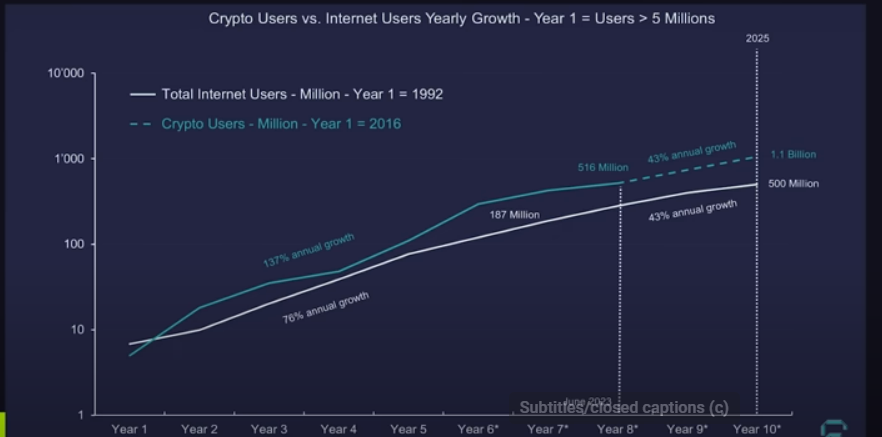
According to his findings, the internet, which remains the fastest-adopted technology in human history, grew at an average rate of 76% annually during its initial years, before eventually tapering to 43% as it reached broader market saturation. In stark contrast, the cryptocurrency space has been expanding at a staggering 137% per year.
Pal points out that crypto has already reached approximately 516 million users, a figure that dwarfs the 187 million users the internet had reached at a comparable stage of its development. By normalizing these growth curves, Pal posits that even if crypto’s growth slows to match the historical pace of the internet, the industry is on a collision course with mass adoption.
A Chronology of Growth: From Niche Asset to Global Standard
To understand the scale of Pal’s prediction, one must look at the timeline of digital asset adoption.
- The Foundational Era (2009–2015): Following the launch of Bitcoin in 2009, the technology existed primarily as a fringe interest for cryptographers and hobbyists. Adoption was negligible in global terms, confined to darknet markets and specialized tech forums.
- The Emergence of Scale (2016): This year marked a critical inflection point in Pal’s model. By 2016, crypto had hit one million users. This serves as the "Year Zero" for his current projection model.
- The Institutional Pivot (2020–2022): The COVID-19 pandemic acted as a massive catalyst. With global monetary stimulus measures driving inflation, institutional interest in Bitcoin as a "digital gold" accelerated, pushing user counts into the hundreds of millions.
- The Present (2024): With over half a billion users, the industry has transitioned from speculative experimentation to a legitimate financial asset class, evidenced by the approval of Spot Bitcoin ETFs and the integration of blockchain tech by major financial institutions like BlackRock and Fidelity.
- The Near-Term Milestone (2025): Pal predicts that by the end of next year, the industry will cross the threshold of 1.1 billion users. This milestone would mark the transition of crypto from a "tech enthusiast" asset to a "mass consumer" product.
- The Four Billion Milestone (2030): Looking toward the end of the decade, Pal’s models indicate that if the current momentum—even with a projected deceleration—holds, the global user base will reach four billion, effectively incorporating half of the world’s population into the crypto-economic framework.
Supporting Data: Why the Model Holds Water
Pal’s optimism is not merely rooted in price action; it is rooted in Metcalfe’s Law, which states that the value of a network is proportional to the square of the number of its connected users. As the user base grows, the utility of the network increases exponentially, creating a feedback loop of adoption.

The "S-Curve" of Technology Adoption
History shows that technologies do not grow linearly; they grow along an "S-Curve." A technology starts slowly, hits a tipping point, grows at an exponential rate, and then levels off as it reaches maturity. Pal’s analysis suggests that cryptocurrency is currently in the "vertical" portion of this S-curve.
Unlike the internet, which required the rollout of massive physical infrastructure (cables, modems, servers), crypto is built atop the internet. It benefits from the existing "rails" of global telecommunications. Therefore, the friction of adoption is significantly lower than it was for the web in the 1990s. Anyone with a smartphone in an emerging market can now access a decentralized exchange, a digital wallet, or a stablecoin-based savings account.
The Role of Emerging Markets
A significant driver of this growth is not the West, but the Global South. In regions with unstable fiat currencies, high inflation, and limited access to traditional banking, Bitcoin and stablecoins are not speculative assets; they are essential survival tools. The adoption rates in countries like Nigeria, Argentina, and Vietnam act as a "canary in the coal mine" for global trends, demonstrating that when the cost of financial inclusion is high, citizens will turn to the most efficient decentralized alternative.
Implications: A Fundamental Shift in Global Finance
If Pal’s predictions materialize, the implications for the global financial order would be seismic.
The End of Traditional Gatekeeping
A world with four billion crypto users implies that the traditional banking system would no longer be the sole arbiter of value transfer. If half the world is participating in a decentralized ledger, the ability for central banks to control capital flows, dictate interest rates, and debase currency would be significantly curtailed.
The "Digital Gold" Standard
As Bitcoin reaches a critical mass of four billion users, its volatility is expected to dampen. It would likely evolve into a global reserve asset, perhaps not replacing fiat currencies entirely, but serving as the ultimate "neutral" settlement layer that operates outside the jurisdiction of any single nation-state.
Regulatory Evolution
The transition to mass adoption will force a shift in regulatory strategy. Governments will likely move from an "attempt to ban" phase to an "attempt to integrate and tax" phase. We are already seeing this with the implementation of the MiCA (Markets in Crypto-Assets) regulation in Europe and the push for clear digital asset frameworks in the United States.
Expert Perspectives and Skepticism
While Pal’s model is compelling, it is not without its critics. Traditional economists often argue that crypto lacks "intrinsic value" and that its growth is purely speculative. They point to the "regulatory risk" as a potential "black swan" event that could stall adoption.
Furthermore, there is the issue of technological literacy. While the barriers to entry are lowering, the complexity of self-custody and the risks of phishing and hacks remain significant hurdles for the average user. For the four-billion-user milestone to be reached, the "User Experience" (UX) layer must improve to the point where interacting with a blockchain is as seamless as sending an email or using a credit card.
Conclusion: The Path Forward
Raoul Pal’s projection of four billion users by 2030 is bold, but it is supported by the relentless pace of technological diffusion. Whether the industry hits exactly four billion or settles slightly lower, the trend is clear: we are witnessing the migration of the global economy from a closed, centralized system to an open, decentralized one.
As with all high-risk, high-reward sectors, the path will likely be paved with periods of extreme volatility and regulatory friction. However, for those looking at the long-term charts, the story is not one of price cycles, but of a fundamental change in how humanity interacts with money, identity, and ownership.
Disclaimer: The information provided in this article is for educational and informational purposes only and does not constitute financial, investment, or legal advice. Cryptocurrency investments carry high risks. Readers should conduct their own due diligence and consult with a professional financial advisor before making any investment decisions. The Daily Hodl is not responsible for any financial losses incurred.