
The Great Capitulation: Why Bitcoin Miners Are Liquidating at Record Rates in 2026
The Bitcoin mining industry, once characterized by its "HODL" mentality and long-term accumulation, is currently undergoing a structural transformation marked by distress, consolidation, and an unprecedented wave of liquidation. As of early 2026, roughly 20% of the entire Bitcoin mining network is operating at a net loss. This sobering statistic serves as the catalyst for a sector-wide exodus, as publicly traded mining giants scramble to dump their treasury holdings—not to realize profits, but to secure the operational liquidity required to keep their facilities powered and their infrastructure online.
The Margin Squeeze: A Race to the Bottom
The primary metric governing the health of the mining sector is "hashprice"—the daily revenue a miner generates per petahash per second (PH/s) of computing power. Since July 2025, hashprice has been on a relentless downward trajectory. As of April 2026, it hovers near $33 per PH/s per day.
For many firms, particularly those relying on legacy hardware that lacks the energy efficiency of newer models, the breakeven threshold sits at approximately $35 per PH/s. This $2 delta may appear marginal on a spreadsheet, but in an industry defined by razor-thin margins and massive electricity expenditures, it is the difference between solvency and bankruptcy.
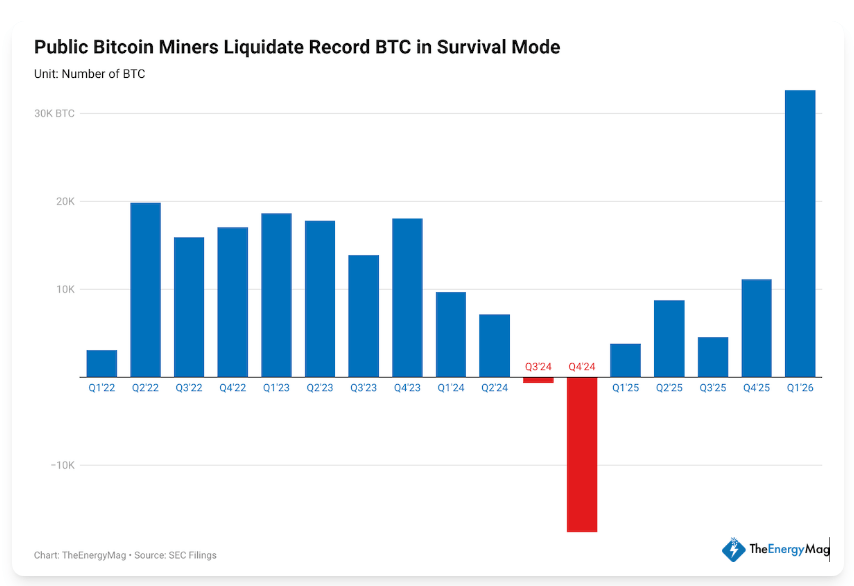
The financial pressure is evident in the activity of the industry’s biggest players. According to data from TheEnergyMag, public mining entities—including industry stalwarts like MARA, CleanSpark, Riot, Cango, Core Scientific, and Bitdeer—collectively offloaded more than 32,000 BTC during the first three months of 2026. To put this in perspective, this figure exceeds the total volume sold by these same companies throughout the entirety of 2025. It also eclipses the previous quarterly record of 20,000 BTC, established during the volatile second quarter of 2022, when the collapse of the Terra-Luna ecosystem sent shockwaves through the digital asset markets.

Chronology of a Crisis: From Bullish Expansion to Defensive Survival
The current state of the mining sector is the culmination of three compounding macroeconomic and technical forces that began to tighten the vice in late 2025:
- The Hashrate Explosion: As the Bitcoin network hashrate has reached new all-time highs, the difficulty of securing the network has scaled accordingly. This has effectively diluted the reward share for individual miners, forcing them to spend more on hardware and energy just to maintain their existing output.
- The Post-Halving Reality: Following the most recent halving event, which slashed the block subsidy in half, the revenue model for miners became significantly more precarious. Without a commensurate spike in Bitcoin’s price, the reduction in supply issuance has left miners with half the production revenue for the same amount of operational work.
- Macroeconomic Headwinds: Broader global economic instability has prevented Bitcoin from sustaining the price levels necessary to offset the reduced block rewards. With electricity costs remaining sticky and rising in many jurisdictions, the "cost-to-mine" has frequently outpaced the market value of the assets produced.
Supporting Data: The Erosion of Miner Reserves
The Q1 2026 sell-off is not an isolated event; it is the acceleration of a trend that has been unfolding for years. Data from analytics firm CryptoQuant reveals a steady, consistent decline in total Bitcoin holdings across the mining ecosystem since 2023.
At the end of 2023, the industry-wide reserve peaked at over 1.86 million BTC. As of April 2026, that figure has drifted down to approximately 1.8 million. While this might seem like a gradual drawdown, the first quarter of 2026 represents a sharp inflection point. The desperation to cover operational overhead is clearly driving a faster depletion of these long-held reserves.
Industry analysts at CoinShares painted a grim picture in their Q1 2026 Bitcoin Mining Report. The firm warned that if the price of Bitcoin does not stage a significant recovery in the coming months, the industry should brace for a period of "continued capitulation." For higher-cost operators—those whose energy contracts are not optimized or whose fleets are outdated—the window to avoid insolvency is closing rapidly.
Official Responses and Corporate Sentiment
While the mining sector is in retreat, the wider corporate landscape for Bitcoin tells a bifurcated story. There is a distinct "changing of the guard" occurring: miners, who historically acted as the primary accumulators of Bitcoin, are being forced to distribute their supply to more stable, treasury-focused entities.
The most notable participant in this shift is Strategy, which continues to solidify its position as the world’s largest corporate holder of Bitcoin. Co-founder Michael Saylor has remained defiant against the market pressure. In a cryptic but widely interpreted post on X (formerly Twitter) on April 12, 2026, Saylor hinted at further acquisitions. By sharing the company’s historical purchase chart—a signature move that his followers recognize as a precursor to an official SEC filing—Saylor signaled that while miners are selling, his firm is ready to absorb the supply.
This divergence in behavior highlights a fundamental shift in the Bitcoin ecosystem. The "miner-as-holder" model is proving increasingly fragile in the face of cyclical downturns. Conversely, large-scale treasury buyers are utilizing their balance sheet strength to accumulate assets during periods of miner capitulation, effectively acting as the market’s floor.
Implications: The Long-Term Outlook for Network Security
The implications of this industry-wide liquidation are profound. First, the ongoing sell-off will likely lead to a massive consolidation within the mining sector. Smaller, less efficient firms are already being acquired or forced to liquidate their equipment, allowing larger, well-capitalized miners to capture greater market share. This centralization of mining power could alter the network’s hash distribution, a subject of ongoing debate among blockchain purists.
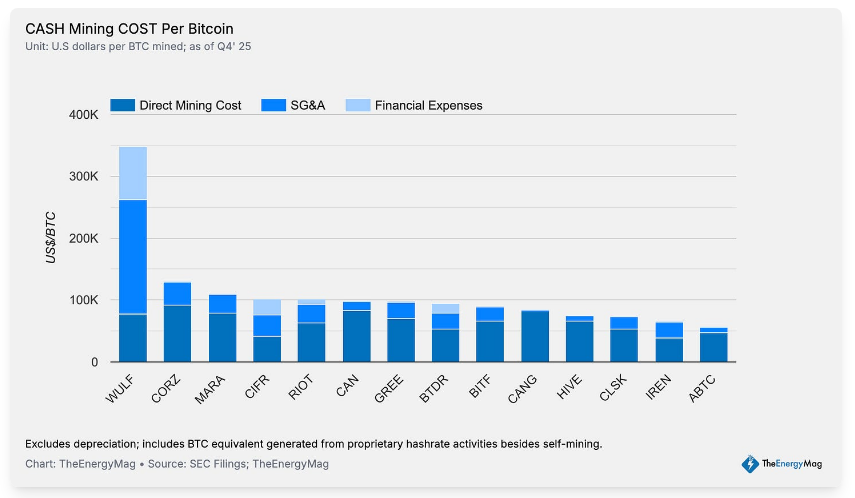
Second, the "clearing out" of inefficient miners is a natural, albeit painful, mechanism of the Bitcoin protocol. By forcing out high-cost producers, the network naturally recalibrates toward more energy-efficient and cost-effective operations. Once the dust settles and the weaker players have exited, the industry may emerge leaner and more resilient.
However, in the short term, the pressure remains acute. The market is watching closely to see if the price of Bitcoin can break above the levels required to make mining profitable again. If the price remains depressed, we may see a temporary drop in the total network hashrate as machines are unplugged, which would lead to a downward adjustment in mining difficulty—a self-correcting feature designed to keep the network functional even during periods of low profitability.
As we move through the second quarter of 2026, the industry is at a crossroads. The miners are testing the limits of their liquidity, and the market is testing the strength of the corporate demand. Whether this record-breaking sell-off leads to a total collapse of the mining fringe or serves as the final "wash-out" before a new bull cycle remains the multi-billion dollar question for investors and stakeholders alike.
For now, the mantra for the mining sector has shifted from "growth at all costs" to "survival at any price." As the industry sheds its reserves, the rest of the market watches to see who will be left standing when the volatility subsides.