
The Great Hash Rate Surge: Bitcoin Mining at a Historical Crossroads
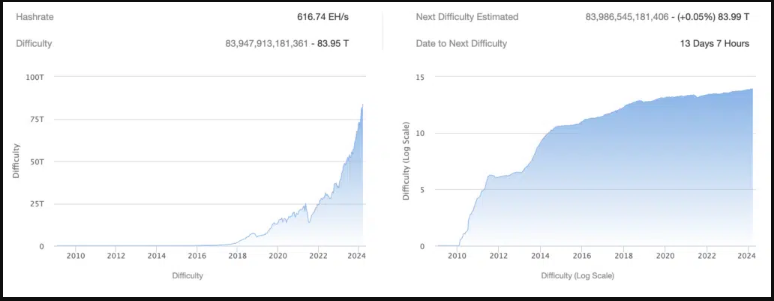
The Bitcoin network is currently traversing a period of unprecedented intensity. As the digital asset ecosystem readies itself for the quadrennial halving event, the fundamental architecture of the Bitcoin blockchain is signaling a dramatic shift in market sentiment and competitive pressure. On March 14, 2024, the network recorded a monumental milestone: mining difficulty surged to an all-time high of 84 trillion hashes. This development is not merely a technical statistic; it is a profound indicator of the current state of the global mining industry, which is grappling with the dual pressures of record-breaking network security and the looming reduction in block rewards.
The Mechanics of the Difficulty Surge
To understand the significance of this 84 trillion hash threshold, one must first appreciate the self-regulating nature of the Bitcoin protocol. Bitcoin is designed to maintain a consistent block production time—approximately ten minutes per block—regardless of the total amount of computing power directed at the network. This is achieved through "mining difficulty," a dynamic metric that adjusts every 2,016 blocks (roughly every two weeks).
When the aggregate hash rate—the total computational power used to secure the network—increases, the protocol automatically elevates the difficulty. This ensures that even as more powerful, state-of-the-art ASIC (Application-Specific Integrated Circuit) miners are deployed, the production rate of new BTC remains stable. The latest adjustment, which saw a 5.80% increase in difficulty, reflects a network that is more fortified than ever before. With the hashrate currently hovering at 617 EH/s (exahashes per second), it is evident that a massive wave of capital and hardware has entered the mining sector.

Chronology of the Current Cycle
The path to this record-breaking difficulty was paved by a confluence of macroeconomic factors and market behavior.
- Early Q1 2024: As anticipation for the approval of spot Bitcoin ETFs grew, market interest intensified. The ensuing price rally served as a catalyst for mining firms to increase their operational capacity.
- March 14, 2024: Bitcoin achieved a new all-time high in valuation, touching approximately $73,800. This price surge acted as a clarion call for miners worldwide, prompting a massive influx of hashing power to capture the lucrative block rewards.
- Post-March 14: Following the price peak, the market experienced a cooling-off period. As of late March, the price of Bitcoin has fluctuated around the $68,000 mark. Despite this minor retracement, the mining difficulty remains elevated, creating a high-pressure environment for smaller or less efficient mining operations.
- April 2024 (Upcoming): The industry is now holding its collective breath for the Bitcoin halving, an event that will reduce the miner reward from 6.25 BTC to 3.125 BTC per block.
Supporting Data: The Mining Economics
The current mining landscape is a complex balancing act. According to data from BTC.com, the increase in difficulty by nearly 5.80% is the largest in recent memory, signaling that the network is undergoing a period of intense "capital expenditure" (CapEx) cycles.
Mining revenue, which reached an impressive $79 million in a single day during the peak of the recent rally, has temporarily offset the rising energy costs and hardware depreciation. However, this revenue figure is a "gross" metric. The "net" profitability of a mining operation is dictated by the cost per kilowatt-hour (kWh) and the efficiency of the mining rigs deployed.

For mining firms, the math is becoming increasingly unforgiving. As the difficulty rises, the "hashprice"—the expected revenue per unit of hash rate—effectively declines. This creates a scenario where only those with the most efficient hardware and the lowest energy costs can maintain profitability. Consequently, we are seeing a trend toward institutionalization; large, publicly traded mining companies are better positioned to absorb the rising difficulty, while smaller, retail-level operations are increasingly being pushed to the fringes.
The Halving Effect: Scarcity and Market Psychology
The upcoming halving is more than a technical update; it is an economic experiment in programmed scarcity. By cutting the daily issuance of new Bitcoin in half, the protocol forces an artificial supply shock. Historically, the periods following the 2012, 2016, and 2020 halvings have been associated with significant long-term price appreciation.
The logic underpinning this optimism is straightforward: if demand remains constant or increases—driven by institutional adoption and the scarcity narrative—while the supply of newly minted BTC is restricted, the price should theoretically rise to meet the new equilibrium. However, the "halving effect" is not instantaneous. Analysts suggest that the market often "prices in" the halving ahead of time, but the true impact on mining operations is often felt only after the event, as the revenue of miners is suddenly cut by 50% overnight.
Implications for the Future
The current state of Bitcoin mining raises several critical questions regarding the future of the Proof-of-Work (PoW) consensus mechanism.
The Sustainability Debate
As the hash rate climbs, so too does the global energy consumption of the Bitcoin network. This has become a focal point for environmental, social, and governance (ESG) critics. However, proponents argue that Bitcoin mining is increasingly becoming a buyer of "stranded" or "curtailed" energy—electricity that would otherwise go to waste. The pressure of the upcoming halving is, ironically, forcing miners to become more efficient, which often translates to seeking out the cheapest and most sustainable energy sources available.
The Viability of Proof-of-Work
While some critics argue that the energy intensity of PoW is a fatal flaw, the network’s current security level suggests otherwise. With a hash rate of 617 EH/s, the Bitcoin network is arguably the most secure computing platform in human history. To attack it would require a level of computational resources that is currently beyond the reach of any nation-state. Nevertheless, as the block reward diminishes over the coming decades, the network will eventually have to rely entirely on transaction fees to incentivize miners. This transition is a long-term challenge that developers and the broader community are actively monitoring.
Market Consolidation
In the short term, the most significant implication is the consolidation of the mining industry. We are likely to witness a period of "miner capitulation," where inefficient operators are forced to liquidate their holdings or shut down their machines. This is a natural, albeit painful, cycle in the Bitcoin economy. It clears the market of "weak hands" and ensures that the remaining infrastructure is robust, efficient, and well-capitalized.
Conclusion: A Resilient Network
The surge to 84 trillion in mining difficulty is a testament to the enduring appeal of the Bitcoin network. Despite the volatility of the crypto markets and the impending reduction in rewards, miners continue to invest billions of dollars into the network’s security.
As we approach the April halving, the Bitcoin network is proving its resilience. It is a system that thrives on pressure; the very challenges that threaten to squeeze out inefficient participants are the same ones that reinforce the scarcity and security of the asset. Whether one views the rising difficulty as a sign of progress or a cause for environmental concern, one thing is certain: the Bitcoin network continues to operate with a clockwork precision that few traditional financial systems can replicate. The coming months will be a definitive chapter in the story of Bitcoin, testing the mettle of the miners who provide the backbone of the most decentralized financial network in history.