
The Great Hash Rate Surge: Bitcoin Mining Faces Unprecedented Complexity Ahead of Halving
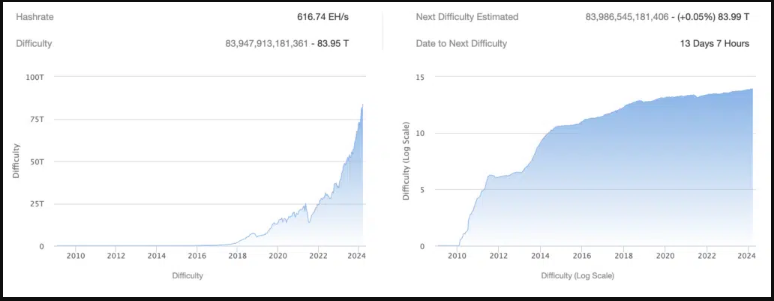
The Bitcoin network is currently navigating one of its most critical technical and economic junctures in recent history. On March 14, 2024, the blockchain reached a watershed moment: mining difficulty surged to an all-time high of 84 trillion hashes. This dramatic increase in computational complexity, which serves as a security barometer for the network, arrived amidst a period of extreme market volatility and intense anticipation surrounding the quadrennial Bitcoin halving event scheduled for April.
As the network prepares to slash miner rewards, the interplay between record-breaking hash rates, soaring mining difficulty, and the anticipation of supply scarcity is creating a complex environment for market participants and infrastructure providers alike.
The Mechanics of Mining: Understanding the Difficulty Adjustment
At its core, Bitcoin mining is a competitive process of verification. Miners utilize specialized hardware, known as Application-Specific Integrated Circuits (ASICs), to solve complex cryptographic puzzles. This Proof-of-Work (PoW) consensus mechanism is designed to ensure that the network remains decentralized, immutable, and secure.
To maintain the protocol’s integrity, Bitcoin’s software includes a "difficulty adjustment" algorithm. This mechanism automatically recalibrates the level of difficulty for mining every 2,016 blocks—approximately every two weeks. The objective is to ensure that, regardless of how much total computing power (hash rate) is directed at the network, a new block is produced, on average, every ten minutes.

According to data from the industry-standard tracking platform BTC.com, the network has seen its difficulty rise by nearly 5.80% in the most recent adjustment cycle. This shift correlates with a significant climb in the network’s total hashrate, which has reached an staggering 617 exahashes per second (EH/s). This metric confirms that, despite the increased cost of entry and operation, the global mining industry is seeing an influx of participants, likely catalyzed by Bitcoin’s price rally that saw the digital asset touch a record-high of $73,800 on the same day the difficulty hit its peak.
Chronology of a Network Evolution
To understand the current state of Bitcoin mining, one must look at the historical trajectory of the network’s growth:
- Q4 2023: As Bitcoin began its steady climb out of the previous "crypto winter," institutional interest fueled by the prospect of Spot Bitcoin ETFs began to materialize. Mining firms began aggressively upgrading their hardware to capture higher transaction fees and prepare for the upcoming halving.
- January 2024: Following the approval of several Spot Bitcoin ETFs in the United States, Bitcoin’s price momentum accelerated, bringing massive amounts of fresh capital into the mining sector.
- March 14, 2024: The network recorded its 84-trillion-hash difficulty milestone. This day served as a stress test for the network, proving that the decentralization of hash power remains robust even as the barrier to entry becomes higher.
- April 2024 (The Horizon): The impending halving is set to reduce the block reward from 6.25 BTC to 3.125 BTC. This event is the most anticipated catalyst in the current market cycle, serving as the primary driver for both institutional and retail interest.
Supporting Data: The Profitability Paradox
While the surge in difficulty might, at first glance, appear detrimental to miners—as it necessitates more energy and hardware to produce the same amount of Bitcoin—the reality is more nuanced. Data shows that mining revenue has seen substantial spikes, with daily rewards reaching near-record levels of $79 million.
This financial windfall is a direct result of the elevated price of Bitcoin combined with a spike in transaction fees, driven by the emergence of new protocols on the Bitcoin blockchain, such as Ordinals and BRC-20 tokens. These innovations have created a secondary market for "block space," allowing miners to earn revenue beyond the block subsidy.

However, the "difficulty dilemma" remains a persistent shadow. For smaller, less efficient mining operations, the increased difficulty acts as a filter. As the difficulty climbs, firms relying on older, less energy-efficient hardware are increasingly finding themselves unable to remain profitable. This leads to a consolidation of the mining industry, where only the most well-capitalized firms—those with access to cheap, renewable energy and the latest generation of mining chips—can sustain operations.
The Impending Halving: A Scarcity Catalyst
The halving is not merely a technical update; it is an economic experiment in real-time. By design, Satoshi Nakamoto, Bitcoin’s pseudonymous creator, encoded this reduction in issuance to simulate the scarcity of precious metals like gold.
Historically, the halving has served as a supply-side shock. When the new supply of Bitcoin entering the market is cut by 50%, the impact on the price is typically delayed but profound. If the demand for Bitcoin remains constant or increases—driven by the aforementioned ETFs and broader institutional adoption—the reduction in supply creates a classic market imbalance, typically pushing the price upward.
Analysts remain divided on whether the "price-in" effect has already occurred. Some argue that the market has anticipated the halving for months, while others believe that the post-halving supply crunch will lead to an unprecedented "supply shock" that will drive the price toward six figures by the end of 2024.
Official Perspectives and Industry Implications
The consensus among industry experts is that we are witnessing the professionalization of the Bitcoin mining sector. The days of "bedroom mining" are largely over, replaced by publicly traded companies operating massive data centers in regions with favorable regulatory and environmental conditions.
Environmental Concerns
The rising difficulty has, inevitably, reignited the debate regarding Bitcoin’s energy consumption. As the hash rate climbs, so does the global electricity demand for the network. While critics point to the carbon footprint of Proof-of-Work, proponents argue that Bitcoin mining is uniquely positioned to act as a "grid stabilizer." By utilizing stranded energy—excess power from renewable sources like hydro, solar, and wind that would otherwise be wasted—miners are becoming key partners in energy infrastructure development.
Long-Term Sustainability
The sustainability of the current model is a point of ongoing discourse. With the block reward shrinking every four years, the security of the Bitcoin network will eventually rely almost entirely on transaction fees. Whether the Bitcoin ecosystem can sustain enough network activity to provide sufficient revenue for miners remains the central question for the next decade of development.
The Rise of Alternative Mechanisms?
While some critics continue to suggest that Bitcoin should transition to less energy-intensive models, the community remains steadfast in its commitment to Proof-of-Work. The security and censorship resistance provided by the current hash rate are considered, by most developers and investors, to be the network’s most valuable features. Alternative consensus mechanisms, while theoretically more efficient, lack the proven historical resilience of the Bitcoin protocol.
Conclusion: A Network in Transition
The recent surge to 84 trillion in mining difficulty is a testament to the health and vitality of the Bitcoin network. It reflects a global market that is actively betting on the long-term success of the asset. As we approach the April halving, the eyes of the financial world are fixed on the miners. They are the gatekeepers of the network, and their ability to navigate this transition will dictate the stability of the entire digital economy.
While challenges regarding energy consumption and mining profitability persist, the underlying trend is clear: Bitcoin is evolving from a niche digital experiment into a foundational pillar of global finance. Whether the market reacts to the halving with a parabolic move or a period of consolidation, the fundamental strength of the network, as evidenced by its record-high difficulty, remains unshakable.
Disclaimer: The information provided in this article is for educational and informational purposes only. It does not constitute financial, investment, or legal advice. Cryptocurrency investments are subject to high volatility and significant risk. Readers are advised to conduct their own independent research and consult with a qualified financial advisor before making any investment decisions. The author and the publication assume no responsibility for any financial losses or damages resulting from the use of this information.