
The Great Hash Rate Surge: Bitcoin Mining’s Toughest Challenge Ahead of the 2024 Halving
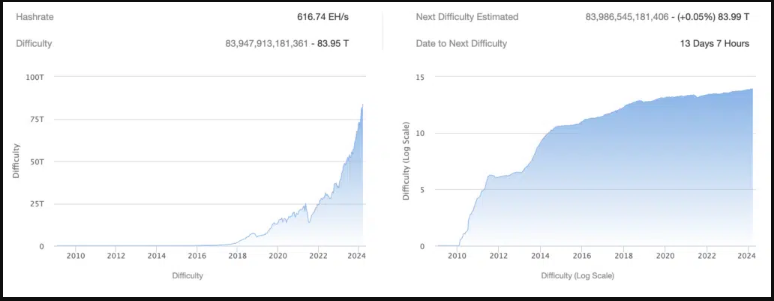
The landscape of the Bitcoin network is currently undergoing a period of unprecedented intensity. As of mid-March 2024, the fundamental mechanics governing the world’s largest cryptocurrency have reached a historic inflection point. On March 14th, the Bitcoin network recorded an all-time high in mining difficulty, hitting a staggering 84 trillion hashes. This milestone serves as more than just a technical statistic; it is a clear indicator of a hyper-competitive mining environment that is rapidly intensifying as the industry braces for the quadrennial "halving" event scheduled for April.
As the network’s self-correcting mechanisms push the limits of computational power, miners find themselves in a high-stakes race. With the price of Bitcoin flirting with record highs and the block reward set to drop significantly, the industry is balancing on a razor’s edge between massive profitability and existential operational pressure.
The Mechanics of Difficulty: Why the Network is Working Harder
To understand the significance of the 84 trillion hash difficulty, one must first understand the "difficulty adjustment" algorithm. Bitcoin is designed to maintain a consistent cadence—producing a new block roughly every ten minutes. To achieve this, the network automatically adjusts the complexity of the cryptographic puzzles that miners must solve to validate transactions and earn rewards.
When the total computational power (the "hash rate") of the network increases—meaning more miners are connecting more powerful machines—the difficulty must rise to prevent blocks from being produced too quickly. According to data from BTC.com, the network has seen a 5.80% surge in difficulty since the previous adjustment. Simultaneously, the total network hash rate has reached a peak of 617 EH/s (exahashes per second).

This represents an influx of capital and hardware into the mining sector. Driven by Bitcoin’s rally, which saw the asset peak at $73,800 on the same day the difficulty record was shattered, miners are expanding their operations to capture as much of the block reward as possible before the upcoming reduction in supply.
A Chronology of the 2024 Mining Evolution
The current state of mining did not happen overnight; it is the culmination of a decade-long professionalization of the industry.
- Q4 2023: As Bitcoin began its recovery from the 2022 bear market, large-scale mining operations began upgrading to more efficient ASIC (Application-Specific Integrated Circuit) miners. This period saw a massive deployment of hardware in anticipation of the bull market.
- January 2024: The approval of Spot Bitcoin ETFs in the United States acted as a catalyst for institutional demand, pushing the price upward and encouraging miners to increase their electricity expenditure to maximize output.
- March 2024: The confluence of a record-breaking price rally and the approaching halving created a "mining gold rush." The hash rate hit record levels, directly triggering the 84 trillion difficulty adjustment on March 14th.
- April 2024 (Projected): The halving will occur, reducing the block reward from 6.25 BTC to 3.125 BTC. This event will act as a "stress test" for the entire mining industry, likely forcing out less efficient operators who cannot maintain profitability at lower margins.
Supporting Data: The Economics of the Hash Rate
The relationship between price, hash rate, and difficulty creates a unique feedback loop. Currently, the total network hash rate stands at 617 EH/s. While this high level of participation makes the network arguably more secure than ever, it also creates a thin margin for error for individual miners.
Mining revenue recently touched nearly $79 million in a single day, a testament to the immense value being processed by the network. However, this figure is deceptive. While the top-tier mining operations—those with access to low-cost electricity and the latest generation of mining hardware—are seeing record profits, smaller operations are struggling to keep up.

The rising difficulty acts as a natural filter. If the price of Bitcoin were to stabilize or decline while the difficulty remains at this 84-trillion-hash peak, many miners would find themselves "underwater," meaning their electricity costs would exceed the value of the Bitcoin they are producing. This reality is forcing the industry toward extreme efficiency.
Official Perspectives and Industry Implications
Industry experts are divided on whether this surge in difficulty is a sign of long-term health or a harbinger of a "mining shakeout."
Proponents of the current system argue that the rising difficulty is a feature, not a bug. By forcing miners to become more efficient, the network effectively purges bad actors and rewards those who can innovate. Companies are increasingly moving toward renewable energy sources and grid-balancing technologies to mitigate the costs associated with the rising difficulty.
Conversely, critics and some environmental advocates point to the energy consumption required to maintain these levels of security. As the difficulty climbs, the total energy load of the Bitcoin network continues to rise, leading to renewed scrutiny regarding its carbon footprint. The industry is responding by attempting to transition toward sustainable power, but the challenge remains significant in regions where non-renewable energy remains the most cost-effective option.
The Halving Effect: The Impending Shift
The April halving is the most significant event in the Bitcoin calendar for 2024. By cutting the block reward in half, the network essentially doubles the cost of production for miners in terms of BTC earned.
Historically, this has functioned as an economic supply-side shock. If demand remains constant or increases while the supply of newly minted Bitcoin is halved, basic economic theory suggests an upward pressure on price. However, the short-term impact is often chaotic. We expect to see:
- A "Hash Price" Dip: As rewards are halved, the amount of revenue per unit of hash power will drop.
- Miner Capitulation: Miners with older, less efficient hardware (such as the S9 or older generation machines) will likely shut down, leading to a temporary drop in hash rate and a subsequent downward adjustment in difficulty.
- Market Consolidation: Larger, public-listed mining companies with better capital access are expected to acquire the assets of smaller, failing miners, leading to a more centralized mining landscape.
Long-Term Sustainability: Beyond Proof-of-Work
The conversation regarding Bitcoin’s Proof-of-Work (PoW) mechanism is evolving. While PoW is lauded for its unparalleled security and decentralization, the trend toward higher difficulty and higher energy consumption is forcing a discussion about the network’s future.
Some developers are exploring "Layer 2" scaling solutions and more efficient transaction processing to ensure that even if mining becomes more exclusive, the network remains accessible to global users. Others are looking at the potential for "merged mining," where miners secure multiple networks simultaneously to diversify their revenue streams.
Despite these discussions, there is no immediate intention to pivot away from the current consensus mechanism. Bitcoin’s security is its primary value proposition, and the 84-trillion-hash difficulty is, in the eyes of many, the strongest firewall against potential network attacks.
Conclusion: The Path Ahead
The current state of Bitcoin mining is a masterclass in economic tension. We are witnessing a historic moment where the network’s security, driven by record hash rates and difficulty, is being stress-tested by a looming reduction in rewards.
For the average observer, this signifies that Bitcoin is maturing. It is no longer a hobbyist’s pursuit but a global, industrial-scale infrastructure project. While the environmental and operational challenges are significant, the resilience shown by the network during this period of transition is a testament to the robustness of Satoshi Nakamoto’s original design. As we move through the halving in April, the world will be watching to see how the industry adapts, which firms survive the transition, and how the price of Bitcoin reacts to the new, more scarce reality of its supply chain.
Whether this leads to a "super-cycle" in pricing or a period of consolidation remains to be seen, but one thing is certain: the era of "easy" mining is firmly in the past, replaced by an era of extreme efficiency and high-stakes competition.