The Great Pivot: How Bitcoin Miners Are Redefining Their Business Models Amidst the Post-Halving Era
The landscape of the cryptocurrency mining industry is currently undergoing its most significant structural shift since the inception of Bitcoin. Following the highly anticipated "halving" event in April 2024, the sector has been thrust into a state of forced evolution. With block rewards slashed by 50%—effectively halving the primary revenue stream for network validators overnight—mining firms are confronting a harsh new reality. As daily revenues have plummeted by over 70% in some instances, the industry is no longer simply about securing the blockchain; it is about survival, efficiency, and diversification.
In this high-stakes environment, a growing number of publicly traded mining companies are looking toward a surprising savior: Artificial Intelligence (AI). By pivoting their high-performance computing infrastructure toward the burgeoning AI sector, miners are attempting to transition from simple transaction processors to the backbone of the next technological revolution.
The Catalyst: The April 2024 Halving and the Revenue Crisis
To understand the current metamorphosis, one must first examine the math. Bitcoin’s halving is a pre-programmed event designed to control inflation, occurring roughly every four years. While the event is celebrated by proponents of "digital gold" as a deflationary triumph, it is undeniably brutal for mining operations.
When the block subsidy dropped from 6.25 BTC to 3.125 BTC per block, miners were suddenly faced with a massive reduction in gross income. For firms operating with older, less efficient hardware, the cost of electricity required to mine a single Bitcoin began to exceed the market value of the coin itself. This created a "miner capitulation" scenario, where operations with high overheads were forced to either shut down, sell their Bitcoin reserves to cover operational costs, or seek alternative revenue streams.

This economic pressure has acted as a crucible, weeding out the inefficient players and forcing industry leaders to innovate or risk insolvency.
The AI Pivot: A Strategic Shift to High-Performance Computing
The rise of generative AI, spearheaded by the global adoption of OpenAI’s ChatGPT and similar large language models, has created an unprecedented demand for data center capacity and high-performance computing (HPC). This is where Bitcoin miners have found a lifeline.
The hardware used for Bitcoin mining—Application-Specific Integrated Circuits (ASICs)—is highly specialized. However, the physical infrastructure that houses them—data centers with massive power contracts, sophisticated cooling systems, and high-speed networking—is remarkably similar to the infrastructure required to run AI clusters.
Industry heavyweights are now aggressively diversifying. Companies like Bit Digital, Hut 8, and Hive have already begun dedicating significant portions of their operational capacity to AI and cloud services. For these firms, AI is not just a side project; it is becoming a core pillar of their business model. Bit Digital, for instance, has reported that more than 30% of its total income is now derived from AI-related services, a clear indicator that the "pivot" is already well underway.

Official Perspectives on the Diversification
Adam Sullivan, the CEO of Core Scientific, underscored the strategic importance of this transition, stating, "The shift to AI allows us to create a diversified business model with more predictable cash flows."
This sentiment is echoed across the C-suites of major mining operations. By diversifying into AI, miners are insulating themselves from the extreme volatility of Bitcoin’s price. While Bitcoin remains a speculative asset, the demand for AI computing power is currently driven by massive enterprise and government investment, providing a more stable and "predictable" revenue profile that investors increasingly demand.
Chronology: From Mining to Computing
- Pre-Halving (Early 2024): Mining firms enjoyed record-high revenues as Bitcoin prices surged toward all-time highs. Investment in mining hardware hit a peak.
- The Halving (April 2024): The block reward reduction occurs. Revenue for miners drops instantaneously by 50%. Mining stocks experience increased volatility.
- The "Capitulation" Phase (May–June 2024): Hashrate—a measurement of the network’s total computing power—begins to decline. Older mining rigs are taken offline. The "Hash Ribbons" indicator signals miner capitulation, often historically interpreted as a long-term buy signal for Bitcoin.
- The AI Pivot (Current Status): Major firms publicly announce multi-million dollar investments into GPU clusters and AI data center conversion. The industry begins to re-brand as "High-Performance Computing" firms rather than simple mining operations.
Supporting Data: The Market Dynamics
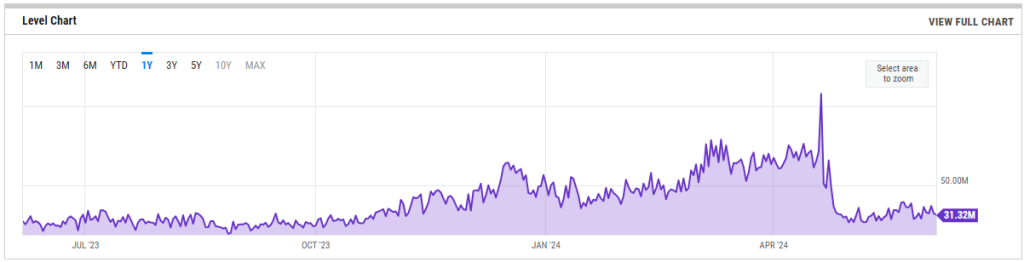
The current market environment is illustrated by two primary metrics: the decline in daily revenue and the movement in hashrate. According to data from YCharts, the revenue per unit of computing power has significantly compressed. This downward pressure has forced miners to move away from purely "mining for Bitcoin" and toward "mining for profit," wherever that profit may lie.
The "Hash Ribbons" indicator, which tracks the 30-day and 60-day moving averages of the network’s hashrate, has shown significant activity recently. When the 30-day average crosses below the 60-day average, it historically suggests that miners are turning off their machines. However, as noted by crypto hedge fund Capriole Investments, this "miner capitulation" can actually be a bullish indicator for the long-term price of Bitcoin. When miners stop selling their Bitcoin to pay for electricity, the "sell pressure" on the market decreases, theoretically allowing the price to stabilize or rise due to reduced supply-side liquidity.
Implications: A New Era for Blockchain Infrastructure
The transformation of the mining industry has profound implications for both the crypto and AI sectors.
1. Market Consolidation
The era of the "bedroom miner" is effectively over. Only firms with massive capital reserves and the ability to leverage their power contracts for AI services will survive. We are likely to see a wave of M&A (Mergers and Acquisitions) as smaller, struggling miners are absorbed by larger, diversified corporations.
2. Reduced Selling Pressure
If miners can pay their bills through AI contracts, they are less likely to liquidate their Bitcoin holdings. This effectively turns miners into "HODLers," creating a supply shock that could favor long-term price appreciation for Bitcoin.
3. The Institutionalization of Mining
As these companies become data-center providers for AI, they become more attractive to traditional institutional investors. Pension funds and insurance companies that might avoid a "pure-play" Bitcoin miner may find a "Bitcoin + AI Infrastructure" company a much more palatable addition to their portfolios.
4. Energy Efficiency and Sustainability
The pivot to AI also forces miners to become more efficient. AI data centers require sophisticated cooling and constant, reliable power. This pressure is accelerating the industry’s transition toward renewable energy and grid-balancing technologies, as miners seek to lower their operational costs to remain competitive in the global AI race.
Conclusion: A Metamorphosis, Not an Exit
The narrative that miners are fleeing the industry is a mischaracterization of what is actually a strategic metamorphosis. While the Bitcoin network may see a short-term decrease in hashrate as inefficient machines are retired, the industry itself is becoming more robust.
By integrating artificial intelligence into their operations, miners are solving the fundamental problem of the halving: the reliance on a single, volatile revenue source. As we move further into the second half of 2024, the companies that successfully navigate this transition will likely emerge as the new giants of the digital age—entities that serve as the foundation for both the decentralized ledger of Bitcoin and the centralized, high-speed computing power required by the next generation of artificial intelligence.
For the long-term investor, this shift represents a silver lining. The volatility that once plagued the mining sector is being tempered by the steady, high-growth demand of the AI sector. The result is a more professionalized, diversified, and sustainable industry, ready to weather the cycles of the crypto market while contributing to the infrastructure of the future.
Disclaimer: The information provided in this article is for educational purposes only and does not constitute financial, investment, or legal advice. Cryptocurrency and AI investments carry significant risks. Always conduct your own research and consult with a professional financial advisor before making any investment decisions. The author and publisher assume no responsibility for any financial losses incurred.