The Psychology of the Bottom: CZ’s Contrarian Call Amidst Crypto’s "Extreme Fear"
In the high-stakes world of cryptocurrency, few voices command the attention of Changpeng Zhao (CZ). As the founder of Binance, his market observations are often dissected by analysts and retail traders alike. Recently, as the digital asset market grappled with persistent volatility and a chilling lack of confidence, CZ offered a blunt, almost textbook reminder of market philosophy: "Unpopular opinion, but it’s better to sell when there is maximum greed, and buy when there is maximum fear."
This sentiment, delivered as Bitcoin struggled to find its footing near the $91,000 mark, arrived at a critical juncture. For weeks, the market had been besieged by a sentiment of "Extreme Fear," a psychological malaise that has caused many investors to sideline their capital. As the industry debates whether current price levels represent a generational buying opportunity or merely a temporary stall before further downside, CZ’s reminder serves as a stark litmus test for investor discipline.
The Anatomy of a Market in Panic
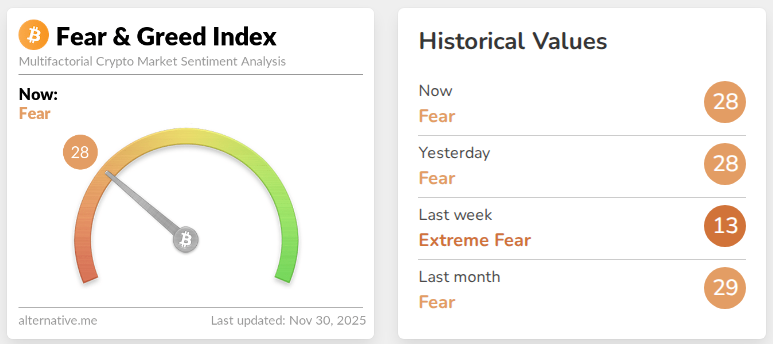
The recent environment in the crypto ecosystem has been defined by the Crypto Fear & Greed Index, a barometer that measures emotional market sentiment. For a grueling eighteen-day stretch, the index remained firmly entrenched in the "Extreme Fear" zone, bottoming out at a harrowing reading of 10 on November 22. While the index has recently nudged upward to 20—a marginal exit from the deepest pit of panic—the underlying mood remains fragile.
Market analysts have characterized this period as unusually severe. Matthew Hyland, a prominent voice in technical analysis, labeled the recent stretch as the "most extreme fear level" of the current market cycle. Such readings are historically rare and usually indicate a total capitulation of sentiment, where retail investors, exhausted by volatility, dump their positions out of desperation rather than fundamental analysis.

The current price action reflects this anxiety. Bitcoin, which once looked invincible as it climbed toward a record-shattering $126,000 in October, has seen its value retract to the $91,000 range. While this remains significantly higher than the $40,000 lows of early 2024, the psychological damage of the recent correction has left market participants skittish. Sentiment tracking tools, such as those used by Santiment, reveal that online discourse is dominated by discussions of macroeconomic instability and institutional hedging rather than the typical retail exuberance that characterizes bull market peaks.
Chronology of the Recent Market Contraction
To understand why CZ’s comments resonated so deeply, one must look at the timeline of the recent downturn:
- October 2025: Bitcoin reaches an all-time high of approximately $126,000, fueled by optimism regarding institutional adoption and favorable regulatory signals.
- Early November 2025: A rapid cooling period begins. Technical resistance levels fail to hold, leading to a series of cascading liquidations.
- November 22, 2025: The Crypto Fear & Greed Index hits a yearly low of 10. The market enters a period of eighteen consecutive days of "Extreme Fear."
- Late November 2025: Bitcoin prices consolidate near the $90,000–$92,000 support zone. The Altcoin Season Index drops to 22/100, indicating a massive rotation into "safe" assets or fiat currency.
- November 29, 2025: CZ issues his reminder on social media, sparking a viral debate on whether the market has finally reached a local bottom.
- November 30, 2025: The Coinbase Premium flips positive for the first time in 29 days, signaling a tentative return of US institutional buying pressure.
Data-Driven Insights: Is the Bottom In?
History offers a compelling, albeit non-guaranteed, argument for the "buy the fear" strategy. Analyst Nicola Duke has observed that over the last five years, Bitcoin has consistently formed a local bottom within weeks of hitting peak "Extreme Fear" readings. This pattern suggests that market sentiment is a lagging indicator of exhaustion; once the last fearful holder sells, the supply-demand imbalance shifts in favor of buyers.
However, historical patterns are colliding with a grim macroeconomic reality. Bitwise researcher André Dragosch has issued a sobering warning: current price action is not happening in a vacuum. It is occurring alongside a global growth outlook that reflects "recession-level" conditions. Dragosch points out that the current bearish environment is the most severe since the pandemic-induced shocks of 2020 and the liquidity crunch of 2022. This introduces a "macro risk" that previous local bottoms did not have to contend with, suggesting that the path to recovery may be slower and more arduous.
Supporting this data is the performance of the Altcoin Season Index, which sits at a depressed 22/100. When this index is low, it indicates that investors are avoiding high-beta assets—smaller coins with higher growth potential—in favor of Bitcoin or, more likely, cash. This lack of risk appetite is a classic sign of a market that has not yet regained its confidence.
The "Coinbase Premium" Signal: A Shift in US Sentiment
One of the most significant pieces of data to emerge in the final days of November is the reversal of the Bitcoin Coinbase Premium. For 29 days, the premium—which tracks the price difference between Bitcoin on Coinbase and the global average—was firmly in the red. A negative premium is typically a bearish signal, suggesting that US-based institutional and retail investors are net sellers, offloading their positions into the global market.
On November 30, the premium flipped into positive territory (0.0255%). While the figure is small, the trend reversal is vital. A positive premium indicates that US buyers are once again paying a slight markup, which is often interpreted as a proxy for institutional interest, recovering dollar liquidity, and a renewed willingness to accumulate. Given that the US market is a primary driver of global crypto price discovery, this pivot may be the first tangible evidence that the "Fear" cycle is beginning to break.
Market Psychology vs. Technical Logic
The reaction to CZ’s post highlighted a profound truth in finance: emotion almost always defeats logic in the short term. One social media user aptly noted, "We all know the rule, but when the chart is bleeding red and the news is toxic, human nature forces us to sell." This "gap" between knowledge and behavior is precisely why the Fear & Greed Index is so effective at identifying bottoms. By the time the average investor feels "safe" enough to buy, the opportunity is often long gone.
However, relying purely on psychology is dangerous. Market veterans argue that while "buying the fear" is a sound principle, it requires a long-term time horizon. In a high-interest-rate environment where institutional capital is sensitive to global recession risks, "buying the fear" could mean enduring months of sideways chop or further downside before any significant reversal occurs.
Implications for the Future
As we look toward the final month of 2025, the crypto market stands at a crossroads. The combination of extreme emotional exhaustion, a shifting Coinbase Premium, and a cautionary macro backdrop creates a complex landscape for investors.
The implications for the industry are clear:
- Institutional Re-entry: The return of a positive Coinbase Premium suggests that the "smart money" may be quietly accumulating while the retail sector remains paralyzed by fear.
- Increased Volatility: As long as the global recessionary outlook persists, Bitcoin is likely to remain tethered to traditional equity market sentiment, leading to sharp, unpredictable swings.
- The Test of Discipline: CZ’s reminder is not just a call to buy; it is a call to decouple personal emotion from market cycles. The investors who succeed in this cycle will likely be those who can distinguish between a market that is fundamentally broken and a market that is simply being driven by temporary panic.
In conclusion, while the "Extreme Fear" that has gripped the market is uncomfortable, it is also a necessary component of the cycle. Whether or not the bottom has been reached, the current data suggests that the aggressive selling pressure of the last month is beginning to wane. For those who subscribe to the contrarian school of thought, the present environment represents exactly the kind of "maximum fear" that historically precedes a reversal—provided they have the conviction to weather the potential storm ahead.