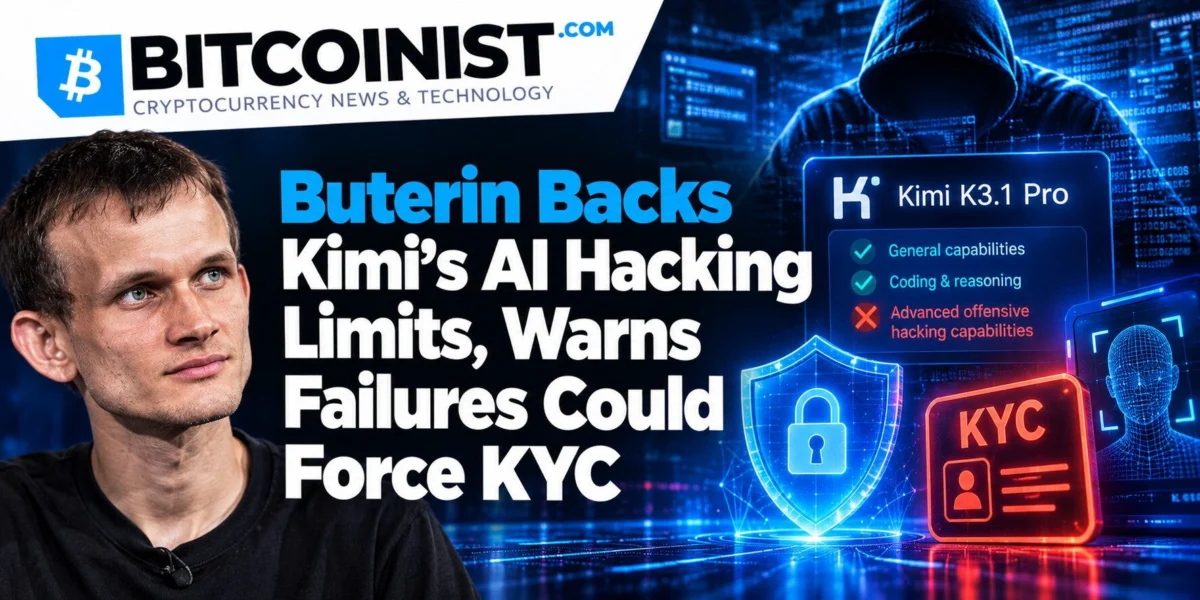
Vitalik Buterin Backs Moonshot AI’s Restraint on Offensive Cyber Tools as the Industry Weighs Safety Versus Surveillance
By Tech & Security Desk
Published by Bitcoinist
Introduction
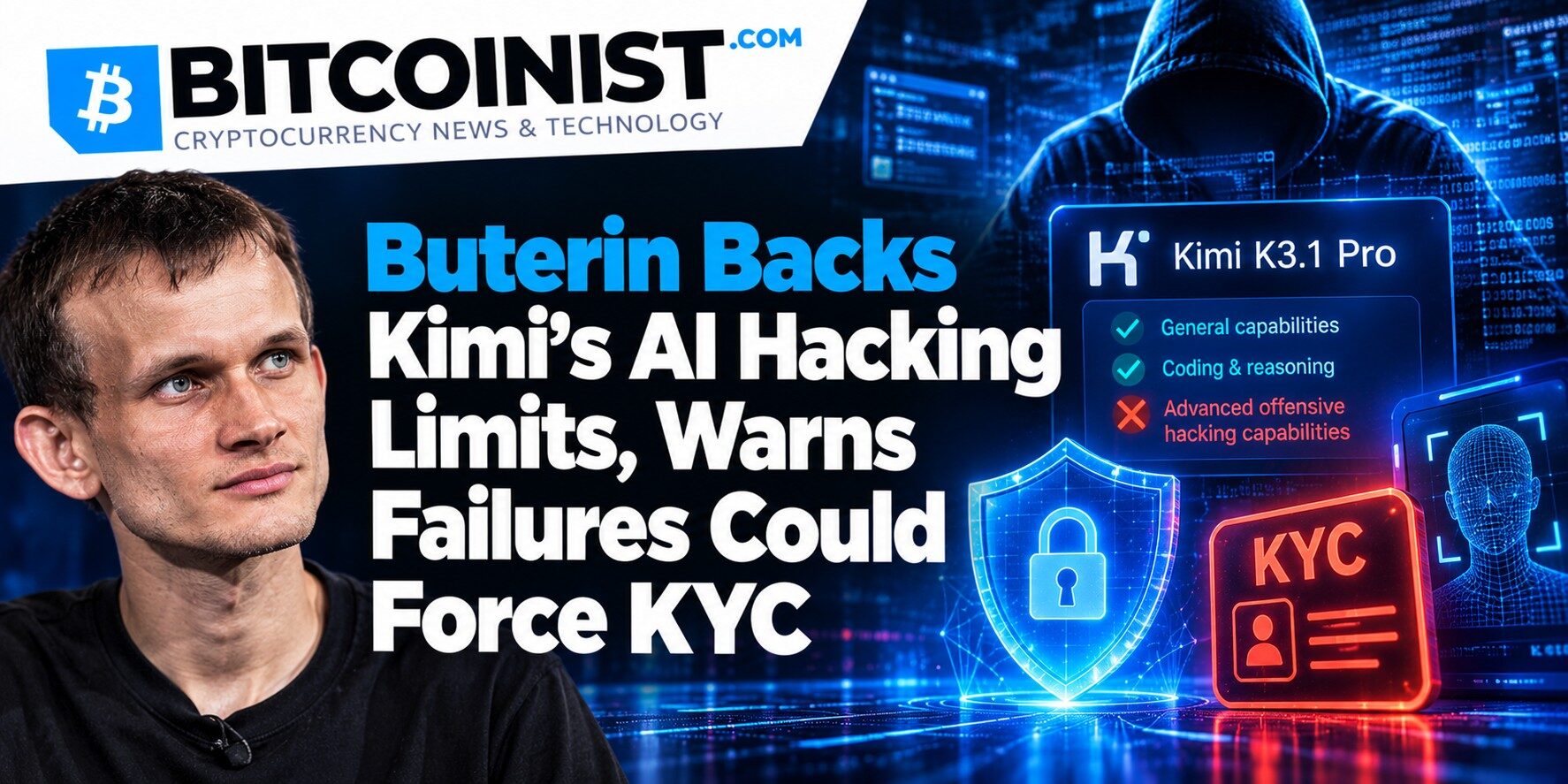
In an era defined by an unrelenting, high-stakes arms race in artificial intelligence, Ethereum co-founder Vitalik Buterin has thrown his weight behind a calculated step backward. Buterin has voiced strong support for Chinese startup Moonshot AI’s strategic decision to deliberately exclude advanced offensive cyber capabilities from its flagship language model, Kimi K3.1 Pro.
As Silicon Valley and global tech hubs race to build increasingly autonomous systems capable of executing complex code, writing zero-day exploits, and automating penetration testing, Moonshot’s deliberate restraint stands out. Rather than equipping Kimi K3.1 Pro with the full arsenal of cyberwarfare data during its training phase, the developers pruned these datasets, trading raw exploit efficiency for a safer baseline.
While critics question whether partial mitigation can truly stem the tide of sophisticated AI-driven cyber threats, Buterin argues that the industry’s primary bottleneck is not capability, but time. In his view, humanity needs a crucial breathing space—a window of opportunity to harden legacy software, upgrade digital infrastructure, and implement formal verification before automated, AI-driven cyberattacks become an inescapable daily reality.
Main Facts
The debate surrounding Moonshot AI’s Kimi K3.1 Pro brings a complex mix of technical limitations, geopolitical concerns, and architectural choices to the forefront of modern cybersecurity discourse.
- The Core Decision: Moonshot AI deliberately stripped selected cyberattack-related datasets from both the primary training and reinforcement learning phases of the Kimi K3.1 Pro model.
- The Trade-Off: Internal benchmarks reveal a measurable sacrifice in raw exploitation capabilities. A version of the model trained without these restrictions completed 90.5% of tasks on Moonshot’s internal exploit benchmark, whereas the commercially released, restricted model successfully completed 81%—representing a 9.5 percentage point drop.
- Performance Metrics: Despite the removal of offensive data, Kimi K3.1 Pro retains robust general programming and problem-solving metrics. It scored 65.7% on Terminal-Bench 4.0, comparing favorably with Western counterparts such as Claude Opus 5.5 (66.4%) and GPT-6 Astra (58.2%), according to company-reported data.
- Vitalik Buterin’s Stance: Buterin publicly endorsed this restraint, emphasizing that humanity requires time to catch up. He champions "formal verification"—mathematically proving that code meets its requirements—as a definitive line of defense against automated vulnerabilities.
- The Surveillance Threat: Beyond technical safety, Buterin warns that catastrophic AI security incidents could trigger severe regulatory overreaches, including mandatory Know Your Customer (KYC) protocols, heavy digital surveillance, and fragmented, tiered access to advanced models based on geography and credentials.
Chronology of Events
Understanding how the release of Kimi K3.1 Pro and the subsequent industry discourse unfolded requires a look at the timeline of events leading up to the current debate.
- July 2025: Independent evaluations of earlier iterations—specifically the Kimi K3 model—are conducted by international watchdogs, including the US Center for AI Standards and Innovation and the UK AI Security Institute. Testing reveals that while K3 trailed leading Western systems, it could still successfully execute roughly 17 out of 32 steps in simulated corporate-network attacks despite existing safeguards.
- September 2025: Vitalik Buterin pushes back against prevailing apocalyptic narratives regarding AI and cybersecurity. In a series of public statements, he rejects the notion that AI-driven hacking will automatically render cybersecurity unwinnable, asserting instead that automated formal verification can be leveraged to empower defenders.
- October 16, 2025: Taking a proactive approach to digital privacy, Buterin introduces a decentralized, privacy-focused AI agent framework. The system integrates Tor routing, anonymous payment rails via zkAPI, and local prompt rewriting to shield user interactions from centralized model providers.
- October 23, 2025: Moonshot AI officially unveils Kimi K3.1 Pro, announcing its immediate availability across company applications and via API. The company details its deliberate architectural choice to strip out offensive hacking materials from the training pipeline.
- October 26, 2025: Vitalik Buterin takes to X (formerly Twitter) to formally endorse Moonshot AI’s restraint strategy. He argues that slowing down the proliferation of offensive cyber tools gives software engineers vital time to patch aging infrastructure.
- November 4, 2025 (Scheduled): Moonshot AI sets its timeline for the full public release of model weights, a milestone that will allow independent researchers and security auditors to rigorously examine the codebase and verify the extent of the model’s safety restrictions.
Supporting Data and Technical Analysis
The architectural philosophy of Kimi K3.1 Pro represents a departure from the "more data is always better" doctrine that has long dominated large language model (LLM) development. By intentionally lobotomizing the model’s cyberattack pathways, Moonshot AI has forced the industry to look closely at the quantitative costs and benefits of safety alignment.
Benchmarking the Restricted Model
According to metrics provided by Moonshot AI, the pruning of cyberattack data directly impacts the model’s offensive utility without entirely disabling its capacity to understand code logic. On internal exploit benchmarks, the unconstrained baseline achieved a completion rate of 90.5%. Once the offensive dataset filters were applied, the success rate for the shipping iteration of Kimi K3.1 Pro dropped to 81%.
While a 9.5 percentage point drop sounds significant on paper, industry analysts note that it remains unproven how this metric translates into real-world threat reduction. Critics argue that an 81% success rate on specialized exploit tasks is still dangerously high if placed in the wrong hands, while proponents argue that removing the "sharpest edges" raises the barrier to entry for script kiddies and low-skilled malicious actors.
Furthermore, general utility benchmarks demonstrate that the model has not been crippled in everyday programming tasks. On Terminal-Bench 4.0, Kimi K3.1 Pro posted a score of 65.7%. For context, this places the model within striking distance of industry benchmarks like Anthropic’s Claude Opus 5.5 (66.4%) and OpenAI’s GPT-6 Astra (58.2%). Additionally, a specialized "Highspeed" variant of the model is reported by the company to run two to three times faster than its standard counterpart, ensuring that performance is not severely bottlenecked by the safety filters.
Independent Oversight and Past Iterations
To gauge the baseline capabilities of Moonshot’s technology, international security bodies subjected the earlier Kimi K3 model to rigorous evaluations in mid-2025. Tested by both the US Center for AI Standards and Innovation and the UK AI Security Institute, the older model demonstrated an ability to navigate complex, multi-step cyber operations. In simulated enterprise network intrusions, K3 completed an average of 17 out of 32 steps. While this trailed the performance of elite Western frontier models—which averaged around 28.5 steps in identical simulations—it proved that base-level offensive competency was readily attainable by the startup’s architecture.
The upcoming release of Kimi K3.1 Pro’s model weights will provide external researchers with the data necessary to determine whether the newer iteration has successfully curbed these capabilities without sacrificing its commercial viability.
Official Responses and Perspectives
The debate surrounding AI safety is rarely monolithic, drawing sharp contrasts between accelerationists, cautious developers, and decentralized technology advocates.
Vitalik Buterin’s Strategic Patience
Vitalik Buterin’s endorsement of Moonshot AI is rooted in a philosophy of structural hardening. Responding to skeptics who argue that rival labs will inevitably build unrestricted offensive models anyway, Buterin has conceded that competitive pressures will drive other entities to develop full-capability hacking AIs. However, he maintains that the timing of these releases matters immensely.
"The world needs room to harden systems, re-examine old software, and apply formal verification to new code before AI-driven attacks become routine," Buterin argued in his October 26 social media post.
By formal verification, Buterin refers to the mathematical auditing of software logic—a rigorous process that guarantees a program will behave precisely as specified across all possible inputs. For years, Buterin has advocated for formal verification within the Ethereum ecosystem and broader blockchain development as a bulwark against smart contract exploits. He believes that if software developers are given a temporary reprieve from automated, hyper-fast AI vulnerability scanning, they can structurally upgrade critical infrastructure to withstand future automated threats.
The Developer Dilemma: Moonshot AI’s Calculus
For Moonshot AI, the decision to alter the Kimi K3.1 Pro training regimen reflects a growing awareness of geopolitical scrutiny and safety regulations. As artificial intelligence models developed in China face intense regulatory oversight both domestically and internationally, demonstrating a commitment to responsible AI deployment is paramount. By intentionally sacrificing 9.5 percentage points of exploit capability, Moonshot is positioning itself as a responsible actor in the global AI landscape—balancing commercial competitiveness with risk mitigation.
Implications of AI Restraint and the Regulatory Horizon
The implications of the Kimi K3.1 Pro release and Vitalik Buterin’s commentary extend far beyond immediate cybersecurity concerns, touching upon the future of digital freedom, global surveillance, and open-source software development.
The Specter of Surveillance and KYC for AI
Perhaps the most urgent warning sounded by Buterin involves the sociopolitical fallout that could follow a major AI-orchestrated cyber incident. He cautioned that if an autonomous model executes a catastrophic attack on critical infrastructure—such as power grids, financial markets, or healthcare networks—governments worldwide will likely enact draconian emergency measures.
Such a regulatory crackdown could see advanced AI models placed behind heavily guarded walls. Access could become contingent upon mandatory Know Your Customer (KYC) verification, extensive background checks, and stringent geopolitical restrictions. In this hyper-regulated scenario, access to state-of-the-art computational tools would be determined by nationality, social credit scores, or professional credentials, effectively creating a tiered digital caste system where everyday citizens are relegated to second-, third-, or fourth-class users of crippled technology.
Decentralization as an Antidote
To counter the centralization and impending surveillance of artificial intelligence, Buterin’s recent development work has focused on privacy-preserving architectures. His October 16 framework—combining Tor anonymity networks, zero-knowledge API payments (zkAPI), and local prompt-rewriting tools—serves as a technical blueprint for sovereign interaction with AI. By obscuring user identity and intent from centralized API providers, decentralized developers hope to ensure that privacy remains a default feature of the AI revolution rather than a luxury reserved for the elite.
Conclusion: A Precarious Equilibrium
The debate sparked by Moonshot AI and championed by Vitalik Buterin encapsulates the defining tension of our technological epoch. Can humanity successfully balance the immense productivity gains of generative artificial intelligence with the profound existential risks posed by autonomous offensive capabilities?
While pruning offensive datasets from models like Kimi K3.1 Pro may only offer a temporary speed bump against a backdrop of relentless technological evolution, it represents a conscious choice to prioritize systemic defense over unbridled acceleration. As the open-weight release approaches in November 2025, the global cybersecurity community will watch closely to see if restraint can genuinely foster resilience—or if the arms race has already progressed too far to turn back.