Crypto Markets Under Pressure: ETF Outflows, Regulatory Shifts, and TradFi Integration
By Financial Markets Desk
Published by Special Arrangement with Leading Industry Editorial Boards
Main Facts
The global digital asset ecosystem is experiencing a high-stakes period of transition, defined by a sharp cooling of institutional capital, aggressive regulatory consolidation in Europe, and shifting battle lines within traditional finance (TradFi).
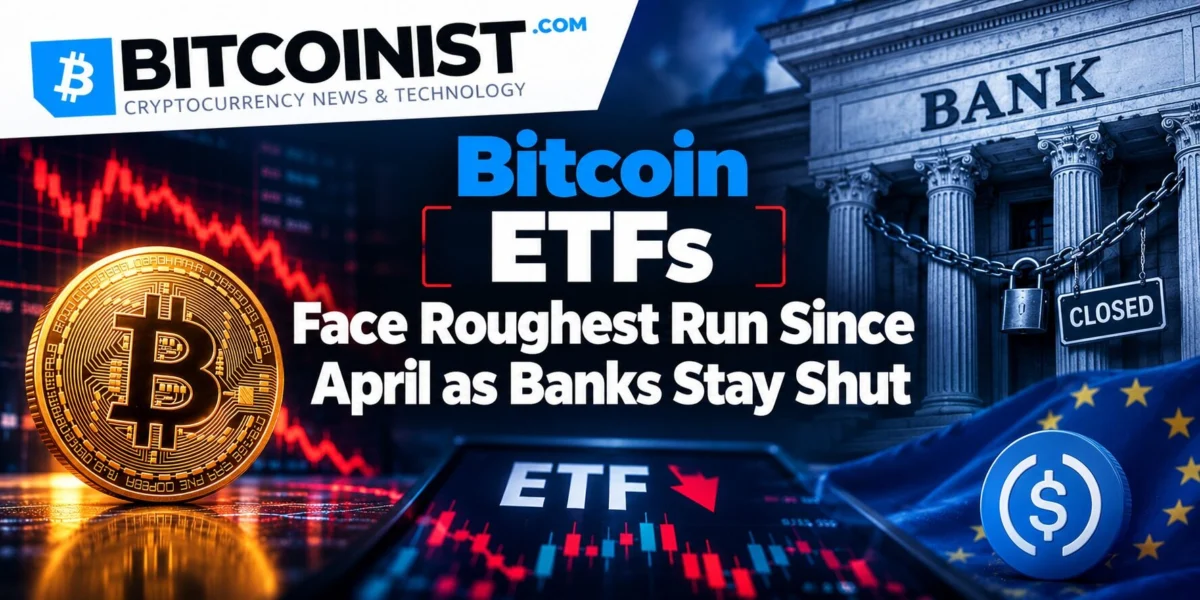
Over a consecutive two-week window in October, United States spot Bitcoin exchange-traded funds (ETFs) hemorrhaged approximately $909 million in net withdrawals. This massive institutional capital flight—comprising $228 million between October 12 and 16, following $681 million the preceding week—marks the steepest pullback recorded by the asset class since April.
The cascading liquidity drain directly impacted price action. Bitcoin (BTC) tumbled below the critical $82,000 threshold, triggering widespread liquidations. Approximately $771 million in derivative positions were wiped out in a single trading session early in the week, followed by nearly $1 billion in liquidations on October 15 as Bitcoin, Ether (ETH), and XRP suffered synchronized declines. BTC ultimately finished the turbulent week hovering near $81,400.
Concurrently, the regulatory landscape is fracturing along geographic and institutional lines. In Europe, the European Banking Authority (EBA) formally designated Circle’s USDC as the region’s first "significant" e-money token under the Markets in Crypto-Assets (MiCA) framework. This move isolates competitors like Tether’s USDT, which has opted out of the compliance pathway, forcing European exchanges into a rapid restructuring of their stablecoin offerings ahead of strict enforcement deadlines.
In the United States, traditional finance continues to advance its integration of digital assets while simultaneously reinforcing systemic barriers. Charles Schwab officially launched spot crypto trading for its vast retail base, while a simultaneous Office of the Comptroller of the Currency (OCC) review revealed that the nation’s nine largest traditional banks maintain internal policies capable of cutting off banking services to digital-asset firms.
Adding to the macroeconomic and structural friction, index provider MSCI advanced criteria that could purge corporate balance-sheet heavyweights like MicroStrategy and Metaplanet from its benchmark equity indices, threatening forced liquidations by passive institutional funds.
Chronology of Events
To understand the velocity of these developments, the events can be mapped across a condensed timeline of institutional and regulatory milestones:
- Early October: Mounting macroeconomic headwinds spark initial profit-taking across digital assets, slowing the historic inflows that characterized US spot Bitcoin ETFs throughout the year.
- Week Ending October 10: Institutional appetite fades rapidly, resulting in $681 million in net outflows from US spot Bitcoin ETFs.
- October 12 – 16: Outflows accelerate further, with an additional $228 million leaving the funds, bringing the two-week total deficit to $909 million.
- Mid-Week Trading Session: Bitcoin slides below $82,000. Leveraged long positions unravel rapidly, resulting in $771 million in liquidations in a single day.
- October 15: A broader market sweep hits Bitcoin, Ether, and XRP simultaneously, liquidating nearly $1 billion more in derivatives and pushing BTC down to close the week near $81,400.
- Upcoming Regulatory Deadlines (November 11 – 30): MSCI’s final roster for its equity index review is scheduled for November 11, with potential removals taking effect after the market close on November 30. Simultaneously, European crypto platforms face a strict three-month window mandated by the European Securities and Markets Authority (ESMA) to unwind non-compliant stablecoin exposure.
Supporting Data and Market Metrics
The scale of the recent market correction is captured in verifiable liquidity shifts, derivative liquidations, and banking exposure metrics:
- $909 Million: The cumulative two-week net withdrawal figure from US spot Bitcoin ETFs between early and mid-October.
- $771 Million to $1 Billion: The magnitude of single-day derivative liquidations recorded during the mid-October market crash, underscoring systemic leverage vulnerabilities.
- $81,400: Bitcoin’s closing price level at the end of the volatile October trading week, down significantly from local highs.
- 0.75%: The per-trade fee structured by Charles Schwab for its newly expanded retail crypto trading platform (Schwab Crypto).
- 35 Million: The approximate number of active brokerage accounts now granted direct, app-based access to Bitcoin and Ether trading through Charles Schwab.
- 9 out of 9: The total number of the largest US national banks identified by the OCC as maintaining internal guidelines capable of restricting or outright denying financial services to crypto-asset businesses.
Official Responses and Regulatory Posture
Regulatory bodies on both sides of the Atlantic are actively reshaping the operational parameters for digital assets, often sending mixed signals to the market.
The European Regulatory Pivot
The European Banking Authority’s decision to label Circle’s USDC as a "significant" e-money token marks a turning point for European digital finance. Effective November 12, oversight of USDC shifts directly from fragmented national supervisors to the centralized EBA. This elevation imposes rigorous capital reserves, strict liquidity requirements, and explicit redemption duties on Circle.
Conversely, Tether’s USDT has deliberately avoided this compliance track, leaving its future utilization within regulated European frameworks in grave doubt. To compound the pressure, ESMA has granted European trading venues a strict three-month window to phase out non-compliant stablecoin products. Consequently, European exchanges face an uncompromising binary choice: delist USDT or risk severe regulatory penalties under MiCA.
The US Policy Vacuum and TradFi Gatekeeping
In the United States, regulatory clarity remains hampered by administrative transitions. Patrick Witt, the final adviser steering the White House digital assets office, has departed without a named successor. This leadership void coincides with active, highly complex rulemakings across the Securities and Exchange Commission (SEC), the Commodity Futures Trading Commission (CFTC), and the OCC.
Amid this federal policy vacuum, traditional financial institutions are pursuing contradictory strategies. On one hand, retail brokerages are lowering barriers to entry. Charles Schwab has rolled out Schwab Crypto to all eligible US clients, integrating Bitcoin and Ether trading directly alongside equities and retirement accounts in an ecosystem serving tens of millions of retail investors.
On the other hand, a revealing OCC review uncovered that all nine of the nation’s largest national banks maintain internal risk frameworks allowing them to restrict or deny services to digital-asset issuers, exchanges, and custodians. While the OCC’s review is informational rather than mandatory, it establishes an official record of systemic "de-banking." This documentation provides digital asset advocates and sympathetic lawmakers with formal grounds to challenge institutional gatekeeping if discriminatory financial practices persist.
Furthermore, structural friction extends to index governance. MSCI has moved forward with criteria evaluations that could result in the ejection of balance-sheet-driven crypto proxies such as MicroStrategy and Metaplanet from its equity benchmarks. Because these firms tie their corporate valuations directly to massive holdings of physical Bitcoin, their operational profiles sit uncomfortably within traditional MSCI evaluation metrics designed for conventional operating companies.
Innovations in Derivatives
Despite regulatory hurdles, product innovation continues within regulated market structures. SEC Trading and Markets Director Jamie Selway revealed that five CFTC-registered exchanges have formally applied to transition into security futures exchanges. Industry projections suggest that at least four of these platforms could successfully list regulated securities perpetual futures before the end of the year. While perpetual contracts—which feature no expiry date and track underlying assets via funding rates—are immensely popular on offshore exchanges, a compliant, onshore US product has historically been unavailable to institutional participants.
Implications
The convergence of institutional capital flight, regulatory bifurcation, and TradFi gatekeeping carries profound implications for the future trajectory of the digital asset class.
- Maturation of the Stablecoin Market: The EBA’s enforcement of MiCA creates a clear regulatory moat in Europe. By elevating USDC while marginalizing non-compliant alternatives like USDT, Europe is effectively fast-tracking a two-tiered stablecoin economy. Compliant tokens will likely gain deeper entrenchment within traditional European banking and corporate treasury management, while non-compliant tokens may be relegated to decentralized or offshore channels.
- The ETF Liquidity Reality Check: The $909 million outflow from US spot Bitcoin ETFs demonstrates that institutional capital allocated via investment funds is just as volatile as retail capital. Macroeconomic pressures, interest rate expectations, and risk-off sentiment can trigger rapid de-risking by institutional allocators, challenging the narrative that ETFs would permanently insulate Bitcoin from severe downside volatility.
- The TradFi Paradox: The dual reality of Charles Schwab welcoming millions of retail investors into crypto while the top nine US national banks maintain policies capable of choking off industry banking access highlights the bifurcated nature of traditional finance. While distribution channels are opening up at the consumer level, infrastructural plumbing remains heavily guarded. The systemic risk of de-banking remains a persistent bottleneck for Web3 startups and digital asset service providers.
- Index Exclusion Risks: If MSCI proceeds with removing corporate crypto proxies like MicroStrategy from its benchmarks, passive index funds will be forced to dump billions of dollars worth of shares. This event could create short-term artificial selling pressure on companies that act as critical corporate bridges between public equity markets and Bitcoin accumulation.
- Onshore Derivatives Expansion: The impending introduction of regulated US securities perpetual futures represents a major structural leap. By bringing perpetual contracts—historically an offshore phenomenon—into fully compliant, CFTC- and SEC-monitored environments, US regulators are opening the door for sophisticated institutional capital to trade leveraged, no-expiry instruments without regulatory counterparty risk.
As the industry navigates the final quarter of the year, market participants must balance the promise of expanding retail access and regulated derivatives against the immediate headwinds of institutional capital withdrawal and stringent compliance mandates.