
Macro Veteran Raoul Pal Predicts Crypto Market Cap Will Explode to $300 Trillion Within a Decade
By Financial Markets Desk
Published: October 2023 (Updated)
Executive Summary: The Dawn of a $300 Trillion Asset Class
In a sweeping assessment of the global financial landscape, macroeconomist, investor, and former Goldman Sachs executive Raoul Pal has issued a remarkably bullish forecast for the cryptocurrency and Web3 sectors. According to Pal, the digital asset market is poised to undergo a historic expansion, growing from its current valuation of roughly $1$ trillion to an astonishing $300 trillion over the next decade.
Speaking during a comprehensive interview for Google Tech Talks, the Real Vision CEO and macro visionary argued that the convergence of institutional capital, venture capital inflows, and the unique structural mechanics of decentralized protocols will fuel the fastest and most expansive wealth creation event in human history. While near-term macroeconomic headwinds and regulatory uncertainties continue to exert pressure on global risk assets, Pal believes that the underlying foundation of Web3 is already solidified. Once broader economic conditions stabilize, the floodgates will open, driving an unprecedented wave of adoption that will dwarf traditional asset classes, including oil and the early-stage internet.
Main Facts: Breaking Down Pal’s Monumental Thesis
At the core of Raoul Pal’s thesis is a fundamental comparison between the current size of the digital asset economy and the scale of traditional global financial markets.
- The Trillion-Dollar Baseline: The cryptocurrency market currently fluctuates around a total market capitalization of $1 trillion—a massive drop from its 2021 all-time high of nearly $3 trillion, yet an astronomical leap from its modest origins a decade prior.
- The $300 Trillion Horizon: Pal projects that over the next 10 to 15 years, the crypto and Web3 ecosystem will scale up to match or exceed traditional asset markets, which individually sit in the $200 trillion to $300 trillion range.
- Institutional and Web2 Undercurrents: Despite a cautious public posture driven by regulatory ambiguity, legacy financial institutions and major Web2 technology conglomerates are actively integrating blockchain infrastructure behind the scenes.
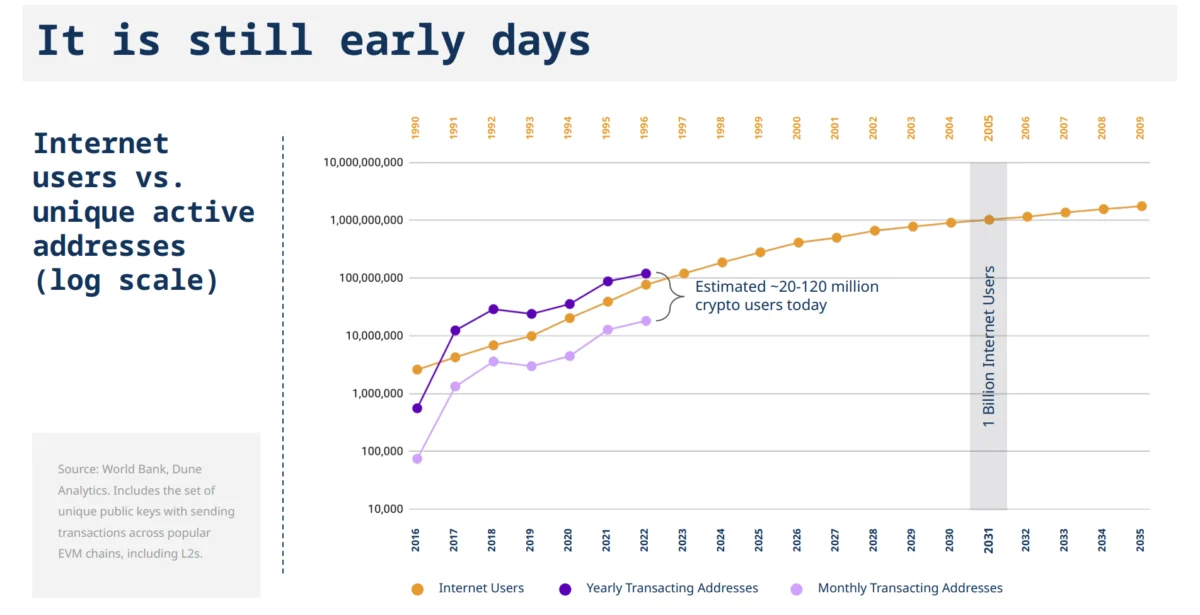
- Unprecedented Speed and Scale: Pal asserts that Web3 is expanding faster than the dot-com boom of the late 1990s while possessing a vastly larger total addressable market due to its unique value-accrual protocol layers.
Chronology: The Evolution of Web3 and Institutional Inflows
To understand how Pal arrives at such an ambitious valuation, it is necessary to examine the evolutionary timeline of digital assets, venture capital deployment, and institutional maturation.
Phase 1: The Retail-Driven Era (2009–2017)
In its infancy, the cryptocurrency market was largely driven by retail investors, cryptography enthusiasts, and early adopters. Bitcoin (BTC) established a decentralized monetary network, followed by the launch of Ethereum (ETH) in 2015, which introduced smart contracts and programmable money. During this period, market caps were measured in billions rather than trillions, and institutional participation was virtually nonexistent.
Phase 2: The Institutional Awakening and DeFi Summer (2018–2021)
Following the 2017 bull run, institutional interest began to materialize. Family offices, hedge funds, and corporate treasuries (such as MicroStrategy and Tesla) began allocating capital to Bitcoin as a hedge against inflation. Simultaneously, the Decentralized Finance (DeFi) movement and the explosion of Non-Fungible Tokens (NFTs) demonstrated that blockchain technology could support complex financial applications and digital property rights.
Phase 3: The Venture Capital Surge (2021–2023)
Even as macroeconomic tightening and rising interest rates sparked a prolonged crypto winter, private investment continued to pour into the sector. According to Pal, approximately $60 billion in venture capital (VC) flooded into Web3 startups and infrastructure projects over an 18-month span. This capital accumulation laid the groundwork for the next generation of scalable layer-1 and layer-2 networks, cross-chain bridges, and consumer-facing decentralized applications.
Phase 4: The Anticipated Institutional Tsunami (2024–2035+)
Looking forward, Pal outlines the next phase of the timeline: the clearing of macroeconomic uncertainty followed by the mass deployment of institutional products. As regulatory frameworks crystallize—exemplified by the global race for spot Bitcoin and Ethereum exchange-traded funds (ETFs)—trillions of dollars in institutional wealth are expected to transition from legacy systems into digital assets.
Supporting Data: Why Web3 Outpaces Traditional Tech
Pal’s projection is not merely speculative optimism; it is rooted in structural observations regarding how value is captured within digital networks versus traditional corporate structures.
1. Protocol-Level Value Accrual
In the traditional Web2 economy (dominated by companies like Meta, Google, and Amazon), corporate equity captures the vast majority of economic value, while foundational internet protocols (such as HTTP, SMTP, and TCP/IP) remain open-source and free, capturing no direct financial value.
In contrast, Web3 protocols embed value directly into their native tokens and decentralized networks. As Pal explains:
"It’s kind of a little bit like the internet, but it’s just faster-paced and actually larger in scope, which sounds crazy, but it is because it accrues value itself to these protocol layers. So there’s this massive value accretion that comes."
2. The $60 Billion VC Catalyst
The massive influx of venture capital during the recent bear market has created a massive backlog of innovation. Because the crypto industry operates on accelerated development cycles, Pal notes that the fruits of that $60 billion investment will manifest rapidly:
"Because of the speed of the cycle in crypto, we’re gonna see a whole lot of products and new changes and new innovations coming in the next six to 12 months and we’ll move the whole narrative forward exponentially yet again."
3. Comparing Asset Classes
To contextualize a $300 trillion valuation, market analysts often look at the global supply of fiat currency, global real estate, global bond markets, and equity markets. Each of these macro sectors represents hundreds of trillions of dollars. Because cryptocurrencies function simultaneously as money, technology equity, commodity assets, and decentralized governance systems, Pal argues that digital assets will eventually subsume portions of all these traditional asset classes.
Official Responses and Industry Reactions
Raoul Pal’s commentary has ignited fierce debate across both traditional finance and the digital asset community.
- The Institutional Perspective: While traditional banking executives publicly maintain caution—often citing compliance burdens, anti-money laundering (AML) requirements, and unclear regulatory guidelines from bodies like the U.S. Securities and Exchange Commission (SEC)—insiders quietly echo Pal’s sentiments. Major asset managers, including BlackRock, Fidelity, and Franklin Templeton, have signaled through their actions—such as filing for crypto spot ETFs and tokenizing real-world assets (RWAs)—that blockchain technology represents the future of financial market settlement.
- The Crypto Native Community: Decentralized finance developers and Web3 founders have widely embraced Pal’s long-term outlook. Many point to the exponential growth of layer-2 scaling solutions (such as Arbitrum, Optimism, and Polygon) and zero-knowledge (ZK) rollups as proof that infrastructure is finally scaling to meet the demands of global mass adoption.
- Skeptics and Traditional Economists: Critics of Pal’s thesis, however, remain skeptical. Traditional economists often argue that a $300 trillion crypto market cap would require an unsustainable expansion of global liquidity and could pose systemic risks to the broader economy if left unregulated. Furthermore, skeptics point to ongoing vulnerabilities in smart contract security, regulatory crackdowns, and the potential for technological obsolescence as hurdles that could impede such meteoric growth.
Macroeconomic Implications and Future Outlook
What does a potential $300 trillion cryptocurrency market mean for the global economy, everyday investors, and the future of finance?
1. The Redefinition of Global Liquidity
If digital assets absorb hundreds of trillions of dollars from traditional markets, the architecture of global finance will fundamentally shift. Central banks will no longer hold a complete monopoly over monetary policy transmission. Instead, decentralized, algorithmic, and programmatic monetary systems will operate in parallel with—or increasingly replace—legacy fiat currency regimes.
2. The Maturation of Financial Products
The transition from a $1 trillion market to a multi-trillion-dollar colossus will necessitate institutional-grade custody solutions, robust insurance markets for digital property, and sophisticated risk management tools. This maturation will likely attract pension funds, sovereign wealth funds, and insurance companies that currently view cryptocurrency as too volatile for fiduciary mandates.
3. Regulatory Clarity as the Ultimate Catalyst
Pal’s timeline hinges heavily on the resolution of macroeconomic turbulence and regulatory gridlock. As governments worldwide move toward clearer regulatory frameworks—such as the European Union’s Markets in Crypto-Assets (MiCA) regulation—institutional hesitation is expected to give way to aggressive capital deployment.
Conclusion
Raoul Pal’s prediction of a $300 trillion crypto market cap within a decade may sound utopian to casual observers, but within the context of exponential technological adoption curves, it represents a continuation of historical trends. Just as the internet revolutionized global communication and commerce far faster than 20th-century analysts anticipated, Web3 is poised to redefine global finance. As venture-backed innovations hit the market and institutional barriers dissolve, the digital asset ecosystem stands on the precipice of a transformation unlike anything the world has ever witnessed.