The Next Big Wave: Why Andreessen Horowitz Believes Web3 Gaming Will Drive Mass Crypto Adoption
SAN FRANCISCO — In the ever-evolving landscape of digital assets, the quest for mainstream adoption remains the holy grail. While decentralized finance (DeFi) captured the imagination of financial technologists and institutional investors during previous market cycles, and non-fungible tokens (NFTs) briefly captivated mainstream culture through digital art and collectibles, venture capital giant Andreessen Horowitz (a16z) points to an entirely different arena as the catalyst for the next massive influx of users.
According to the firm’s comprehensive "State of Crypto" report released by its dedicated crypto arm, a16z crypto, the intersection of blockchain technology and interactive entertainment—commonly known as Web3 gaming—is primed to serve as the definitive gateway for onboarding millions of everyday consumers into the digital asset ecosystem.
Rather than relying on complex financial instruments or speculative trading to attract participants, the venture capital titan argues that the trillion-dollar global gaming industry possesses the natural engagement loops, community structures, and digital-asset familiarity necessary to normalize blockchain integration on a global scale.
Main Facts: The Intersection of Gaming and Blockchain
The central thesis of a16z crypto’s latest publication is straightforward: Web3 games represent the most viable, scalable mechanism to introduce non-crypto natives to blockchain infrastructure.
For decades, traditional gaming has operated on closed ecosystems. Players spend billions of dollars annually acquiring digital items, skins, in-game currency, and virtual real estate. However, under traditional "Web2" models, these purchases remain strictly siloed within the specific game or platform where they were bought. Players do not truly own their digital assets; if a game shuts down, changes its terms of service, or bans an account, the user’s investment vanishes instantly.
Web3 gaming fundamentally disrupts this paradigm by introducing verifiable digital ownership through blockchain technology. By leveraging non-fungible tokens and decentralized ledgers, players can truly own, trade, and transfer their in-game assets across different platforms or secondary marketplaces.
- The Core Proposition: Web3 games are not merely about speculation or "play-to-earn" tokenomics; they are about transforming virtual economies into genuine, player-owned marketplaces.
- The Adoption Engine: By embedding blockchain technology into entertainment—an industry with billions of global participants—users interact with smart contracts, digital wallets, and Layer-1 or Layer-2 scaling solutions organically, often without needing to understand the underlying technical mechanics.
Chronology: The Evolution of Crypto Adoption Parallels
To contextualize the current state of the blockchain ecosystem, a16z crypto’s report draws a striking chronological parallel between the developmental trajectory of Web3 and the dawn of the commercial internet during the 1990s.
The 1990s Internet Boom vs. Modern Crypto
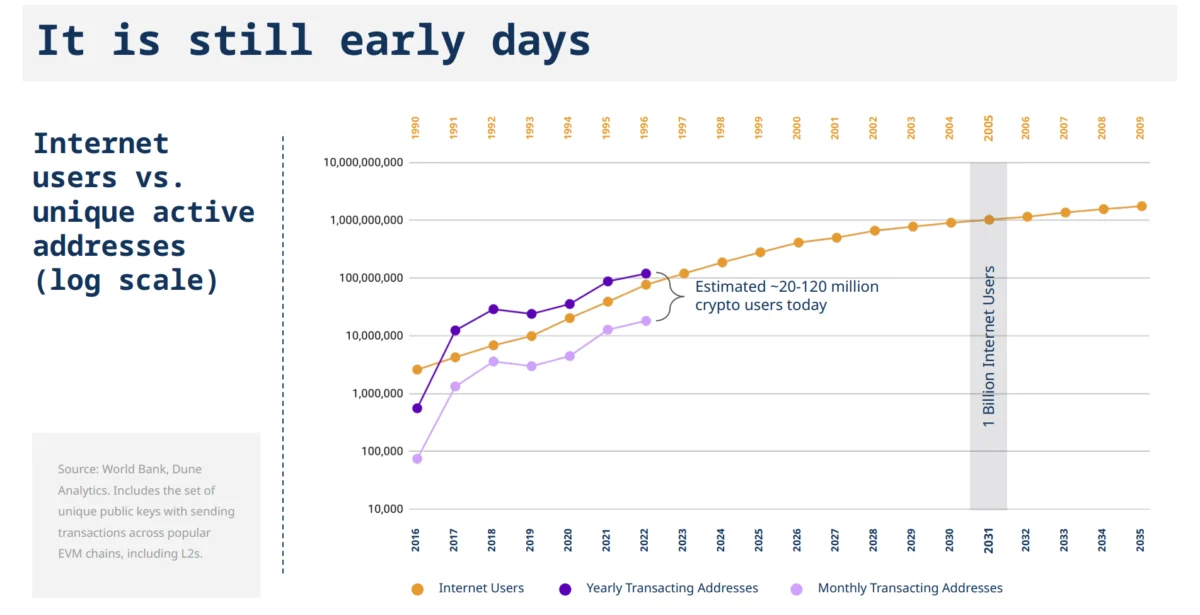
In its foundational analysis, a16z maps out the user growth of the internet starting in 1990 alongside the user growth of cryptocurrency starting in 2016. The comparison reveals that crypto is currently tracking a remarkably similar adoption curve to the early World Wide Web—a period characterized by clunky dial-up connections, skepticism from traditional institutions, and rapid infrastructural innovation.

- 1990–1996 (The Internet): During the first half of the 1990s, the internet evolved from an esoteric tool used primarily by academics and government researchers into a commercial medium. By 1996, global internet penetration had reached approximately 100 million users.
- 2016–2022 (Cryptocurrency): Following the maturation of Bitcoin and the launch of Ethereum’s smart contract platform, the crypto ecosystem began building out foundational protocols. By the close of 2022, data showed that the ecosystem had registered an estimated 20 million monthly active transacting addresses and approximately 120 million yearly transacting addresses.
This chronological mapping indicates that despite years of mainstream media coverage, market booms, and regulatory scrutiny, the digital asset industry is still firmly in its "early days," mirroring the technological maturity of the mid-1990s internet before the dot-com explosion and the advent of Web2 social media platforms.
Supporting Data: By the Numbers
The a16z crypto report backs up its bullish stance on Web3 gaming with staggering macroeconomic and transactional metrics that highlight the sheer scale of the gaming sector compared to traditional crypto verticals.
1. Massive Consumer Spend on Digital Goods
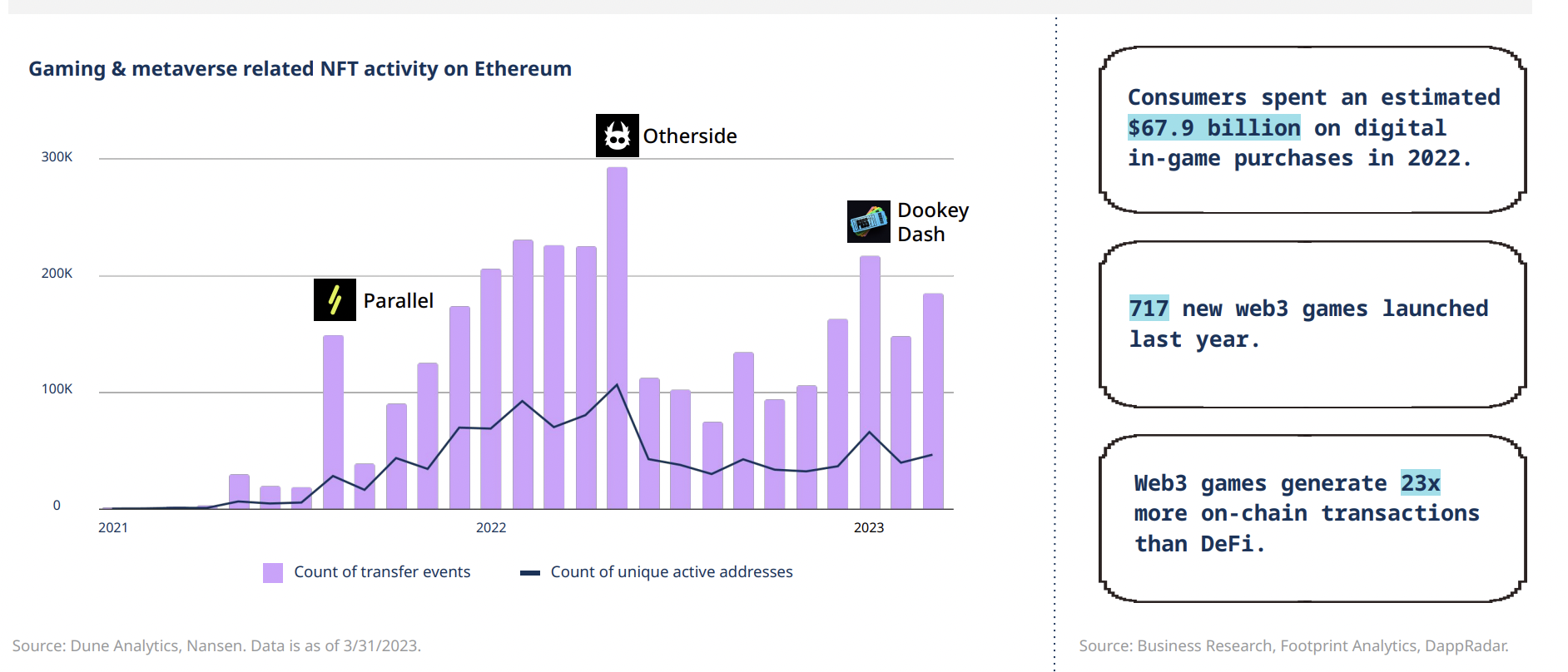
According to industry data cited in the report, consumers spent an estimated $67.9 billion on digital in-game purchases in 2022 alone. This figure underscores the fact that global audiences are already comfortable spending real fiat currency on intangible digital goods, establishing a pre-existing psychological and financial bridge to digital asset ownership.
2. Explosive Development Activity
Despite bear market conditions across broader financial markets throughout 2022 and early 2023, development teams continued to flood the Web3 gaming space. The report highlights that 717 new Web3 games have launched over the course of a single year, reflecting intense builder momentum and venture capital deployment into gaming studios.
3. Transactional Dominance: Gaming vs. DeFi
Perhaps the most telling statistic regarding user engagement is the volume of blockchain activity generated by gaming protocols compared to traditional decentralized finance (DeFi) applications.
- Web3 games are currently generating 23 times more on-chain transactions than decentralized finance protocols.
- While DeFi captured massive Total Value Locked (TVL) during peak market cycles, it largely catered to existing crypto-native traders, yield farmers, and institutional speculators. In contrast, Web3 games are generating high-frequency, continuous user interactions with smart contracts through everyday gameplay loops, item crafting, trading, and in-game governance.
Official Responses and Industry Perspectives
The findings from Andreessen Horowitz have ignited widespread discourse across both the traditional gaming community and the broader Web3 ecosystem.
Industry analysts point out that while venture capital firms have a vested financial interest in promoting portfolio sectors, the underlying metrics regarding in-game spending are indisputable. Major gaming studios—traditionally hesitant to adopt blockchain technology due to consumer backlash over early, poorly executed "play-to-earn" models—are beginning to pivot toward sophisticated hybrid models. These new iterations prioritize fun, engaging gameplay first, utilizing blockchain infrastructure strictly under the hood to ensure player property rights and interoperability.
Conversely, critics within traditional gaming circles continue to voice skepticism. Prominent figures in the gaming industry have historically expressed concerns over speculative bubbles, environmental impacts, and the potential for games to transform into financial extraction mechanisms rather than immersive leisure experiences.
In response to these criticisms, modern Web3 game developers emphasize a shift in terminology and philosophy. Modern studios are deliberately moving away from terms like "play-to-earn" in favor of "owned economies" and "player empowerment," ensuring that blockchain elements enhance rather than overshadow the core entertainment value.
Implications: What This Means for the Future of Web3
The implications of a16z crypto’s findings extend far beyond the entertainment sector, signaling a profound shift in how the next generation of internet users will interact with decentralized infrastructure.
1. User Experience (UX) and Abstraction
For Web3 gaming to successfully onboard millions of users, the friction associated with crypto wallets, gas fees, seed phrases, and network switching must disappear. The gaming industry is uniquely positioned to pioneer account abstraction and seamless onboarding tools, allowing players to create secure digital wallets via traditional social logins (such as Google or Apple IDs) while interacting with blockchain backends invisibly.
2. Decentralized Economies and Interoperability
As millions of players begin trading assets across decentralized marketplaces integrated into video games, the concept of a "metaverse" composed of interoperable digital goods moves closer to reality. Gamers will no longer be locked into proprietary ecosystems controlled by single corporate entities, paving the way for open, community-governed virtual economies.
3. Regulatory and Compliance Horizons
As gaming and crypto increasingly converge, regulatory bodies worldwide will likely scrutinize in-game marketplaces, virtual currencies, and NFT trading systems. Ensuring consumer protection, preventing underage gambling mechanics, and establishing clear tax guidelines for virtual asset trades will become paramount challenges for developers and policymakers alike.
Conclusion
Andreessen Horowitz’s "State of Crypto" report paints a clear picture of an industry transitioning from speculative financial experimentation to practical, consumer-facing utility. By leveraging the multi-billion-dollar gaming industry, Web3 is poised to bridge the gap between niche crypto enthusiasts and the global mainstream.
If the historical parallels to the internet’s growth in the 1990s hold true, the current wave of Web3 gaming development may well be laying the foundational infrastructure for the next digital revolution—transforming casual players into digital property owners and ushering in the next hundred million crypto users.
Disclaimer: This article is for informational purposes only and does not constitute financial or investment advice. Cryptocurrency investments and digital asset transactions carry high risks. Readers should conduct their own thorough due diligence before making any financial decisions.