Crypto Is Inevitable: Why Industry Insiders Remain Bullish on Digital Assets Despite a Brutal Year of Collapses
Despite a tumultuous 12 months marked by high-profile corporate bankruptcies, regulatory crackdowns, fraud allegations, and a severe contraction in venture capital funding, prominent digital asset analysts argue that the long-term trajectory of cryptocurrency remains unchanged.
While public sentiment has been battered by cascading failures across the ecosystem, the underlying infrastructure of decentralized finance (DeFi), blockchain technology, and digital currencies continues to advance. According to industry leaders, the transition toward a tokenized global economy is no longer a matter of if, but when.
Main Facts: Resilience Amidst Structural Turmoil
The core narrative surrounding the digital asset sector is one of profound dichotomy. On one side of the ledger, 2022 was widely characterized as an annus horribilis for crypto. Trillions of dollars in market capitalization were wiped out, retail investors suffered staggering losses, and public trust plummeted following the dramatic downfall of multi-billion-dollar centralized entities.
On the other side, technological development, protocol upgrades, and global adoption metrics tell a vastly different story.
Key developments driving this persistent optimism include:
- Decentralized Finance (DeFi) Resilience: While centralized lending platforms and exchanges (CeFi) collapsed under the weight of poor risk management and outright fraud, self-executing smart contracts and decentralized protocols functioned precisely as coded, processing billions in transactions without systemic failures.
- Institutional and Sovereign Adoption: Bitcoin continues to make inroads as legal tender in developing economies, while stablecoins have established themselves as vital instruments for cross-border remittances and global liquidity.
- Infrastructure Scaling: Despite a noticeable contraction in venture capital (VC) investments compared to the historic highs of 2021, core developers and engineers have maintained a relentless pace of building foundational Web3 architecture.
In a recent broadcast to his 443,000 YouTube subscribers, the anonymous host of the prominent analytics channel InvestAddress addressed the state of the market. Citing the comprehensive Crypto Theses for 2023 report authored by Ryan Selkis, founder and CEO of crypto intelligence firm Messari, the strategist emphasized that the structural growth of the asset class far outweighs the cyclical noise of market crashes.
"It’s been a horrible, horrible year," the analyst conceded. "But crypto is inevitable. Bitcoin is emerging as legal tender for some emerging economies, stablecoins are growing like wildfire, Web3 computing is happening at an astronomical pace, DeFi has proven to be more reliable than CeFi, NFTs are there, of course… DAOs can scale entities at internet speed."
Chronology of a Crisis: How 2022 Tested the Ecosystem
To understand why industry veterans view current developments as a testament to crypto’s resilience, it is necessary to examine the cascading sequence of events that defined the 2022 market cycle.
Q1–Q2 2022: The Unwinding of Leverage
The trouble began in earnest during the first half of 2022. Macroeconomic pressures—specifically aggressive interest rate hikes by the United States Federal Reserve—triggered a flight from risk assets globally.
- The Terra/Luna Collapse (May 2022): The algorithmic stablecoin TerraUSD (UST) and its companion token Luna imploded within days, erasing roughly $40 billion in market value. This event exposed the fragility of over-leveraged algorithmic models and sent shockwaves through the broader lending ecosystem.
- The Contagion Spreads: The collapse of Terra triggered a domino effect. Major crypto lenders and hedge funds that had taken excessive risks with customer deposits—such as Three Arrows Capital (3AC)—suddenly faced insolvency.
Q3 2022: CeFi Insolvencies
As liquidity dried up, several prominent centralized platforms froze withdrawals, trapping retail and institutional funds alike.
- Platforms like Celsius Network, Voyager Digital, and BlockFi filed for Chapter 11 bankruptcy protection. These events starkly highlighted the risks of trusting centralized intermediaries with private cryptographic keys, accelerating the ethos of “not your keys, not your coins.”
Q4 2022: The FTX Cataclysm
Just as the market attempted to stabilize, the industry experienced its most devastating blow.
- In November 2022, FTX—then one of the world’s largest cryptocurrency exchanges—collapsed practically overnight following revelations of massive commingling of funds and severe balance sheet discrepancies. Its founder, Sam Bankman-Fried, was subsequently arrested and later convicted on multiple counts of fraud and conspiracy.
The fallout from FTX led to a severe credit crunch across the industry, prolonged negative media coverage, and intensified scrutiny from global regulators. Yet, despite the apocalyptic headlines, the core blockchain networks—Bitcoin, Ethereum, Solana, and others—never missed a block. They continued to validate transactions, secure ledgers, and execute smart contracts without interruption.
Supporting Data: Infrastructure, VC Funding, and Adoption Metrics
While media narratives frequently focus on falling asset prices and regulatory probes, data paints a nuanced picture of an industry maturing through painful attrition.
1. Venture Capital Shifts from Speculation to Infrastructure
While capital inflows receded sharply from the dizzying peaks of 2021—when VC funding flooded into speculative NFT projects and derivative tokens—institutional investors did not abandon the space entirely. Instead, capital deployment pivoted toward foundational infrastructure.
- Developer Retention: Metrics from developer platforms like GitHub indicate that active monthly code commits and developer retention rates remained remarkably robust throughout the bear market.
- Layer-2 and Scalability Solutions: Investments in scaling solutions (such as Ethereum Layer-2 rollups like Arbitrum and Optimism) continued to scale, addressing historical bottlenecks regarding transaction speed and gas fees.
2. Stablecoin Dominance and Global Utility
Despite regulatory headwinds, stablecoins proved indispensable. Total supply and settlement volumes for dollar-pegged assets like Tether (USDT) and USD Coin (USDC) demonstrated that demand for borderless, instantaneous digital settlement tools remains exceptionally high, particularly in regions experiencing hyperinflation or strict capital controls.
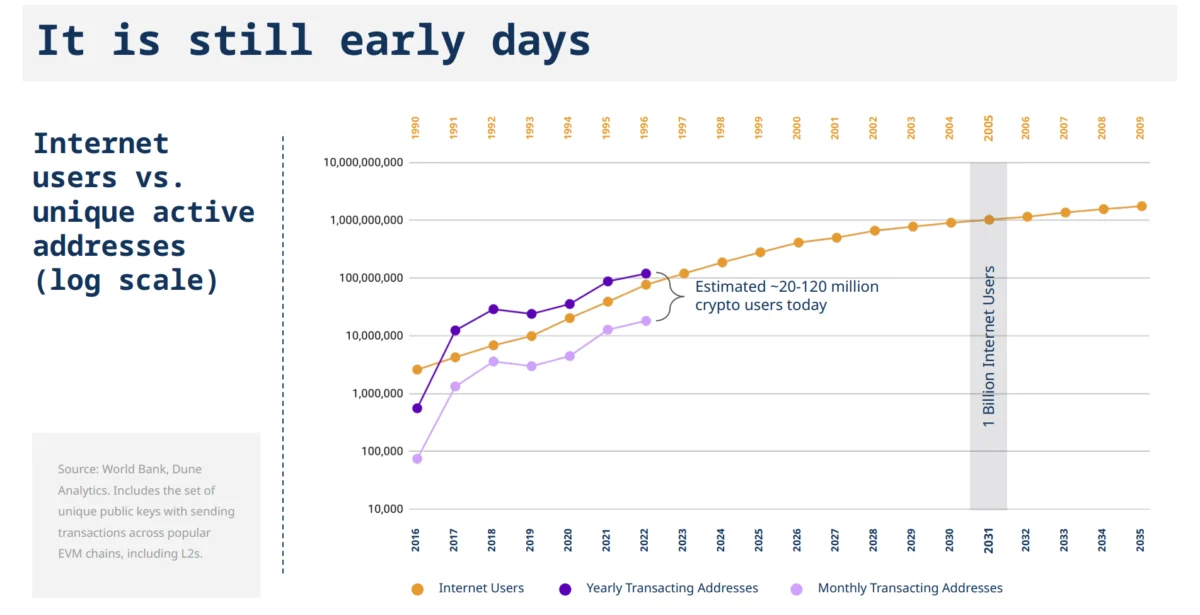
3. The Path to One Billion Users
According to forecasts cited by industry analysts, the current phase of infrastructure building is designed specifically to bridge the gap between niche financial technology and mass consumer adoption.
"While we’ve had the situation where bad actors, villains have perpetuated fraud, fleeced investors and the amount of venture capital coming into space isn’t as much as it was in 2021, it still looks like the critical infrastructure is being built that will change the world and that will onboard a billion people into crypto," the InvestAnswers host noted. "No ifs, ands, or buts, I’m convinced of that."
Official Responses and Regulatory Shifts
The events of 2022 fundamentally altered the relationship between the cryptocurrency industry and global policymakers. For years, the sector operated in a regulatory gray area, characterized by minimal oversight and self-regulation. The spectacular failures of centralized entities forced a permanent paradigm shift.
Global Regulatory Push
Governments and financial watchdogs worldwide responded to the 2022 liquidations with heightened urgency:
- The United States: Regulatory bodies such as the Securities and Exchange Commission (SEC) and the Commodity Futures Trading Commission (CFTC) ramped up enforcement actions against unregistered securities offerings and non-compliant exchanges. Lawmakers on Capitol Hill introduced a flurry of bipartisan bills aimed at establishing clear statutory definitions for digital assets and defining jurisdiction over spot markets.
- The European Union: The EU finalized its landmark Markets in Crypto-Assets (MiCA) regulation, establishing a comprehensive, harmonized legal framework across all 27 member states designed to protect consumers, prevent market manipulation, and enforce strict reserve requirements for stablecoin issuers.
- Asia-Pacific: Jurisdictions like Hong Kong, Singapore, and Japan moved to position themselves as regulated crypto hubs, creating transparent licensing regimes to attract compliant fintech firms while insulating local banking sectors from systemic contagion.
While many market participants initially viewed aggressive regulatory crackdowns as a threat to innovation, long-term industry proponents increasingly view regulatory clarity as a prerequisite for institutional capital deployment. Clear rules of the road are widely seen as the mechanism necessary to transition crypto from an alternative asset class for risk-tolerant speculators into a fully integrated pillar of global finance.
Implications: What the Future Holds for Digital Assets
The long-term implications of surviving 2022’s crucible are profound for developers, investors, and everyday users. The industry has been forced to undergo a painful but necessary structural detox.
1. The Triumph of Decentralization over Centralized Trust
The overarching lesson of the previous market cycle is a validation of crypto’s foundational ethos: trustlessness. The failures of Celsius, BlockFi, and FTX underscored the dangers of recreating traditional, opaque financial intermediaries on top of transparent blockchain networks.
As a result, the market has witnessed a structural shift toward non-custodial wallets, decentralized exchanges (DEXs), and cryptographic proof-of-reserves. Users are increasingly demanding verifiable transparency rather than relying on the personal reputations of charismatic executives.
2. Tokenization of Real-World Assets (RWAs)
Looking ahead, the next wave of mainstream adoption is widely expected to be driven by the tokenization of traditional financial assets. Financial institutions—ranging from global asset managers like BlackRock to traditional banking giants like JPMorgan—are actively exploring blockchain rails for issuing bonds, equities, and real estate. The ability to settle traditional financial instruments instantly via smart contracts promises to drastically reduce operational friction and counterparty risk.
3. Maturation of the Asset Class
As speculative excess is systematically flushed out of the system, digital assets are increasingly evaluated through the lens of macroeconomic utility, technological innovation, and network security. While volatility will undoubtedly remain a defining characteristic of cryptocurrencies for the foreseeable future, the maturation of underlying infrastructure ensures that the network effects underpinning Bitcoin, Ethereum, and decentralized networks continue to compound.
Conclusion
History suggests that revolutionary technologies frequently experience severe growth pains during their formative years. The internet bubble of the late 1990s wiped out countless speculative dot-com companies, yet the underlying architecture survived to reshape global commerce entirely.
For the cryptocurrency ecosystem, 2022 served as its dot-com crash. And if the tenacity of its developers, the evolution of its infrastructure, and the persistent expansion of global adoption are any indication, the maturation of digital assets is, indeed, inevitable.
Disclaimer: The opinions and analysis presented in this article are for informational purposes only and do not constitute financial or investment advice. Cryptographic and digital assets carry a high degree of risk; readers should conduct thorough due diligence before engaging in financial transactions or investments.