The Psychology of the Bottom: CZ’s Contrarian Call Amidst Historic Crypto Market Fear
In the high-stakes arena of digital asset trading, few voices carry as much weight as that of Binance founder Changpeng Zhao (CZ). As the cryptocurrency market grapples with a prolonged period of volatility and waning investor confidence, a succinct social media post from the industry titan has reignited a fierce debate over market timing and psychological resilience.
On November 29, 2025, CZ took to X (formerly Twitter) to share a classic, albeit difficult, investment mantra: "Unpopular opinion, but it’s better to sell when there is maximum greed, and buy when there is maximum fear."
The timing of this reminder was far from accidental. It landed during a period of intense scrutiny as Bitcoin and the broader altcoin market struggled to find a definitive direction. While veteran traders often cite this "contrarian" philosophy as a cornerstone of wealth preservation, the application of such wisdom during a genuine market drawdown—where fear is palpable and capital is evaporating—remains the ultimate test of an investor’s discipline.
A Chronology of Sentiment: From Extreme Fear to Fragile Hope
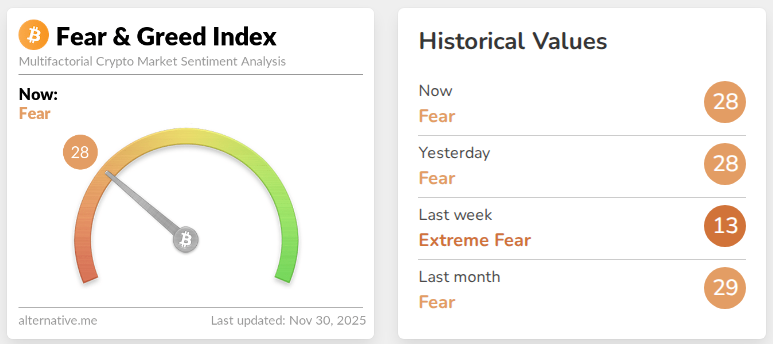
To understand the weight of CZ’s statement, one must look at the recent trajectory of the Crypto Fear & Greed Index, a primary gauge for investor sentiment. Throughout much of November 2025, the market existed in a state of paralyzing anxiety.
The 18-Day Descent
For eighteen consecutive days, the index remained firmly entrenched in the "Extreme Fear" zone. The nadir of this period occurred on November 22, when the index bottomed out at a score of 10. Analysts who have monitored the index for years described this as a historically deep stretch, noting that the intensity of the pessimism was notably higher than typical market corrections.
Market analyst Matthew Hyland labeled the stretch "the most extreme fear level" of the current market cycle. His assessment resonated with a trading community that had grown accustomed to the bullish euphoria seen earlier in the year. When the index finally crawled back to a reading of 20, it was not an indicator of a bull market return, but rather a modest easing of the absolute panic that had gripped retail and institutional players alike.

The Fragility of the Current Rally
Bitcoin, currently trading in the $91,000–$92,000 range, remains a shadow of its October peaks, where it flirted with the $126,000 mark. While the asset is significantly up from its 2024 lows of approximately $40,000, the psychological damage of the recent correction has left the market in a state of hyper-vigilance. Santiment, a leading provider of on-chain data, has tracked a shift in online discourse: the conversation is no longer driven by the "fear of missing out" (FOMO) or excitement about new utility. Instead, it is dominated by discussions of volatility, hedging, and institutional flow management.
Supporting Data: Why the "Fear" Narrative Holds Weight
The skepticism currently permeating the crypto sector is supported by a confluence of macroeconomic and technical data.
The Altcoin Season Index
The Altcoin Season Index currently sits at 22/100, a figure that historically indicates that the market is favoring "safety" over speculative growth. When this index is low, capital typically flows toward Bitcoin or, in more risk-averse scenarios, toward stablecoins and fiat, rather than into the more volatile altcoin ecosystem. This confirms that investors are currently in a defensive posture, prioritizing the preservation of capital over aggressive yield-seeking.
The Coinbase Premium Pivot
One of the most encouraging, yet fragile, signals in recent days has been the shift in the Bitcoin Coinbase Premium. After 29 days of residing in negative territory—indicating that selling pressure was being driven primarily by US-based institutional and retail investors—the metric flipped into positive territory on November 30, hitting 0.0255%.
The Coinbase Premium measures the price differential between Bitcoin on the Coinbase exchange (favored by US institutions) and global exchange averages. A positive premium suggests that the "buy-side" demand in the United States is finally beginning to outpace global selling. This reversal is often interpreted by analysts as a leading indicator of institutional re-entry, suggesting that liquidity may be beginning to stabilize as institutional players seek to capitalize on the lower price floor.
Official Responses and Expert Analysis
The reaction to CZ’s message was a study in contrasts between those who view trading as a game of logic and those who view it as a battle against human biology.
Psychology Overriding Charts
In response to CZ’s post, the community was quick to point out the disconnect between knowing a rule and following it. One prominent trader remarked, "Emotion often beats logic in real-time. We all know we should buy when there is blood in the streets, but when the screen is red, the biological urge to survive forces us to sell."
This psychological gap is where most investors fail. While technical analysis provides the "what" and "when," market psychology provides the "why." The current market environment is characterized by this very struggle: traders are acknowledging that the fundamental data supports a bottom, yet the collective fear prevents them from executing the buy orders necessary to facilitate a reversal.
The Macroeconomic Warning
Not all experts are convinced that the "Extreme Fear" reading is a definitive green light. Bitwise researcher André Dragosch has offered a more sobering perspective, warning that the current pricing is not merely a result of market sentiment but a reflection of a deteriorating global macroeconomic outlook.
Dragosch points to a recession-level growth forecast—the most bearish setting since the market shocks of 2020 and 2022. For those viewing the market through a macroeconomic lens, the "fear" is not just a sentiment metric; it is a rational response to a global economy facing tightening liquidity and persistent inflationary pressures. In this view, buying the dip carries a higher risk than in previous cycles, as the traditional "safety net" of global monetary expansion may not be as readily available as it was in previous years.
Implications for the Future: What Happens Next?
The debate surrounding CZ’s call to action highlights the dual nature of the current crypto landscape. On one hand, the historical data suggests that we are in the "buy" zone. Nicola Duke, a market analyst who tracks historical patterns, notes that over the last five years, Bitcoin has consistently found a local bottom within weeks of hitting extreme fear levels. This historical "hint" offers hope to those who believe the worst of the cycle is behind us.
However, the implications of the current market environment are broader than simple price action. They touch upon the maturity of the asset class.
The Institutional Shift
The transition from a retail-driven market to an institutional-dominated one has changed the nature of "fear." Institutional investors, unlike retail day traders, look for macro-triggers—regulatory clarity, interest rate pivots, and liquidity influxes. The return of a positive Coinbase Premium suggests that institutional confidence is beginning to thaw, even if retail participants remain on the sidelines.
The "Wait and See" Strategy
For the average investor, the implication of the current state of the market is a call for patience. While the mantra "buy when there is maximum fear" is a proven strategy, it is not a guarantee of immediate profitability. Investors must balance this contrarian advice against the current economic reality. The market is currently oscillating between two poles: the historical reliability of the Fear & Greed Index and the harsh reality of global macroeconomic headwinds.
Conclusion: Balancing Wisdom and Risk
Changpeng Zhao’s message serves as a timely reminder of the cyclical nature of financial markets. "Maximum fear" is rarely the end of a trend; rather, it is the threshold where the risk-to-reward ratio shifts in favor of the bold. However, the current cycle is unique. It is a period where the traditional "crypto-only" narratives are being forced to contend with global economic shifts that have not been present in previous bull runs.
As the market digests the recent return to positive territory in the Coinbase Premium and continues to monitor the Fear & Greed Index, the primary takeaway is one of cautious optimism. The tools for informed decision-making are available, but the execution remains a deeply human endeavor. Whether this period of "extreme fear" will be remembered as the launchpad for the next leg of the bull market or a temporary pause in a larger structural decline remains to be seen. In the meantime, the market continues to provide a masterclass in the most important lesson of all: in the world of crypto, the loudest signal is often the one that tells you to hold your nerve.