
Silicon Valley Giant Andreessen Horowitz Defies Market Downturn with Blockbuster $4.5 Billion Crypto Fund
SAN FRANCISCO — In a resounding vote of confidence for the long-term viability of distributed ledger technology, Silicon Valley venture capital titan Andreessen Horowitz (a16z) has officially announced the launch of a massive $4.5 billion crypto fund.
The launch arrives at a precarious moment for the broader financial markets. Digital asset valuations have experienced widespread stagnation, and macroeconomic pressures have fueled a broader risk-off sentiment across global exchanges. Yet, rather than retreating to traditional asset classes, a16z is doubling down on its thesis that the fundamental architecture of the internet is undergoing a generational shift.
According to general partner Chris Dixon, the new capital vehicle—dubbed "Crypto Fund IV"—will be deployed across a diverse array of Web 3.0 sectors, spanning early-stage seed projects to fully scaled, late-stage networks. The firm intends to back builders who are actively reshaping everything from decentralized finance (DeFi) and layer-2 scaling solutions to metaverse infrastructure and decentralized autonomous organizations (DAOs).
Main Facts: Inside Crypto Fund IV
The sheer scale of Andreessen Horowitz’s latest capital injection cements its status as the premier institutional powerhouse in the digital asset ecosystem.
- The Capital Breakdown: Of the $4.5 billion total, a16z has allocated $1.5 billion specifically for seed-stage investments, while the remaining $3 billion is earmarked for venture-stage growth.
- Cumulative Capital: With this latest round, a16z’s total capital raised exclusively for cryptocurrency and Web 3.0 investments crosses the $7.6 billion threshold, following previous funds in 2018 ($300 million), 2020 ($515 million), and a $2.2 billion fund launched in mid-2021.
- Investment Mandate: The fund will target programmable blockchains, Web 3.0 social media protocols, non-fungible token (NFT) communities, metaverse gaming ecosystems, and advanced cryptographic applications such as zero-knowledge (ZK) rollups.
- Strategic Timing: The announcement comes amidst severe market correction, proving that top-tier venture capitalists are positioning themselves for the next multi-year technology cycle rather than reacting to short-term price charts.
Chronology of a Tech Titan: How a16z Became a Crypto Powerhouse
To understand the magnitude of a $4.5 billion crypto fund, it is necessary to examine how Andreessen Horowitz evolved from a traditional Silicon Valley software venture firm into the undisputed kingmaker of Web 3.0.
2013–2016: Early Conviction in an Unproven Asset Class
Long before institutional interest became mainstream, co-founders Marc Andreessen and Ben Horowitz recognized the transformative potential of Bitcoin and blockchain technology. In 2013, the firm made its maiden voyage into the sector by leading a $25 million Series B funding round for Coinbase, then a fledgling cryptocurrency wallet and exchange platform. Throughout the mid-2010s, a16z continued to quietly back foundational infrastructure providers, betting that cryptographic protocols would eventually disrupt traditional finance.
2018: Formalizing the Thesis with Crypto Fund I
As the initial Initial Coin Offering (ICO) boom gave way to the 2018 bear market, a16z did what few traditional venture firms dared to do: they institutionalized their digital asset strategy. The firm launched its first dedicated crypto fund, raising $300 million. Managed by Chris Dixon and general partner Ali Yahya, the fund was designed to invest across market cycles, supporting projects that could survive prolonged periods of low liquidity and consumer interest.
2020–2021: The DeFi Summer and the $2.2 Billion Expansion
The onset of the COVID-19 pandemic catalyzed an unprecedented explosion in digital asset adoption, highlighted by the meteoric rise of decentralized finance (DeFi) and NFTs. Capitalizing on this momentum, a16z launched Crypto Fund II ($515 million) in 2020, followed rapidly by Crypto Fund III in June 2021, which commanded an impressive $2.2 billion. During this era, a16z backed nearly every major protocol defining the decentralized economy, including Solana, Uniswap, OpenSea, and Near Protocol.
2022: Defying the "Crypto Winter" with Crypto Fund IV
As macroeconomic tightening, rising interest rates, and systemic failures within algorithmic stablecoins triggered a fresh crypto winter in early 2022, a16z refused to slow its momentum. Unveiling Crypto Fund IV at $4.5 billion, the firm signaled to the global technology sector that the development of decentralized networks is entirely decoupled from the short-term speculative sentiment of public token markets.
Supporting Data: The Historical Context of Computing Cycles
In his seminal announcement letter, Chris Dixon contextualized the launch of Crypto Fund IV within the broader historical framework of technological evolution. According to Dixon, humanity has experienced a predictable, macro-level computing cycle roughly every decade to 15 years since the advent of modern computing in the 1940s:
- The 1980s: The Personal Computer (PC) revolution, which democratized computing power for households and small businesses.
- The 1990s: The commercialization of the World Wide Web, connecting global information networks and birthing e-commerce.
- The 2000s & 2010s: The mobile computing revolution, placing powerful computers in the pockets of billions of people worldwide through smartphones and app stores.
[Computing Evolution Timeline]
1940s: Mainframe Computing
  └── 1980s: Personal Computers (PCs)
        └── 1990s: The Internet & Web 1.0/2.0
              └── 2000s: Mobile Computing Era
                    └── 2020s & Beyond: Blockchains & Web 3.0 (a16z Thesis)
A16z argues that blockchains represent the natural successor to these cycles—constituting the foundational layer for Web 3.0. Unlike previous iterations of the internet—which centralized data collection and monetization in the hands of a few corporate tech monopolies—Web 3.0 utilizes programmable, trustless blockchains to return ownership, digital sovereignty, and economic participation directly to users.
Furthermore, empirical data supports the firm’s observation regarding talent migration. Over the 2020–2022 period, top-tier engineers, cryptographers, and product managers left traditional tech giants like Meta, Google, and Apple in record numbers to build decentralized protocols, highlighting an unprecedented brain drain toward the blockchain sector.
Official Responses and Executive Insights
The leadership team at Andreessen Horowitz has been vocal about the psychological and strategic advantages of deploying capital during a downturn.
In an interview with CNBC following the fund’s announcement, a16z general partner Arianna Simpson emphasized that market corrections offer a vital filter for the venture capital ecosystem, separating short-term speculators from long-term visionaries.
"Bear markets are often when the best opportunities come about when people are actually able to focus on building technology rather than getting distracted by short-term price activity," Simpson stated. "When asset prices are crashing, the noise level in the industry drops significantly. The tourists leave, and the true believers stay behind to write clean code and build durable infrastructure."
Chris Dixon echoed these sentiments in his official publication, pointing out that programmable blockchains have finally matured to a point where they can support millions of active users without sacrificing security or decentralization.
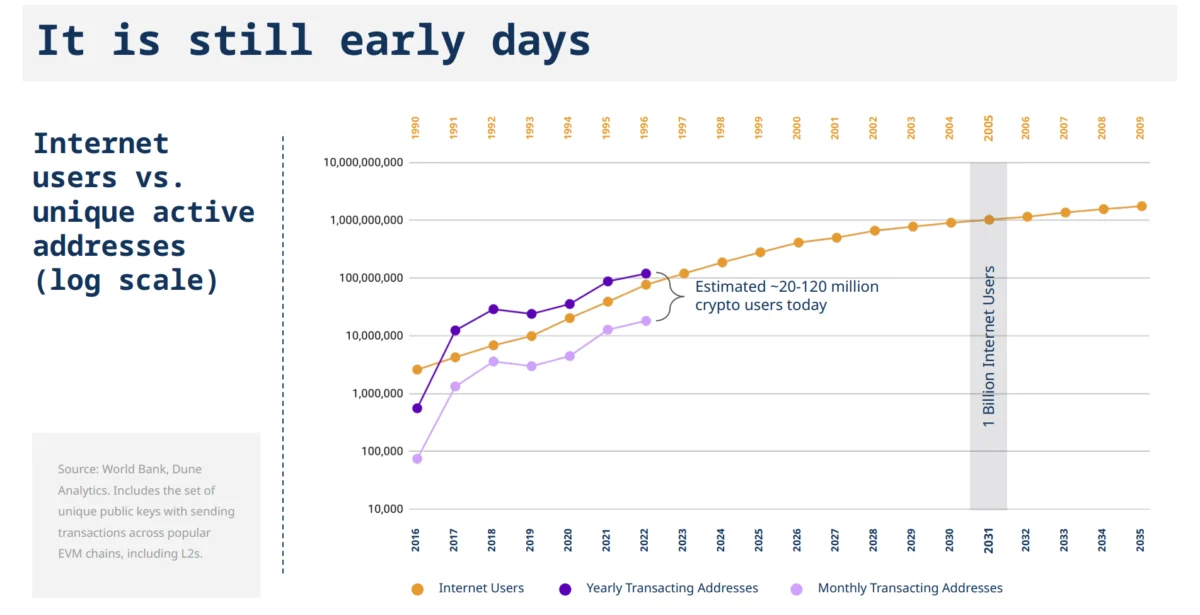
"We think we are now entering the golden era of Web 3.0," Dixon wrote. "Programmable blockchains are sufficiently advanced, and a diverse range of apps have reached tens of millions of users. More importantly, a massive wave of world-class talent has entered Web 3.0 over the last year. They are brilliant and passionate and want to build a better internet."
Broader Implications for the Tech and Crypto Ecosystems
The deployment of a $4.5 billion war chest by Silicon Valley’s most influential venture firm carries profound implications for the future direction of technology, regulatory frameworks, and global capital markets.
1. Acceleration of Institutional Infrastructure
With $3 billion dedicated to growth-stage companies, Crypto Fund IV will likely serve as the primary financial engine for scaling Web 3.0 infrastructure. This means faster development of layer-2 scaling solutions, more robust developer tooling, and enhanced cross-chain interoperability bridges. As institutional-grade infrastructure improves, friction for enterprise adoption of blockchain technology will significantly decrease.
2. The Shift Toward Zero-Knowledge (ZK) Technology
One of the most heavily emphasized areas within a16z’s new mandate is zero-knowledge (ZK) rollups. As privacy and scalability remain two of the most pressing bottlenecks for public blockchains like Ethereum, ZK-proof technology offers a mathematically rigorous solution. By validating transactions off-chain while maintaining cryptographic proof on-chain, ZK technology promises to scale decentralized networks to Visa-like transaction throughputs while preserving user privacy.
3. Regulatory Navigation and Compliance
Managing a fund of this magnitude in the current regulatory environment—particularly under the watchful eye of the U.S. Securities and Exchange Commission (SEC)—requires immense legal and operational sophistication. A16z has historically maintained a robust policy and regulatory team in Washington, D.C., advocating for sensible regulatory frameworks that protect consumers while preserving technological innovation. The deployment of Crypto Fund IV signals that the firm is confident in navigating these regulatory headwinds over the coming decade.
4. A Validation of Decentralized Governance (DAOs)
As capital flows into decentralized autonomous organizations (DAOs) and community-owned protocols, traditional corporate hierarchies face a serious ideological competitor. A16z’s backing of DAOs normalizes cooperative ownership models, potentially shifting how corporations are structured, capitalized, and governed in the 21st century.
Conclusion
Andreessen Horowitz’s $4.5 billion fund is far more than a routine venture capital raise; it is a calculated macro-wager on the inevitability of decentralized computing.
While retail traders and short-term speculators fixate on daily price volatility and macro headwinds, institutional architects like a16z are quietly laying the physical and cryptographic groundwork for the next generation of the internet. If history repeats itself, the technologies funded during this current period of market stagnation will form the bedrock of the digital economy for decades to come.